. 2006 Oct;74(10):5826-33.
doi: 10.1128/IAI.00375-06.

Optimization of the delivery of heterologous proteins by the Salmonella enterica serovar Typhimurium type III secretion system for vaccine development

Affiliations

Optimization of the delivery of heterologous proteins by the Salmonella enterica serovar Typhimurium type III secretion system for vaccine development

Li-Mei Chen et al. Infect Immun. 2006 Oct.

Abstract

Type III protein secretion systems, which are organelles with the capacity to deliver bacterial proteins into host cells, have been adapted to deliver heterologous antigens for vaccine development. A limitation of these antigen delivery systems is that some proteins are not amenable to secretion through this pathway. We show here that proteins from the simian and human immunodeficiency viruses that are not permissive for secretion through a Salmonella enterica serovar Typhimurium type III secretion system can be modified to travel this secretion pathway by introduction of discrete mutations. Proteins optimized for secretion were presented more efficiently via the major histocompatibility complex class I pathway and were able to induce a better immune response.


Figures
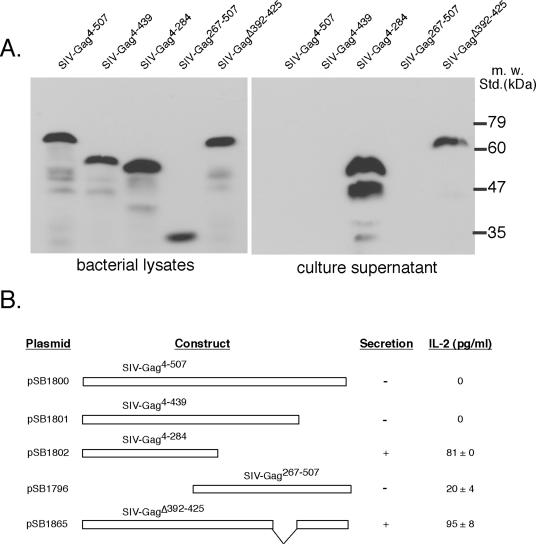
FIG. 1.
FIG. 1.
Optimization of SIV Gag for delivery through the S. enterica serovar Typhimurium type III secretion pathway. (A) Western blot analysis of bacterial lysates and culture supernatants of bacterial strains carrying plasmids that express the SopE-SIV Gag chimeras indicated. All cultures were standardized to the same optical density before processing, and a monoclonal antibody directed to the M45 epitope tag present in the constructs was used. m. w. Std., molecular mass standards. (B) Antigen presentation by RMA cells infected with S. enterica serovar Typhimurium expressing different SIV Gag constructs. RMA cells were infected with the strains indicated prior to exposure to 12.164 hybridoma cells, which produce IL-2 upon antigen presentation. The concentration of IL-2 secreted into the medium was determined by an ELISA. The data are means ± standard deviations of three independent experiments.
FIG. 2.
FIG. 2.
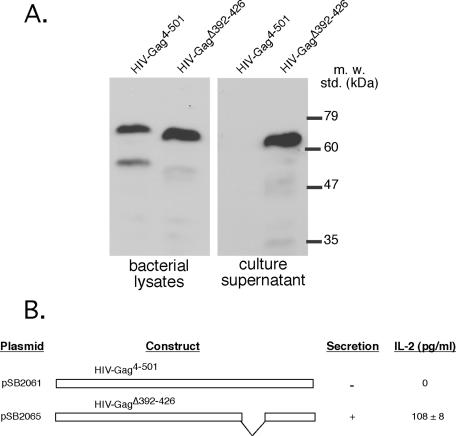
Optimization of HIV Gag for delivery through the S. enterica serovar Typhimurium type III secretion pathway. (A) Western blot analysis of bacterial lysates and culture supernatants of bacterial strains carrying plasmids that express the SopE-HIV Gag chimeras indicated. All cultures were standardized to the same optical density before processing, and a monoclonal antibody directed to the M45 epitope tag present in the constructs was used. m. w. std., molecular mass standards. (B) Antigen presentation by RMA cells infected with S. enterica serovar Typhimurium expressing different HIV Gag constructs. RMA cells were infected with the strains indicated prior to exposure to 12.164 hybridoma cells, which produce IL-2 upon antigen presentation. The concentration of IL-2 secreted into the medium was determined by an ELISA. The data are means ± standard deviations of three independent experiments.
FIG. 3.
FIG. 3.
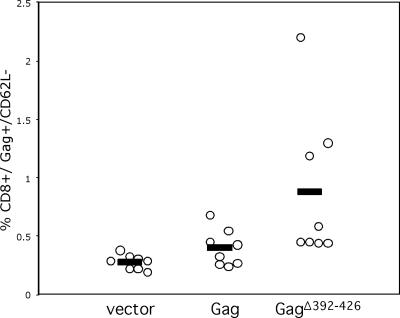
Comparison of the immunogenicities of type III secretion-optimized and nonoptimized HIV Gag. Mice (eight mice per group) were immunized with avirulent strains of S. enterica serovar Typhimurium expressing wild-type HIV Gag (SopE1-104HIV-Gag4-501) (Gag) or type III secretion-optimized HIV Gag (SopE1-104HIV-GagΔ392-426) (GagΔ392-426) fused to the type III secretion and translocation signals of SopE or carrying the empty vector control (vector). Splenocytes from immunized animals were examined by flow cytometry to determine the levels of HIV Gag-specific CD8+ T cells. Open circles represent individual mice, and the values are the percentages of CD8 T cells that are tetramer specific for the Gag epitope. The horizontal bars indicate the means. The differences between the levels of Gag-specific CD8 T cells in animals immunized with the optimized Gag and the levels of Gag-specific CD8 T cells in animals immunized with the nonoptimized Gag and between the levels of Gag-specific CD8 T cells in animals immunized with the optimized Gag and the levels of Gag-specific CD8 T cells in animals immunized with the vector control were statistically significant (P = 0.038 and 0.0001, respectively).
FIG. 4.
FIG. 4.
Optimization of SIV Rev, Tat, and Nef for delivery through the S. enterica serovar Typhimurium type III secretion pathway. (A, B, and D) Antigen presentation by RMA cells infected with S. enterica serovar Typhimurium expressing different SIV Rev, Tat, and/or Nef constructs. RMA cells were infected with the strains indicated prior to exposure to 12.164 hybridoma cells, which produce IL-2 upon antigen presentation. The concentration of IL-2 secreted into the medium was determined by an ELISA. The data are means ± standard deviations of three independent experiments. (C) Western blot analysis of bacterial lysates and culture supernatants of bacterial strains carrying plasmids that express the SIV Rev-Tat-Nef constructs indicated. M.W. Std., molecular weight standards.
FIG. 5.
FIG. 5.
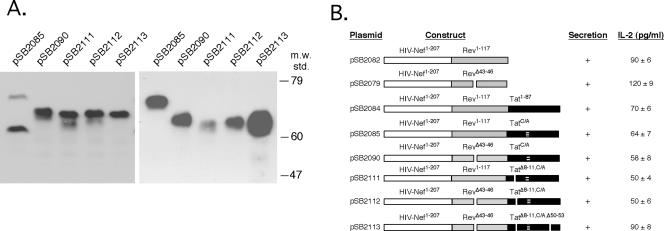
Optimization of HIV Rev, Tat, and Nef for delivery through the S. enterica serovar Typhimurium type III secretion pathway. (A) Western blot analysis of bacterial lysates and culture supernatants of bacterial strains carrying plasmids that express SopE-HIV Nef-Rev-Tat chimeras. All cultures were standardized to the same optical density before processing, and a monoclonal antibody directed to the M45 epitope tag present in the constructs was used. m.w. std., molecular weight standards. (B) Antigen presentation by RMA cells infected with S. enterica serovar Typhimurium expressing different SopE-HIV Nef-Rev-Tat constructs. RMA cells were infected with the strains indicated prior to exposure to 12.164 hybridoma cells, which produce IL-2 upon antigen presentation. The concentration of IL-2 secreted into the medium was determined by an ELISA. The data are means ± standard deviations of three independent experiments. C/A indicates the region of Tat in which the original amino acid sequence, CKKCCFHCQVC, was changed to GKKGAFHAQVG.

References

    1. Akeda, Y., and J. E. Galan. 2005. Chaperone release and unfolding of substrates in type III secretion. Nature 437:911-915. - PubMed
    1. Aldovini, A., and R. Young. 1990. Mutations of RNA and protein sequences involved in human immunodeficiency virus type 1 packaging result in production of noninfectious virus. J. Virol. 64:1920-1926. - PMC - PubMed
    1. Angelakopoulos, H., and E. L. Hohmann. 2000. Pilot study of phoP/phoQ-deleted Salmonella enterica serovar Typhimurium expressing Helicobacter pylori urease in adult volunteers. Infect. Immun. 68:2135-2141. - PMC - PubMed
    1. Bayer, P., M. Kraft, A. Ejchart, M. Westendorp, R. Frank, and P. Rosch. 1995. Structural studies of HIV-1 Tat protein. Related articles, links. J. Mol. Biol. 247:529-535. - PubMed
    1. Berger, J., C. Aepinus, M. Dobrovnik, B. Fleckenstein, J. Hauber, and E. Bohnlein. 1991. Mutational analysis of functional domains in the HIV-1 Rev trans-regulatory protein. Virology 183:630-635. - PubMed

Publication types

MeSH terms

LinkOut - more resources