Comparative Study
. 2006 Dec 1;577(Pt 2):739-51.
doi: 10.1113/jphysiol.2006.119032. Epub 2006 Sep 21.

Temperature- and exercise-induced gene expression and metabolic enzyme changes in skeletal muscle of adult zebrafish (Danio rerio)

Affiliations
Comparative Study

Temperature- and exercise-induced gene expression and metabolic enzyme changes in skeletal muscle of adult zebrafish (Danio rerio)

Grant B McClelland et al. J Physiol. .

Abstract

Both exercise training and cold acclimatization induce muscle remodelling in vertebrates, producing a more aerobic phenotype. In ectothermic species exercise training and cold-acclimatization represent distinct stimuli. It is currently unclear if these stimuli act through a common mechanism or if different mechanisms lead to a common phenotype. The goal of this study was to survey responses that represent potential mechanisms responsible for contraction- and temperature-induced muscle remodelling, using an ectothermic vertebrate. Separate groups of adult zebrafish (Danio rerio) were either swim trained or cold acclimatized for 4 weeks. We found that the mitochondrial marker enzyme citrate synthase (CS) was increased by 1.5x in cold and by 1.3x with exercise (P<0.05). Cytochrome c oxidase (COx) was increased by 1.2x following exercise training (P<0.05) and 1.2x (P=0.07) with cold acclimatization. However, only cold acclimatization increased beta-hydroxyacyl-CoA dehydrogenase (HOAD) compared to exercise-trained (by 1.3x) and pyruvate kinase (PK) relative to control zebrafish. We assessed the whole-animal performance outcomes of these treatments. Maximum absolute sustained swimming speed (Ucrit) was increased in the exercise trained group but not in the cold acclimatized group. Real-time PCR analysis indicated that increases in CS are primarily transcriptionally regulated with exercise but not with cold treatments. Both treatments showed increases in nuclear respiratory factor (NRF)-1 mRNA which was increased by 2.3x in cold-acclimatized and 4x in exercise-trained zebrafish above controls. In contrast, peroxisome proliferator-activated receptor (PPAR)-alpha mRNA levels were decreased in both experimental groups while PPAR-beta1 declined in exercise training only. Moreover, PPAR-gamma coactivator (PGC)-1alpha mRNA was not changed by either treatment. In zebrafish, both temperature and exercise produce a more aerobic phenotype, but there are stimulus-dependent responses (i.e. HOAD and PK activities). While similar changes in NRF-1 mRNA suggest that common responses might underlie aerobic muscle remodelling there are distinct changes (i.e. CS and PPAR-beta1 mRNA) that contribute to specific temperature- and exercise-induced phenotypes.


Figures
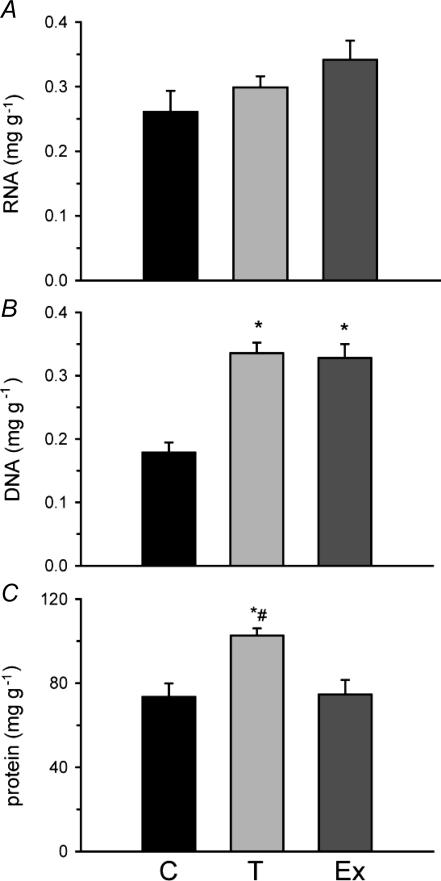
Figure 1
Figure 1. Total skeletal muscle RNA (A) DNA (B) and protein (C) from zebrafish cold acclimatized (T) to 18°C for 4 weeks, exercise-trained (Ex) for 4 weeks at 28°C compared to 28°C controls (C) from group 1 fish
N= 9—10 for DNA and protein measured on the same samples; n = 5 for RNA from separate fish. *Significantly different from controls, #significantly different from exercise-trained fish. Error bars represents s.e.m.
Figure 2
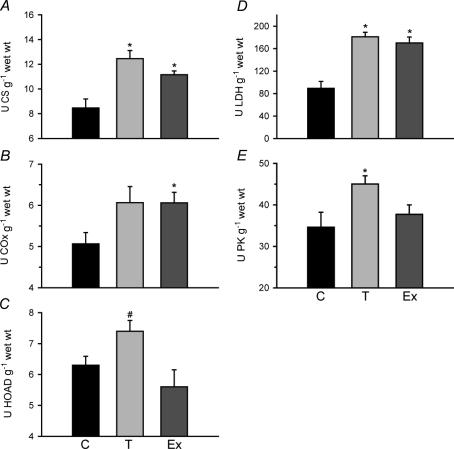
Figure 2. Skeletal muscle enzyme activities (assayed at 28°C) in adult zebrafish (Danio rerio) after exposure to cold (18°C, T) for 2 and 4 weeks and after 4 weeks of exercise training (Ex) at 28°C, compared to 28°C controls (C)
Values are presented for A, citrate synthase (CS) B, cytochrome oxidase (COx), C, β-hydroxyacyl-CoA dehydrogenase (HOAD), D, lactate dehydrogenase (LDH) and E, pyruvate kinase (PK) All measurements are from group 1 n= 10, except HOAD from group 2, n= 5. *Significantly different from controls (P < 0.05). U, μmol min−1. Error bars represent s.e.m.
Figure 3
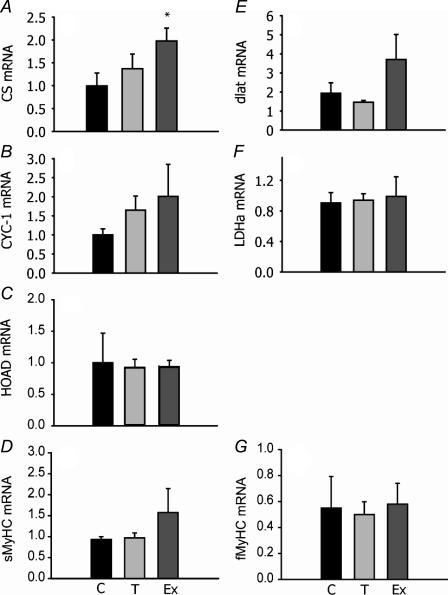
Figure 3. Relative gene expression levels (mRNA) for citrate synthase (CS: A), cytochrome c oxidase subunit I (CYC-1; B), β-hydroxyacyl-CoA dehydrogenase (HOAD; C), myosin heavy chain slow isoform (sMyHC; D), pyruvate dehydrogenase E2 subunit (dLat; E), lactate dehydrogenase (LDH; F) and fast (fMyHC; G) isoform in adult zebrafish exposed to cold temperatures (18°C, T) for 4 weeks and exercise trained for 4 weeks (Ex), compared to 28°C controls (C)
Expression levels were measured by real-time PCR using SYBR green. Results are relative to a randomly selected control sample and normalized to β-actin. n= 5 except for MyHC (n= 3). *Significantly different from controls (P < 0.05). Error bars represent s.e.m.
Figure 4
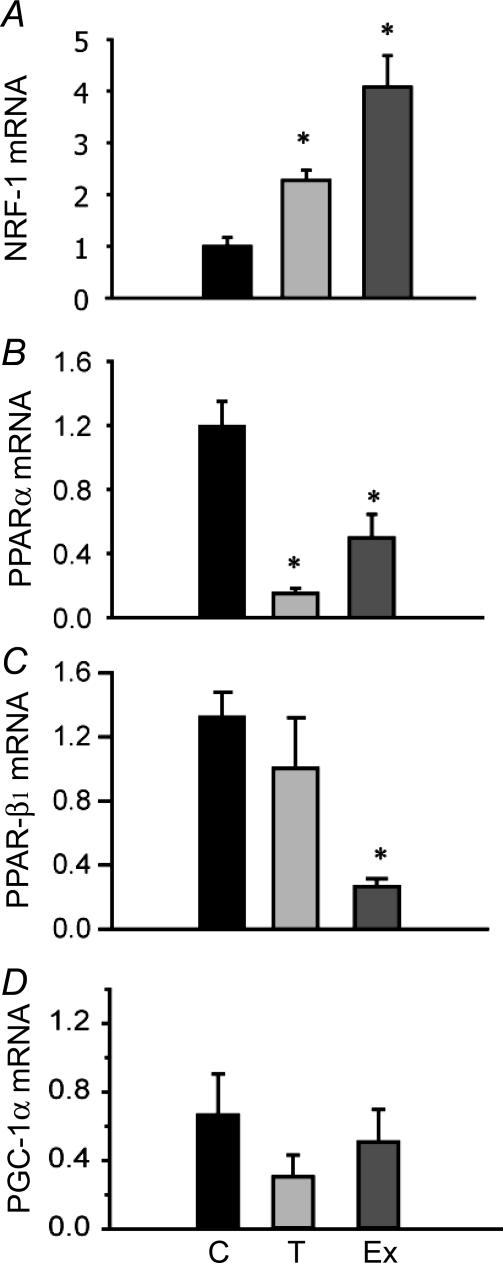
Figure 4. Gene expression levels (mRNA) for transcription factors: nuclear respiratory factor (NRF)-1 (A), peroxisome proliferator activator receptor (PPAR)-α (B), PPAR-β1 (C) and PPAR-γ cofactor (PGC)-1α (D) in adult zebrafish exposed to cold temperatures (18°C, T) for 4 weeks and exercise trained for 4 weeks (Ex), compared to 28°C controls
Expression levels were measured by real-time PCR using SYBR green. Results are relative to a randomly selected control sample and normalized to β-actin. n= 5 for all except PCG-1α (n= 6). *Significantly different from control (P < 0.05). Error bars represent s.e.m.
Figure 5
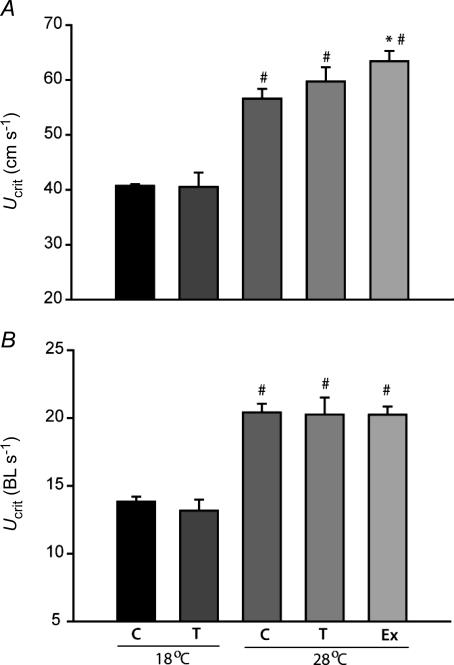
Figure 5. Critical swimming speeds (Ucrit) in absolute speeds (cm s−1; A) or relative Ucrit in body lengths per second (BL s−1; B) at 18°C and 28°C in adult zebrafish exposed to cold temperatures (18°C, T) for 4 weeks and exercise trained for 4 weeks (Ex), compared to controls (C)
*Significantly different from 28°C controls, #significantly different from 18°C. n= 15 (C, T and Ex at 28°C) and n= 10 (C, T at 18°C). Error bars represent s.e.m.
Figure 6
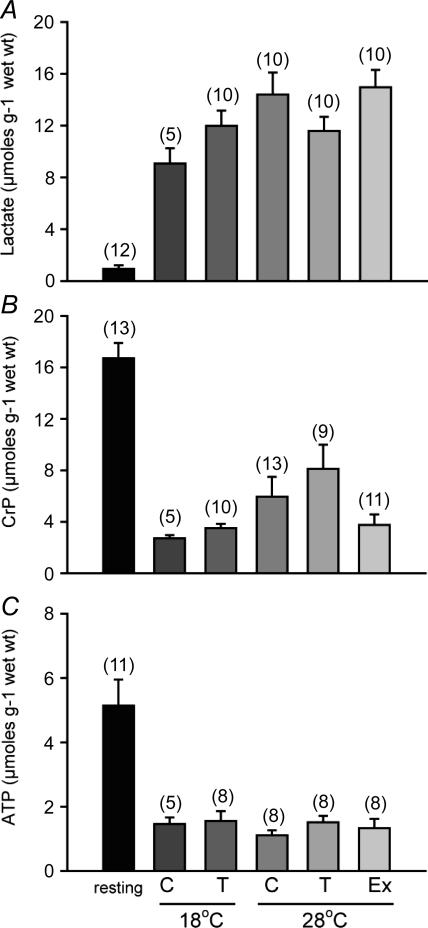
Figure 6. Mixed muscle concentrations of A, lactate (A), phosphocreatine (B) and ATP in μmol (g wet weight)−1 (C)
Resting values from 28°C controls are compared to fatigue values at the end of the critical swimming (Ucrit) tests at 18°C and 28°C in adult zebrafish exposed to cold temperatures (18°C, T) for 4 weeks and exercise trained for 4 weeks (Ex), compared to controls (C). Samples sizes appear above each bar. All post-exercise data are significantly different from resting controls. #Significantly different from T exercised at 28°C. Error bars represent s.e.m.

References

    1. Abele D, Heise K, Portner HO, Puntarulo S. Temperature-dependence of mitochondrial function and production of reactive oxygen species in the intertidal mud clam Mya arenaria. J Exp Biol. 2002;205:1831–1841. - PubMed
    1. Adhihetty PJ, Irrcher I, Joseph A-M, Ljubicic V, Hood DA. Plasticity of skeletal muscle mitochondria in response to contractile activity. Exp Physiol. 2003;88:99–107. - PubMed
    1. Amores A, Force A, Yan Y-L, Joly L, Amemiya C, Fritz A, Ho RK, Langeland J, Prince V, Wang Y-L, Westerfield M, Ekker M, Postlethwait JH. Zebrafish hox clusters and vertebrate genome evolution. Science. 1998;282:1711–1714. - PubMed
    1. Barger PM, Brandt JM, Leone TC, Weinheimer CJ, Kelly DP. Deactivation of peroxisome proliferator-activated receptor-α during cardiac hypertrophic growth. J Clin Invest. 2000;105:1723–1730. - PMC - PubMed
    1. Barger PM, Browning AC, Garner AN, Kelly DP. p38 Mitogen-activated protein kinase activates peroxisome proliferator-activated receptor alpha. J Biol Chem. 2001;276:44495–44501. - PubMed

Publication types

MeSH terms