


Structural changes in the myosin filament and cross-bridges during active force development in single intact frog muscle fibres: stiffness and X-ray diffraction measurements
- PMID: 16990403
- PMCID: PMC1890380
- DOI: 10.1113/jphysiol.2006.115394
Structural changes in the myosin filament and cross-bridges during active force development in single intact frog muscle fibres: stiffness and X-ray diffraction measurements
Abstract
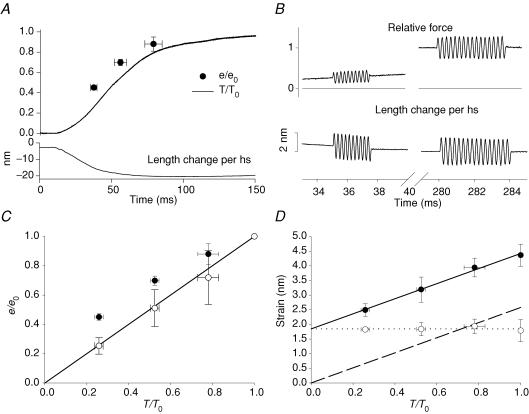
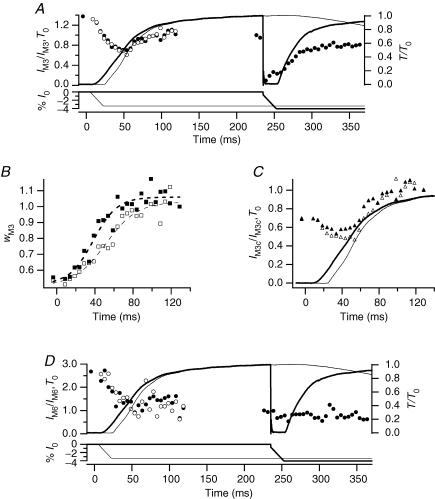
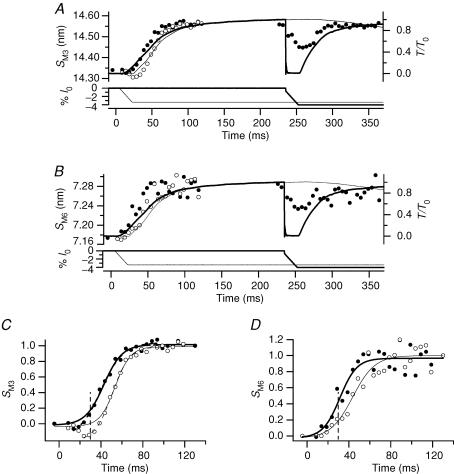
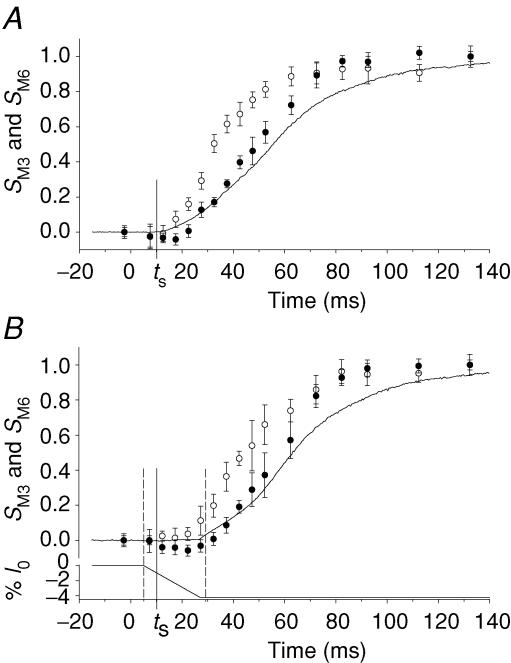
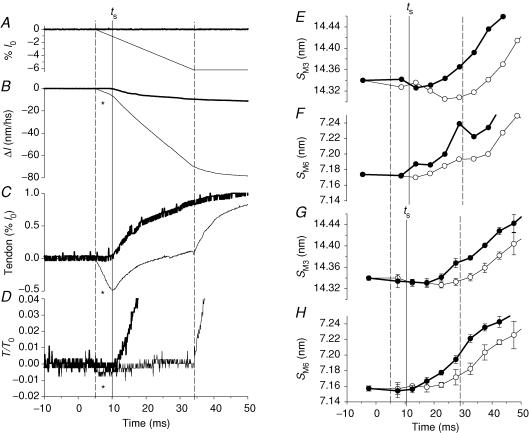
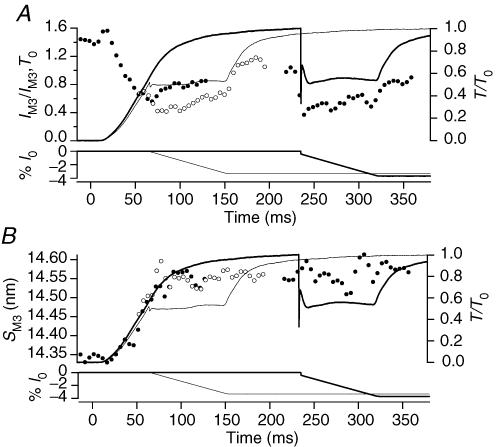
Structural and mechanical changes occurring in the myosin filament and myosin head domains during the development of the isometric tetanus have been investigated in intact frog muscle fibres at 4 degrees C and 2.15 microm sarcomere length, using sarcomere level mechanics and X-ray diffraction at beamline ID2 of the European Synchrotron Radiation Facility (Grenoble, France). The time courses of changes in both the M3 and M6 myosin-based reflections were recorded with 5 ms frames using the gas-filled RAPID detector (MicroGap Technology). Following the end of the latent period (11 ms after the start of stimulation), force increases to the tetanus plateau value (T(0)) with a half-time of 40 ms, and the spacings of the M3 and M6 reflections (S(M3) and S(M6)) increase by 1.5% from their resting values, with time courses that lead that of force by approximately 10 and approximately 20 ms, respectively. These temporal relations are maintained when the increase of force is delayed by approximately 10 ms by imposing, from 5 ms after the first stimulus, 50 nm (half-sarcomere)(-1) shortening at the velocity (V(0)) that maintains zero force. Shortening at V(0) transiently reduces S(M3) following the latent period and delays the subsequent increase in S(M3), but only delays the S(M6) increase without a transient decrease. Shortening at V(0) imposed at the tetanus plateau causes an abrupt reduction of the intensity of the M3 reflection (I(M3)), whereas the intensity of the M6 reflection (I(M6)) is only slightly reduced. The changes in half-sarcomere stiffness indicate that the isometric force at each time point is proportional to the number of myosin heads bound to actin. The different sensitivities of the intensity and spacing of the M3 and M6 reflections to the mechanical responses support the view that the M3 reflection in active muscle originates mainly from the myosin heads attached to the actin filament and the M6 reflection originates mainly from a fixed structure in the myosin filament signalling myosin filament length changes during the tetanus rise.
Figures
References
-
- Bagni MA, Cecchi G, Cecchini E, Colombini B, Colomo F. Force responses to fast ramp stretches in stimulated frog skeletal muscle fibres. J Muscle Res Cell Motil. 1998;19:33–42. - PubMed
-
- Bordas J, Diakun GP, Diaz FG, Harries JE, Lewis RA, Lowy J, Mant GR, Martin-Fernandez ML, Towns-Andrews E. Two-dimensional time-resolved X-ray diffraction studies of live isometrically contracting frog sartorius muscle. J Muscle Res Cell Motil. 1993;14:311–324. - PubMed
-
- Cecchi G, Colomo F, Lombardi V, Piazzesi G. Stiffness of frog muscle fibres during rise of tension and relaxation in fixed-end or length-clamped tetani. Pflugers Arch. 1987;409:39–46. - PubMed
Publication types
MeSH terms
Substances
LinkOut - more resources
Full Text Sources
