


Ollier disease
- PMID: 16995932
- PMCID: PMC1592482
- DOI: 10.1186/1750-1172-1-37
Ollier disease
Abstract
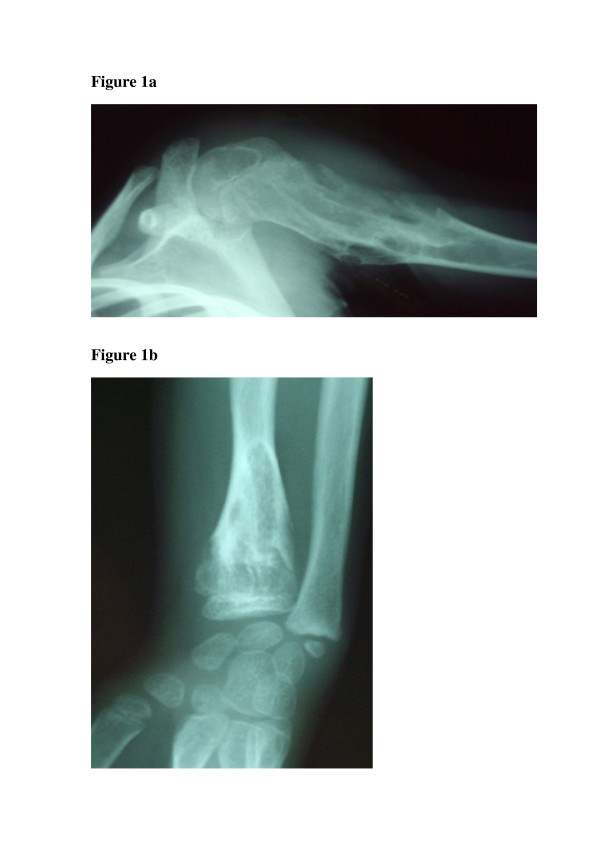
Enchondromas are common intraosseous, usually benign cartilaginous tumors, that develop in close proximity to growth plate cartilage. When multiple enchondromas are present, the condition is called enchondromatosis also known as Ollier disease (WHO terminology). The estimated prevalence of Ollier disease is 1/100,000. Clinical manifestations often appear in the first decade of life. Ollier disease is characterized by an asymmetric distribution of cartilage lesions and these can be extremely variable (in terms of size, number, location, evolution of enchondromas, age of onset and of diagnosis, requirement for surgery). Clinical problems caused by enchondromas include skeletal deformities, limb-length discrepancy, and the potential risk for malignant change to chondrosarcoma. The condition in which multiple enchondromatosis is associated with soft tissue hemangiomas is known as Maffucci syndrome. Until now both Ollier disease and Maffucci syndrome have only occurred in isolated patients and not familial. It remains uncertain whether the disorder is caused by a single gene defect or by combinations of (germ-line and/or somatic) mutations. The diagnosis is based on clinical and conventional radiological evaluations. Histological analysis has a limited role and is mainly used if malignancy is suspected. There is no medical treatment for enchondromatosis. Surgery is indicated in case of complications (pathological fractures, growth defect, malignant transformation). The prognosis for Ollier disease is difficult to assess. As is generally the case, forms with an early onset appear more severe. Enchondromas in Ollier disease present a risk of malignant transformation of enchondromas into chondrosarcomas.
Figures
References
-
- Maroteaux P, Le Merrer M. Les maladies osseuses de l'enfant. Paris: Médecine-Sciences, Flammarion; 2002.
-
- Whyte M. Acquired Disorders of Cartilage and Bone. Washington DC: American Society for Bone and Mineral Research; 2003.
-
- Fletcher CDM, Unni K, Mertens F, (Ed) World Health Organization Classification of Tumors Pathology and genetics Tumors of Soft Tissue and Bone. Lyon: IARC Press; 2002. p. 427.
Publication types
MeSH terms
LinkOut - more resources
Full Text Sources
Medical
Molecular Biology Databases
