


Canine faecal contamination and parasitic risk in the city of Naples (southern Italy)
- PMID: 16995934
- PMCID: PMC1590007
- DOI: 10.1186/1746-6148-2-29
Canine faecal contamination and parasitic risk in the city of Naples (southern Italy)
Abstract
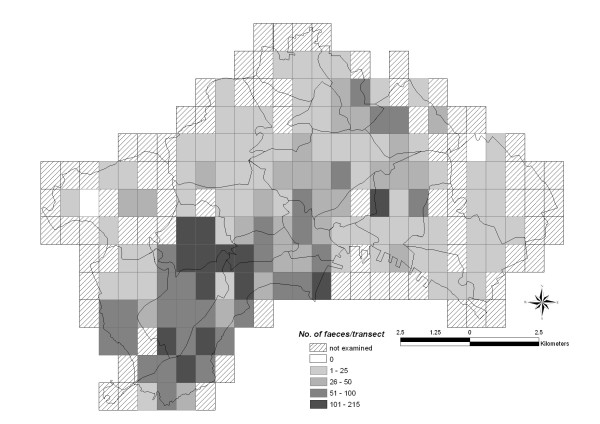
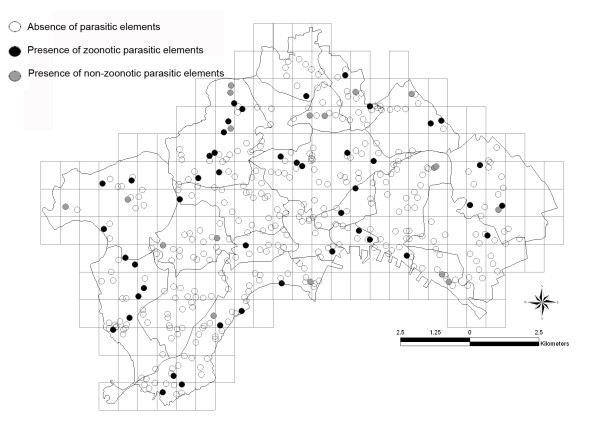
Background: Dogs are associated with more than 60 zoonotic diseases among which, parasitosis and, in particular, helminthosis, can pose serious public-health concerns worldwide. Many canine gastrointestinal parasites eliminate their dispersion elements (eggs, larvae, oocysts) by the faecal route. The quantity of canine faeces deposited on public and private property in cities worldwide is both a perennial nuisance and an important health issue. Public sites such as playgrounds, parks, gardens, public squares and sandpits may be an important source of human infection. The aim of this study was to evaluate the extent of both canine faecal contamination in the city of Naples (southern Italy), and presence of canine parasitic elements, with particular regard to those which are potential agents of zoonosis. A regular grid of sub-areas (1 km x 700 m) was overlaid on the city map using a Geographical Information System (GIS). In each sub-area the straightest 1 km transect was drawn and digitalized on-screen in the GIS. Between February and May 2005 canine faeces were counted along the 1 km transects in 143 sub-areas, and 415 canine faecal samples were collected and submitted to coprological examinations. Negative binomial regression models and Gaussian random effects models were used to analyze the association between faeces count and human population density taking into account for extraPoisson variability. Logistic regression model was used to evaluate the association between positivity to parasitic elements and number of canine faeces.
Results: Out of the 143 studied sub-areas, 141 (98.6%) contained canine faeces. There was a strong spatial gradient with 48% of the total variability accounted by between neighbourhood variability; a positive association between the number of faeces and the human population density was found. Seventy (over 415, 16.9%) canine faecal samples were positive for parasitic elements. There was no association between positivity to parasitic elements and the number of canine faeces. Eggs of Toxocara canis, Toxascaris leonina, Ancylostoma caninum and Trichuris vulpis were found, as well as oocysts of Isospora canis.
Conclusion: In conclusion, the results of the present study, conducted using GIS both for planning and sampling and for evaluation and presentation of findings, showed the presence of canine faecal contamination in the city of Naples, and the presence of canine parasitic elements, some of which are potential agents of zoonosis.
Figures
References
-
- Baxter DN. The deleterious effects of dogs on human health: dog associated injuries. Community Med. 1984;6:29–36. - PubMed
-
- WHO . World survey of rabies no 32 for the Year 1996. WHO, Geneva; 1998.
-
- Schantz PM. Of worms, dogs, and human hosts: continuing challengesfor veterinarians in prevention of human disease. J Am Vet Med Assoc. 1994;204:1023–1028. - PubMed
Publication types
MeSH terms
LinkOut - more resources
Full Text Sources
Medical
