


Identification and comparative analysis of sixteen fungal peptidyl-prolyl cis/trans isomerase repertoires
- PMID: 16995943
- PMCID: PMC1618848
- DOI: 10.1186/1471-2164-7-244
Identification and comparative analysis of sixteen fungal peptidyl-prolyl cis/trans isomerase repertoires
Abstract
Background: The peptidyl-prolyl cis/trans isomerase (PPIase) class of proteins is present in all known eukaryotes, prokaryotes, and archaea, and it is comprised of three member families that share the ability to catalyze the cis/trans isomerisation of a prolyl bond. Some fungi have been used as model systems to investigate the role of PPIases within the cell, however how representative these repertoires are of other fungi or humans has not been fully investigated.
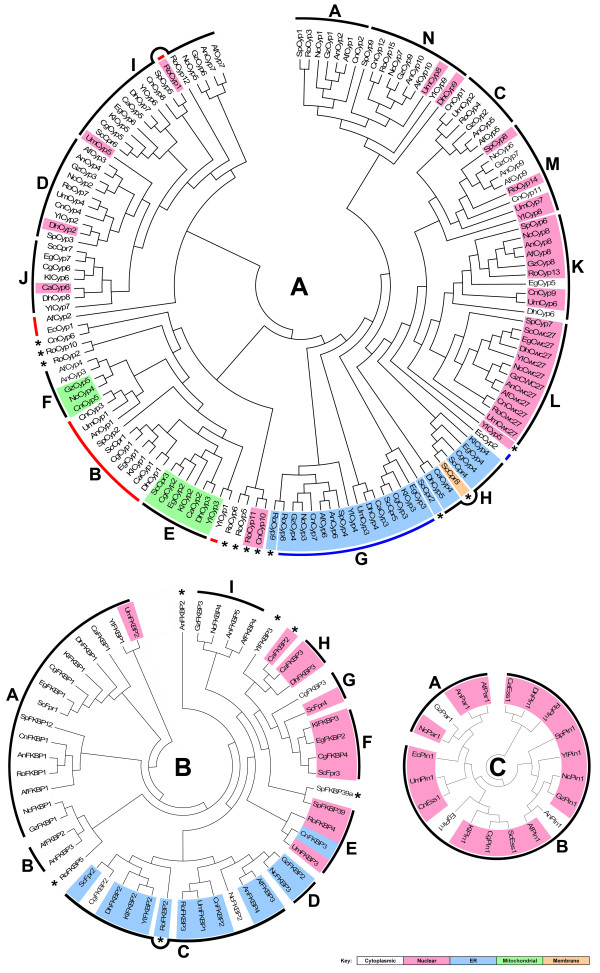
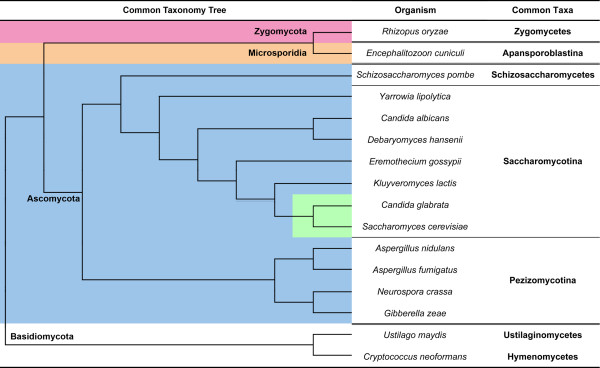
Results: PPIase numbers within these fungal repertoires appears associated with genome size and orthology between repertoires was found to be low. Phylogenetic analysis showed the single-domain FKBPs to evolve prior to the multi-domain FKBPs, whereas the multi-domain cyclophilins appear to evolve throughout cyclophilin evolution. A comparison of their known functions has identified, besides a common role within protein folding, multiple roles for the cyclophilins within pre-mRNA splicing and cellular signalling, and within transcription and cell cycle regulation for the parvulins. However, no such commonality was found with the FKBPs. Twelve of the 17 human cyclophilins and both human parvulins, but only one of the 13 human FKBPs, identified orthologues within these fungi. hPar14 orthologues were restricted to the Pezizomycotina fungi, and R. oryzae is unique in the known fungi in possessing an hCyp33 orthologue and a TPR-containing FKBP. The repertoires of Cryptococcus neoformans, Aspergillus fumigatus, and Aspergillus nidulans were found to exhibit the highest orthology to the human repertoire, and Saccharomyces cerevisiae one of the lowest.
Conclusion: Given this data, we would hypothesize that: (i) the evolution of the fungal PPIases is driven, at least in part, by the size of the proteome, (ii) evolutionary pressures differ both between the different PPIase families and the different fungi, and (iii) whilst the cyclophilins and parvulins have evolved to perform conserved functions, the FKBPs have evolved to perform more variable roles. Also, the repertoire of Cryptococcus neoformans may represent a better model fungal system within which to study the functions of the PPIases as its genome size and genetic tractability are equal to those of Saccharomyces cerevisiae, whilst its repertoires exhibits greater orthology to that of humans. However, further experimental investigations are required to confirm this.
Figures
References
Publication types
MeSH terms
Substances
Grants and funding
LinkOut - more resources
Full Text Sources
Other Literature Sources
Medical
Molecular Biology Databases
Miscellaneous
