


Selective nonoperative management of penetrating abdominal solid organ injuries
- PMID: 16998371
- PMCID: PMC1856549
- DOI: 10.1097/01.sla.0000237743.22633.01
Selective nonoperative management of penetrating abdominal solid organ injuries
Abstract
Objective: To assess the feasibility and safety of selective nonoperative management in penetrating abdominal solid organ injuries.
Background: Nonoperative management of blunt abdominal solid organ injuries has become the standard of care. However, routine surgical exploration remains the standard practice for all penetrating solid organ injuries. The present study examines the role of nonoperative management in selected patients with penetrating injuries to abdominal solid organs.
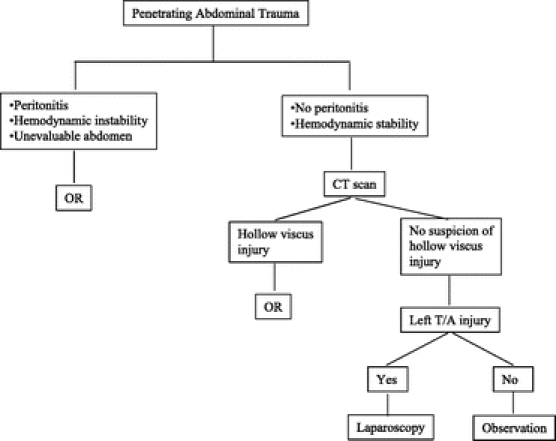
Patients and methods: Prospective, protocol-driven study, which included all penetrating abdominal solid organ (liver, spleen, kidney) injuries admitted to a level I trauma center, over a 20-month period. Patients with hemodynamic instability, peritonitis, or an unevaluable abdomen underwent an immediate laparotomy. Patients who were hemodynamically stable and had no signs of peritonitis were selected for further CT scan evaluation. In the absence of CT scan findings suggestive of hollow viscus injury, the patients were observed with serial clinical examinations, hemoglobin levels, and white cell counts. Patients with left thoracoabdominal injuries underwent elective laparoscopy to rule out diaphragmatic injury. Outcome parameters included survival, complications, need for delayed laparotomy in observed patients, and length of hospital stay.
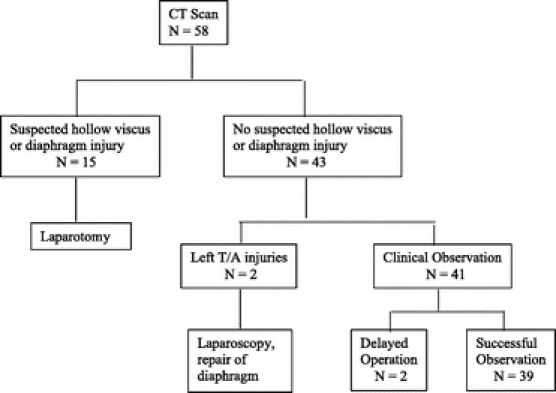
Results: During the study period, there were 152 patients with 185 penetrating solid organ injuries. Gunshot wounds accounted for 70.4% and stab wounds for 29.6% of injuries. Ninety-one patients (59.9%) met the criteria for immediate operation. The remaining 61 (40.1%) patients were selected for CT scan evaluation. Forty-three patients (28.3% of all patients) with 47 solid organ injuries who had no CT scan findings suspicious of hollow viscus injury were selected for clinical observation and additional laparoscopy in 2. Four patients with a "blush" on CT scan underwent angiographic embolization of the liver. Overall, 41 patients (27.0%), including 18 cases with grade III to V injuries, were successfully managed without a laparotomy and without any abdominal complication. Overall, 28.4% of all liver, 14.9% of kidney, and 3.5% of splenic injuries were successfully managed nonoperatively. Patients with isolated solid organ injuries treated nonoperatively had a significantly shorter hospital stay than patients treated operatively, even though the former group had more severe injuries. In 3 patients with failed nonoperative management and delayed laparotomy, there were no complications.
Conclusions: In the appropriate environment, selective nonoperative management of penetrating abdominal solid organ injuries has a high success rate and a low complication rate.
Figures
References
-
- Demetriades D, Charalambides D, Lakhoo M, et al. Gunshot wounds of the abdomen: role of selective nonoperative management. Br J Surg. 1991;78:220–222. - PubMed
-
- Demetriades D, Velmahos G, Cornwell E, et al. Selective non-operative management of gunshot wounds of the anterior abdomen. Arch Surg. 1997;132:178–183. - PubMed
-
- Velmahos G, Demetriades D, Cornwell E, et al. A selective approach to the management of gunshot wounds to the back. Am J Surg. 1997;174:342–346. - PubMed
Publication types
MeSH terms
LinkOut - more resources
Full Text Sources
Miscellaneous
