


Tails of the unexpected - an atypical receptor for the chemokine RANTES/CCL5 expressed in brain
- PMID: 17001302
- PMCID: PMC2014672
- DOI: 10.1038/sj.bjp.0706910
Tails of the unexpected - an atypical receptor for the chemokine RANTES/CCL5 expressed in brain
Abstract
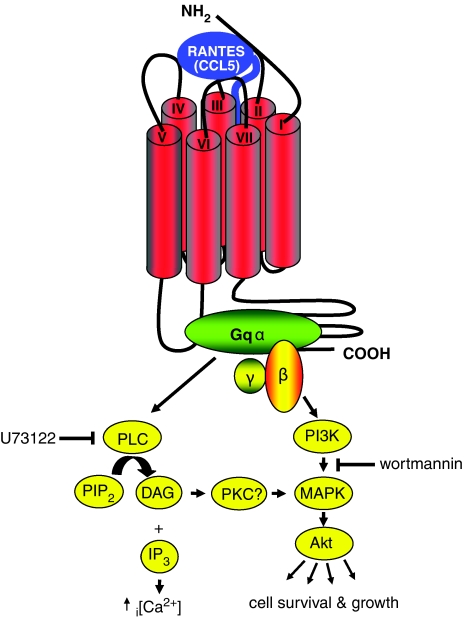
Chemokines and their receptors play a central role in the trafficking of leukocytes within the body, a process which is amenable to antagonism by small molecules and which holds promise as a treatment for clinically important diseases. In the issue of the British Journal of Pharmacology accompanying this commentary, Ignatov and colleagues describe an unexpected role for the chemokine RANTES/CCL5, namely an ability to signal via the orphan G protein-coupled receptor named GPR75. This receptor bears little homology to other chemokine receptors, most strikingly within the putative intracellular domains, with the third loop and C-terminal tail dwarfing those of other known chemokine receptors. This most likely accounts for the atypical pertussis toxin-insensitive signalling induced by RANTES. Intriguingly, this signalling is neuro-protective, inducing the survival of a hippocampal cell line following insult with the neurotoxic amyloid-beta peptide. Since this peptide is implicated in the pathogenesis of Alzheimer's disease, it may be that exploitation of this signalling pathway presents itself as a future therapeutic treatment.
Figures
Comment on
-
RANTES stimulates Ca2+ mobilization and inositol trisphosphate (IP3) formation in cells transfected with G protein-coupled receptor 75.Br J Pharmacol. 2006 Nov;149(5):490-7. doi: 10.1038/sj.bjp.0706909. Epub 2006 Sep 25. Br J Pharmacol. 2006. PMID: 17001303 Free PMC article.
References
-
- Charo IF, Ransohoff RM. The many roles of chemokines and chemokine receptors in inflammation. N Engl J Med. 2006;354:610–621. - PubMed
-
- Cohen P. Hooked on HIV – What's the connection between a 1980s film character and the cutting edge of AIDS research? New Scientist. 1996;2060:24.
-
- Johnstone M, Gearing AJ, Miller KM. A central role for astrocytes in the inflammatory response to beta-amyloid; chemokines, cytokines and reactive oxygen species are produced. J Neuroimmunol. 1999;93:182–193. - PubMed
Publication types
MeSH terms
Substances
LinkOut - more resources
Full Text Sources
Molecular Biology Databases
