Bovine and porcine transscleral solute transport: influence of lipophilicity and the Choroid-Bruch's layer
- PMID: 17003447
- PMCID: PMC3324974
- DOI: 10.1167/iovs.06-0404
Bovine and porcine transscleral solute transport: influence of lipophilicity and the Choroid-Bruch's layer
Abstract
Purpose: To determine the influence of the choroid-Bruch's layer and solute lipophilicity on in vitro transscleral drug permeability in bovine and porcine eyes.
Methods: The in vitro permeability of two VEGF inhibitory drugs, budesonide and celecoxib, which are lipophilic and neutral at physiologic pH, and of three marker solutes, 3H-mannitol (hydrophilic, neutral), sodium fluorescein (hydrophilic, anionic), and rhodamine 6G (lipophilic, cationic), were determined across freshly excised scleras, with or without the underlying choroid-Bruch's layer. Select studies were performed using porcine sclera with and without choroid-Bruch's layer. Neural retina was removed by exposure of the eyecup to isotonic buffer and wherever required, the retinal pigment epithelial (RPE) layer of the preparation was disrupted and removed by exposure to hypertonic buffer. Because of the poor solubility of celecoxib and budesonide, permeability studies were conducted with 5% wt/vol of hydroxypropyl-beta-cyclodextrin (HPbetaCD). For other solutes, permeability studies were conducted, with and without HPbetaCD. Partitioning of the solutes into bovine sclera and choroid-Bruch's layer was also determined.
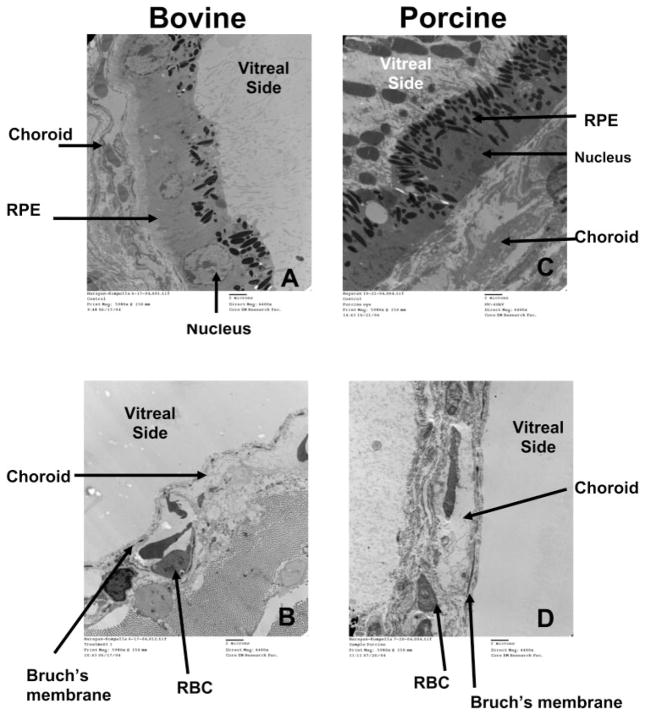
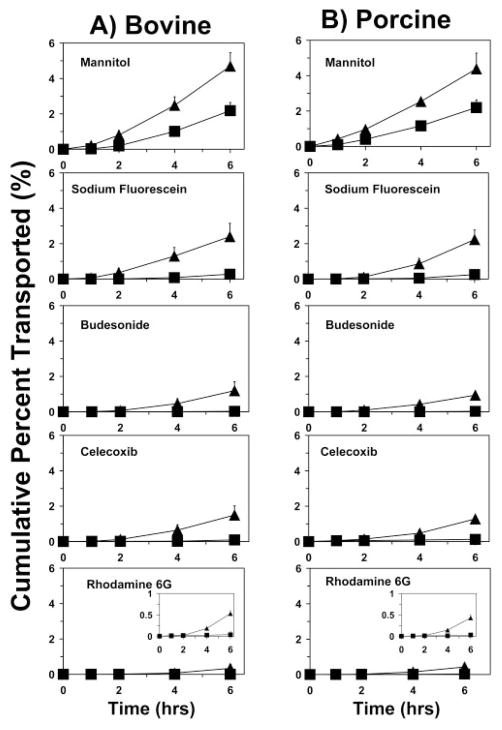
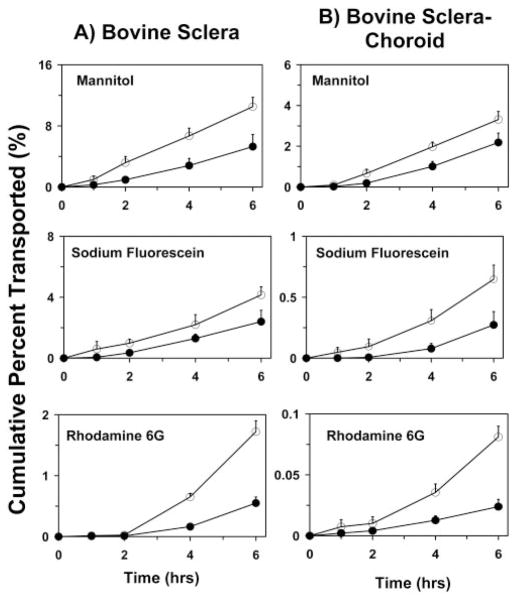
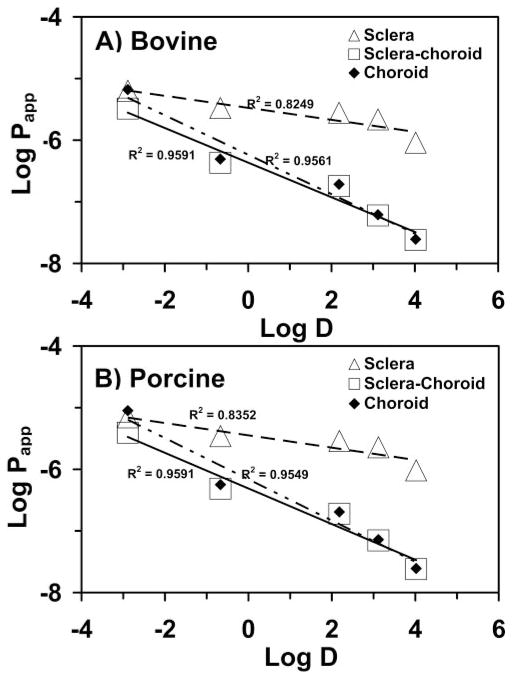
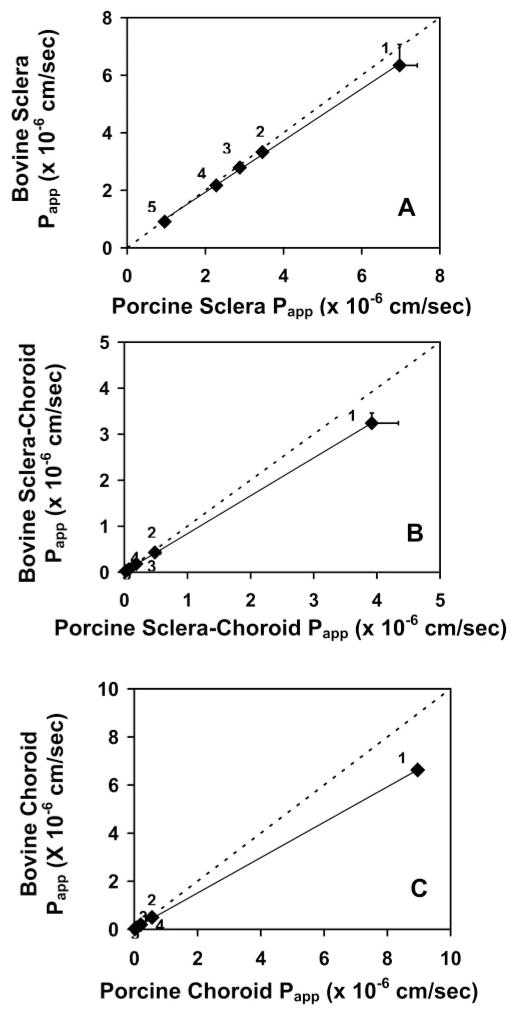
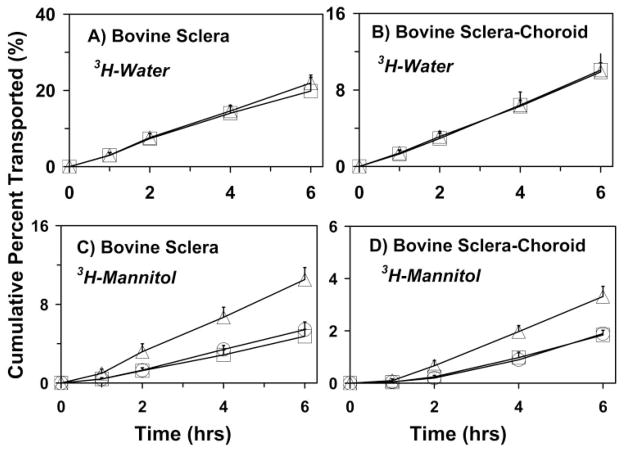
Results: The calculated log (distribution coefficient) values were -2.89, -0.68, 2.18, 3.12, and 4.02 for mannitol, sodium fluorescein, budesonide, celecoxib, and rhodamine 6G, respectively. Removal of RPE was confirmed by transmission electron microscopy and differences in the transport of mannitol. The order of the permeability coefficients (Papp) across sclera and sclera-choroid-Bruch's layers in bovine and porcine models was 3H-mannitol > fluorescein > budesonide > celecoxib > rhodamine 6G, with HPbetaCD, and 3H-mannitol > fluorescein > rhodamine 6G, without HPbetaCD. The presence of choroid-Bruch's layer reduced the bovine scleral permeability by 2-, 8-, 16-, 36-, and 50-fold and porcine tissue permeability by 2-, 7-, 15-, 33-, and 40-fold, respectively, for mannitol, sodium fluorescein, budesonide, celecoxib, and rhodamine 6G. The partition coefficients measured in bovine tissues correlated positively with the log (distribution coefficient) and exhibited a trend opposite that of transport. The partition coefficient ratio of bovine choroid-Bruch's layer to sclera was approximately 1, 1.5, 1.7, 2, and 3.5, respectively, for the solutes, as listed earlier.
Conclusions: The choroid-Bruch's layer is a more significant barrier to drug transport than is sclera. It hinders the transport of lipophilic solutes, especially a cationic solute, more than hydrophilic solutes and in a more dramatic way than does sclera. The reduction in transport across this layer directly correlates with solute binding to the tissue. Understanding the permeability properties of sclera and underlying layers would be beneficial in designing better drugs for transscleral delivery.
Figures
References
-
- Adamis AP, Miller JW, Bernal MT, et al. Increased vascular endothelial growth factor levels in the vitreous of eyes with proliferative diabetic retinopathy. Am J Ophthalmol. 1994;118:445–450. - PubMed
-
- Speicher MA, Danis RP, Criswell M, Pratt L. Pharmacologic therapy for diabetic retinopathy. Expert Opin Emerg Drugs. 2003;8:239–250. - PubMed
-
- Kompella UB, Bandi N, Ayalasomayajula SP. Subconjunctival nano-and microparticles sustain retinal delivery of budesonide, a corticosteroid capable of inhibiting VEGF expression. Invest Ophthalmol Vis Sci. 2003;44:1192–1201. - PubMed
-
- Ayalasomayajula SP, Kompella UB. Celecoxib, a selective cyclooxygenase-2 inhibitor, inhibits retinal vascular endothelial growth factor expression and vascular leakage in a streptozotocin-induced diabetic rat model. Eur J Pharmacol. 2003;458:283–289. - PubMed
-
- Carrasquillo KG, Ricker JA, Rigas IK, Miller JW, Gragoudas ES, Adamis AP. Controlled delivery of the anti-VEGF aptamer EYE001 with poly(lactic-co-glycolic)acid microspheres. Invest Ophthalmol Vis Sci. 2003;44:290–299. - PubMed
Publication types
MeSH terms
Substances
Grants and funding
LinkOut - more resources
Full Text Sources
Other Literature Sources