


Comparative Study
doi: 10.1128/JVI.01399-06.
Epub 2006 Sep 27.
Nonneutralizing human rhinovirus serotype 2-specific monoclonal antibody 2G2 attaches to the region that undergoes the most dramatic changes upon release of the viral RNA
Affiliations
- PMID: 17005641
- PMCID: PMC1676314
- DOI: 10.1128/JVI.01399-06
Item in Clipboard
Comparative Study
Nonneutralizing human rhinovirus serotype 2-specific monoclonal antibody 2G2 attaches to the region that undergoes the most dramatic changes upon release of the viral RNA
J Virol.
2006 Dec.
Abstract
The monoclonal antibody 2G2 has been used extensively for detection and quantification of structural changes of human rhinovirus serotype 2 during infection. It recognizes exclusively A and B subviral particles, not native virus. We have elucidated the basis of this selectivity by determining the footprint of 2G2. Since viral escape mutants obviously cannot be obtained, the structures of complexes between Fab fragments of 2G2 and 80S subviral B particles were determined by cryoelectron microscopy. The footprint of the antibody corresponds to the capsid region that we predicted would undergo the most dramatic changes upon RNA release.
Figures
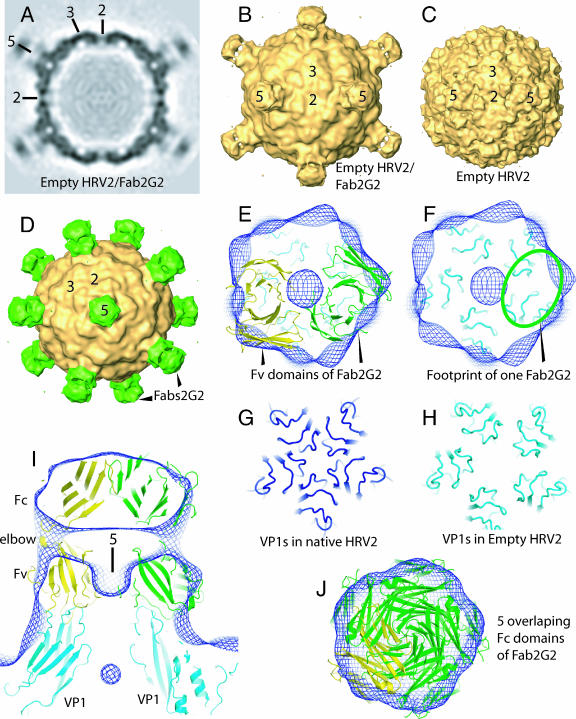
Three-dimensional reconstructions of the empty capsid of HRV2 alone and in complex with Fab fragments of 2G2. Shown are a central section (A) and a surface representation (B) of the map of the complex viewed down a twofold axis. (C) Comparable surface view of the empty HRV2 capsid (9). (D) View down a fivefold axis of the complex with the 2G2 Fabs shaded in green. Representative two-, three-, and fivefold icosahedral axes are marked. The structure of the Fab 2G2 is not determined and so was replaced for docking by Fab 4C4 (28). A view down a fivefold axis of a thick section shows two Fab molecules docked in the complex map (E), and the footprint of one Fab which overlaps two VP1 molecules is outlined in green (F). One Fab is shaded in yellow, and the other is shaded in green. The Cα chains of VP1 in the empty capsid are depicted in cyan. The density map of the complex is represented by a blue mesh. Docking was performed manually using the program O. The disposition of the VP1s around a fivefold axis for the native capsid shaded in dark blue (26) (G) and the empty capsid shaded in cyan (9) (H) shows that each VP1 has moved with respect to its neighbor, thus modifying any epitope that covers two VP1s. (I) A thick section parallel to a fivefold axis showing the fit of the Fab in the density of the complex. (J) The fit of the constant domains of the Fab. As for the variable domains, steric hindrance is evident and will prevent more than two Fabs from binding on each fivefold axis. Panels A to D were produced using Amira (Mercury Computer Systems, Courtaboeuf, France), and panels E to J were made with PyMOL (http://pymol.sourceforge.net/ ).
References
-
- Andrew, S. M., and J. A. Titus. 2000. Fragmentation of immunoglobulin G, p. 16.4.1-16.4.6. In J. S. Bonifacino, M. Dasso, J. B. Hartford, J. Lippincott-Schwartz, and M. Yamada (ed.), Current protocols in cell biology, 1st ed., vol. 2. John Wiley and Sons, Inc., New York, N.Y.
-
- Bayer, N., E. Prchla, M. Schwab, D. Blaas, and R. Fuchs. 1999. Human rhinovirus HRV14 uncoats from early endosomes in the presence of bafilomycin. FEBS Lett. 463:175-178. - PubMed
Publication types
MeSH terms
Substances
LinkOut - more resources
Full Text Sources
