


Induction of innate immunity against herpes simplex virus type 2 infection via local delivery of Toll-like receptor ligands correlates with beta interferon production
- PMID: 17005672
- PMCID: PMC1617293
- DOI: 10.1128/JVI.01036-06
Induction of innate immunity against herpes simplex virus type 2 infection via local delivery of Toll-like receptor ligands correlates with beta interferon production
Abstract
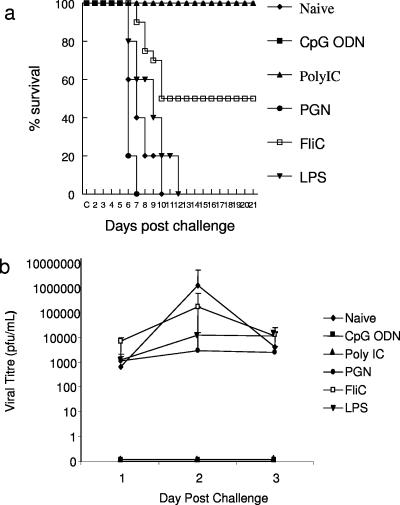
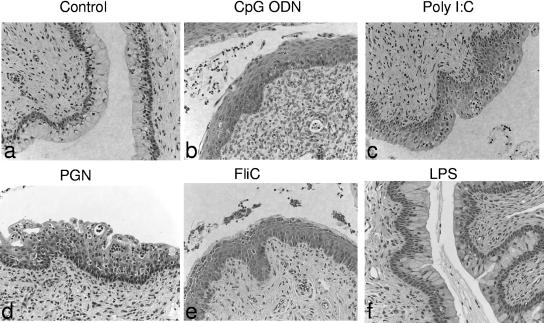
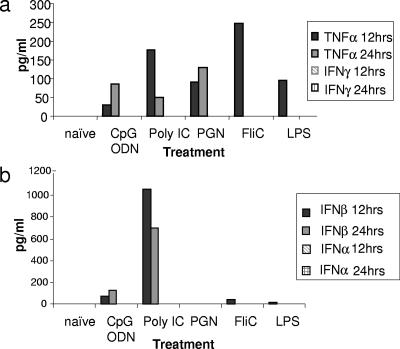
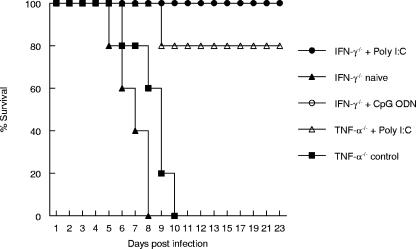
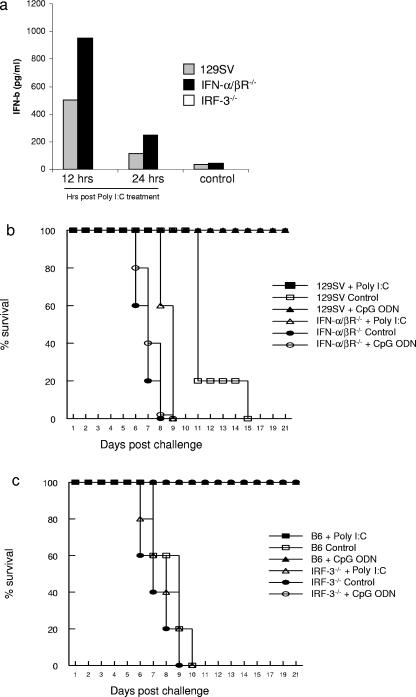
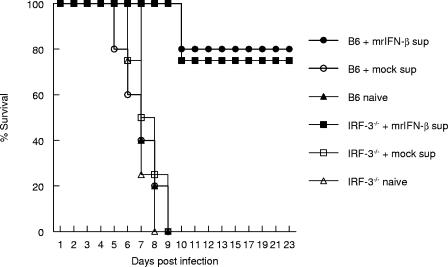
Toll-like receptors (TLRs) constitute a family of innate receptors that recognize and respond to a wide spectrum of microorganisms, including fungi, bacteria, viruses, and protozoa. Previous studies have demonstrated that ligands for TLR3 and TLR9 induce potent innate antiviral responses against herpes simplex virus type 2 (HSV-2). However, the factor(s) involved in this innate protection is not well-defined. Here we report that production of beta interferon (IFN-beta) but not production of IFN-alpha, IFN-gamma, or tumor necrosis factor alpha (TNF-alpha) strongly correlates with innate protection against HSV-2. Local delivery of poly(I:C) and CpG oligodeoxynucleotides induced significant production of IFN-beta in the genital tract and provided complete protection against intravaginal (IVAG) HSV-2 challenge. There was no detectable IFN-beta in mice treated with ligands for TLR4 or TLR2, and these mice were not protected against subsequent IVAG HSV-2 challenge. There was no correlation between levels of TNF-alpha or IFN-gamma in the genital tract and protection against IVAG HSV-2 challenge following TLR ligand delivery. Both TNF-alpha(-/-) and IFN-gamma(-/-) mice were protected against IVAG HSV-2 challenge following local delivery of poly(I:C). To confirm that type I interferon, particularly IFN-beta, mediates innate protection, mice unresponsive to type I interferons (IFN-alpha/betaR(-/-) mice) and mice lacking IFN regulatory factor-3 (IRF-3(-/-) mice) were treated with poly(I:C) and then challenged with IVAG HSV-2. There was no protection against HSV-2 infection following poly(I:C) treatment of IFN-alpha/betaR(-/-) or IRF-3(-/-) mice. Local delivery of murine recombinant IFN-beta protected C57BL/6 and IRF-3(-/-) mice against IVAG HSV-2 challenge. Results from these in vivo studies clearly suggest a strong correlation between IFN-beta production and innate antiviral immunity against HSV-2.
Figures
References
-
- Akira, S., and K. Takeda. 2004. Toll-like receptor signalling. Nat. Rev. Immunol. 4:499-511. - PubMed
-
- Akira, S., K. Takeda, and T. Kaisho. 2001. Toll-like receptors: critical proteins linking innate and acquired immunity. Nat. Immunol. 2:675-680. - PubMed
-
- Ashkar, A. A., X. D. Yao, N. Gill, D. Sajic, A. J. Patrick, and K. L. Rosenthal. 2004. Toll-like receptor (TLR)-3, but not TLR4, agonist protects against genital herpes infection in the absence of inflammation seen with CpG DNA. J. Infect. Dis. 190:1841-1849. - PubMed
Publication types
MeSH terms
Substances
LinkOut - more resources
Full Text Sources
Other Literature Sources
Medical
Molecular Biology Databases
