. 2006 Oct;80(20):10096-108.
doi: 10.1128/JVI.01186-06.

Packaging of brome mosaic virus subgenomic RNA is functionally coupled to replication-dependent transcription and translation of coat protein

Affiliations

Packaging of brome mosaic virus subgenomic RNA is functionally coupled to replication-dependent transcription and translation of coat protein

Padmanaban Annamalai et al. J Virol. 2006 Oct.

Abstract

In Brome mosaic virus (BMV), genomic RNA1 (gB1) and RNA2 (gB2), encoding the replication factors, are packaged into two separate virions, whereas genomic RNA3 (gB3) and its subgenomic coat protein (CP) mRNA (sgB4) are copackaged into a third virion. In vitro assembly assays performed between a series of deletion variants of sgB4 and wild-type (wt) CP subunits demonstrated that packaging of sgB4 is independent of sequences encoding the CP open reading frame. To confirm these observations in vivo and to unravel the mechanism of sgB4 copackaging, an Agrobacterium-mediated transient in vivo expression system (P. Annamalai and A. L. N. Rao, Virology 338:96-111, 2005) that effectively uncouples replication from packaging was used. Cultures of agrotransformants, engineered to express sgB4 and CP subunits either transiently (sgB4(Trans) and CP(Trans)) or in replication-dependent transcription and translation when complemented with gB1 and gB2 (sgB4(Rep) and CP(Rep)), were mixed in all four pair-wise combinations and infiltrated to Nicotiana benthamiana leaves to systematically evaluate requirements regulating sgB4 packaging. The data revealed that (i) in the absence of replication, packaging was nonspecific, since transiently expressed CP subunits efficiently packaged ubiquitous cellular RNA as well as transiently expressed sgB4 and its deletion variants; (ii) induction of viral replication increased specificity of RNA packaging; and most importantly, (iii) efficient packaging of sgB4, reminiscent of the wt scenario, is functionally coupled not only to its transcription via replication but also to translation of CP from replication-derived mRNA, a mechanism that appears to be conserved among positive-strand RNA viruses of plants (this study), animals (flock house virus), and humans (poliovirus).


Figures
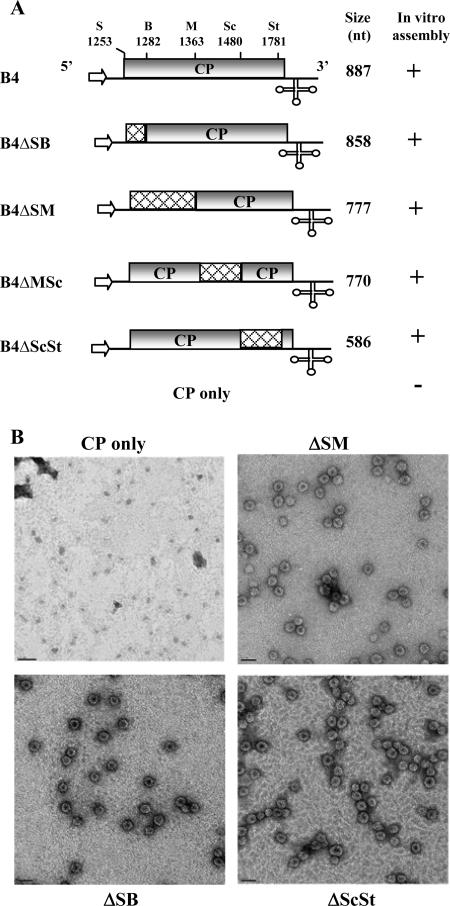
FIG. 1.
FIG. 1.
Schematic representation of wild-type (wt) and deletion variants of B4. (A) The organization of wt B4 is shown, with noncoding sequences represented by solid lines and the open box representing the CP ORF region. The arrow at the 5′ end represents the position of T7 RNA polymerase, and the cloverleaf structure at the 3′ end represents a tRNA-like structure (3′ TLS). Restriction sites used for constructing variants of the full-length cDNA clone of B4 are shown above the map. Cross-hatched boxes in each variant clone represent the extent of each engineered deletion. The lengths of in vitro-synthesized RNA transcripts corresponding to wt B4 and its deletion variants are shown. The results of in vitro assembly assays between wt CP subunits and noncapped RNA transcripts (7) of each B4 variant are shown. +, virion assembly; −, no virion assembly. S, SalI; B, BssHII; M, MscI; Sc, SacI; St, StuI. (B) Electron micrographic images of negatively stained virions for selected representative samples from the above-mentioned in vitro assembly assays. Bar, 50 nm.
FIG. 2.
FIG. 2.
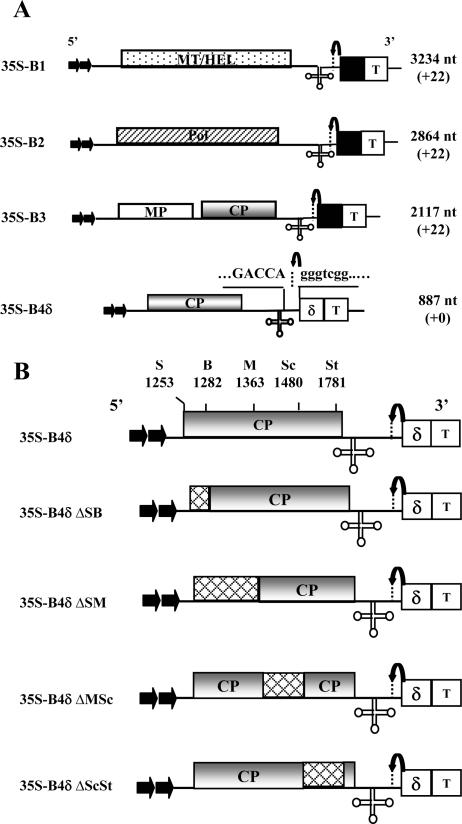
(A) Characteristics of T-DNA plasmids harboring BMV genomic RNAs used for Agrobacterium-mediated transient expression in plants. The 35S-B1, 35S-B2, and 35S-B3 constructs contain full-length cDNA copies of BMV genomic RNA1 (B1), RNA2 (B2), and RNA3 (B3), respectively (3). Filled arrows at the 5′ end represent the location of double 35S promoters (35S), whereas a filled square and T, respectively, denote ribozyme sequence cassettes derived from Satellite tobacco ring spot virus and the 35S-polyadenylation terminator signals. The bent arrow at the 3′ end represents a ribozyme cleavage site. Characteristics of a T-DNA construct of BMV sgB4 (35S-B4δ) used for transient expression with authentic 5′ and 3′ termini are shown. In 35S-B4δ, the position of a hepatitis delta ribozyme (δ) is shown. All other features are the same those described above. Viral and nonviral nucleotide sequences located at the 3′ end are shown by uppercase and lowercase letters, respectively, and the bent arrow represents the ribozyme cleavage site. The lengths of wt BMV RNAs and the number of nonviral nucleotides left after self cleavage by ribozymes (shown in brackets) are indicated. (B) Characteristic features of agrotransformants of sgB4 and its deletion variants. Characteristic features of each variant are the same as those describe in the legend to Fig. 1. S, SalI; B, BssHII; M, MscI; Sc, SacI; St, StuI.
FIG. 3.
FIG. 3.
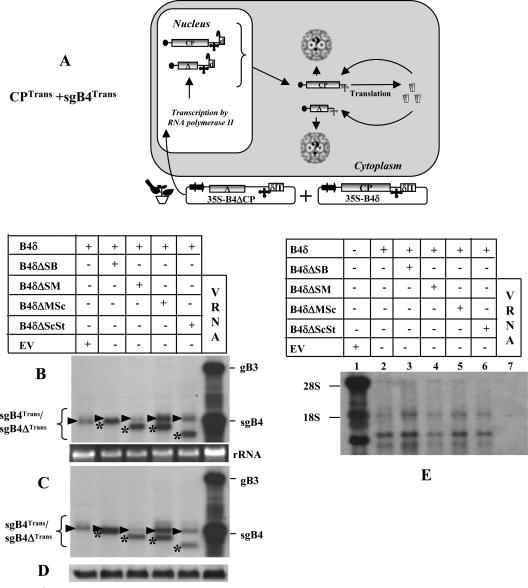
(A) Graphic representation of an agroinfiltration scheme designed to analyze sgB4 packaging involving coexpression of sgB4Trans and CPTrans. The composition of the inoculum mixture consisting of two agrotransformants (35S-B4δ and 35S-B4ΔCP) used to infiltrate leaves of N. benthamiana is shown. The double arrowheads represent a cauliflower mosaic virus double 35S promoter. δ, hepatitis delta ribozyme; T, 35S terminator. The filled circle at the 5′ end and the cloverleaf-like structure at the 3′ end, respectively, represent the cap and 3′ TLS. RNA species chosen to verify packaging by CPTrans into virions is indicated by a question mark. (B) Transient expression and packaging in plants of sgB4 (sgB4Trans) and its deletion variants (sgB4ΔTrans). N. benthamiana leaves were infiltrated with indicated Agrobacterium cultures, and the total (B) and virion RNAs (C) recovered 4 days postinfiltration were subjected to Northern blot hybridization. Leaves infiltrated with empty vector (EV) served as a negative control. Approximately 5 μg of total nucleic acid preparation from agroinfiltrated leaves or 0.5 μg of virion RNA was denatured with formamide-formaldehyde and subjected to 1.2% agarose electrophoresis prior to vacuum blotting to a nylon membrane. The blot was hybridized with 32P-labeled riboprobes complementary to a homologous 3′ TLS present on all four BMV RNAs. Conditions of hybridization are as described previously (3). The positions of wt gB3 and sgB4 are shown to the right, and migrating positions of sgB4Trans (arrowhead) and sgB4ΔTrans (asterisk) are indicated by a bracket on the left. wt BMV virion RNA (vRNA) was used as a size marker. (D) Western blot analysis of BMV CP. Total protein extracts from leaves agroinfiltrated independently with either empty vector (EV) or the indicated mixture of agrotransformants were fractionated by sodium dodecyl sulfate-polyacrylamide gel electrophoresis, followed by transferring to polyvinylidene difluoride membrane and probing with antibodies prepared against purified BMV (24). (E) Packaging of cellular RNA by CPTrans. Virion RNAs recovered 4 days postinfiltration from N. benthamiana leaves with the indicated set of Agrobacterium transformant cultures (lanes 2 to 7) were subjected to Northern blot hybridization as described previously (3). Total RNA recovered from leaves infiltrated with empty vector (EV) was used as a marker (lane 1). In each lane, 0.5 μg virion RNA was subjected to Northern blot analysis. The blot was hybridized with a 5′-end-labeled cellular RNA probe (3). The positions of 28S and 18S cellular RNAs are indicated to the left.
FIG. 4.
FIG. 4.
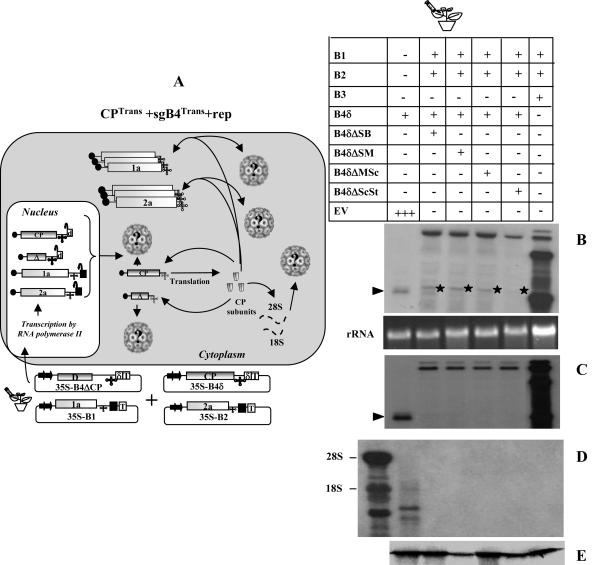
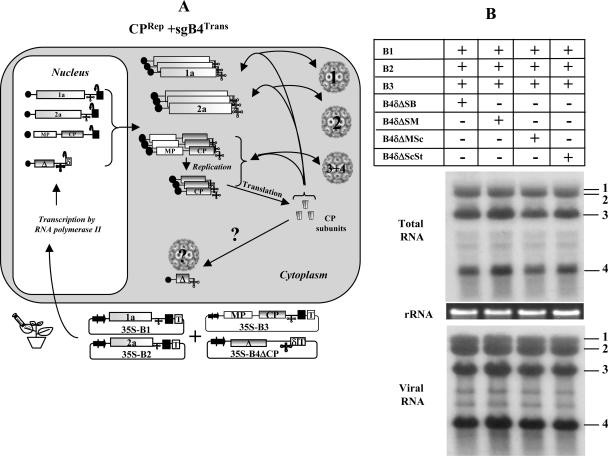
(A) Graphic representation of packaging events examined when leaves coexpressing sgB4Trans or sgB4ΔTrans and CPTrans were supplemented with gB1 and gB2 to induce viral replication. In agrotransformants B1 and B2, a filled square at the 3′ end represents a Satellite tobacco ring spot virus ribozyme cassette. Other features are the same as those described in the legend to Fig. 3. RNA species chosen to verify packaging by CPTrans into virions is indicated by a question mark. The composition of the inoculum mixture consisting of four agrotransformants used to infiltrate leaves of N. benthamiana is shown. (B) Effect of viral replication on packaging of sgB4 (sgB4Trans) and its deletion variants (sgB4ΔTrans) by CPTrans. N. benthamiana leaves were infiltrated with the indicated set of Agrobacterium transformant cultures. Analysis of total (B) and virion (C) RNAs by Northern blot hybridization as described was as described in the legend to Fig. 3. Shown is an analysis of cellular RNA in purified virions (D) and BMV CP (E) in agroinfiltrated leaves by Northern and Western blot hybridization, respectively, as described in the legend to Fig. 3. (B and C) The position of sgB4Trans is indicated by an arrowhead. (B) The asterisk indicates an RNA species of unknown origin migrating slower than sgB4Trans (see the text for details). (D) The position of 28S and 18S cellular RNAs is indicated to the left.
FIG. 5.
FIG. 5.
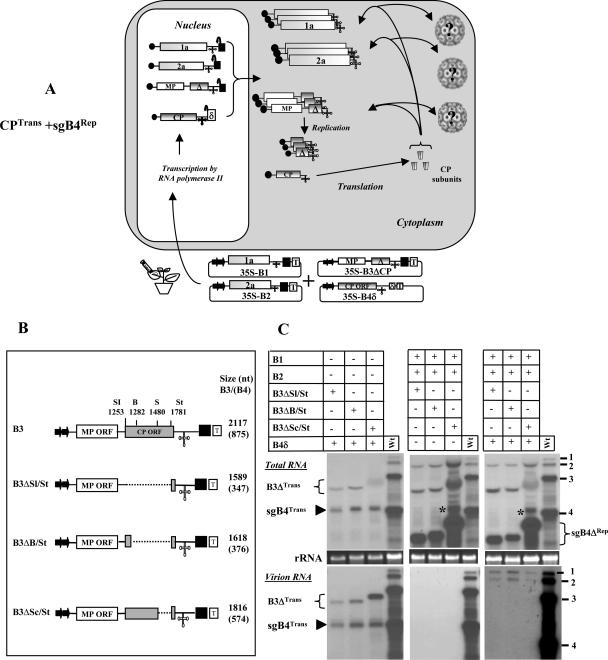
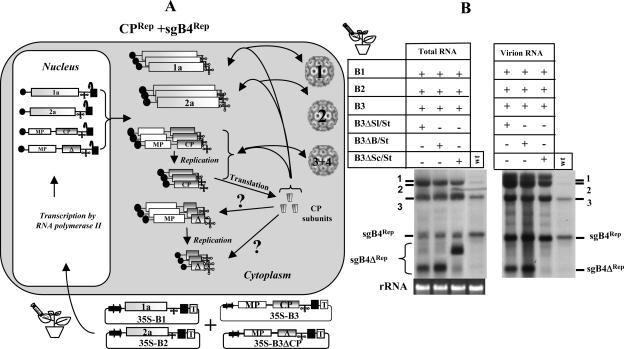
(A) Graphic representation of packaging events examined in leaves expressing sgB4Rep or sgB4ΔRep and CPTrans. Features of T-DNA constructs are the same as those described in the legend to Fig. 3. RNA species chosen to verify packaging by CPTrans into virions is indicated by a question mark. The composition of the inoculum mixture consisting of four agrotransformants used to infiltrate leaves of N. benthamiana is shown. (B) Characteristics of agrotransformants of wt B3 and its deletion variants. The selected restrictions sites (the same as those specified in the legend to Fig. 1A) used to engineer deletions in the CP ORF are shown. The dotted line in each variant clone represents the extent of an engineered deletion. The lengths (in nucleotides) of wt B3 and its variants are shown. The number shown in brackets represents the predicted nucleotide length of sgB4 synthesized in vivo following replication of respective gB3 variant clones. Other features are the same as those described in the legend to Fig. 3. (C) Packaging competence in vivo of sgB4Rep or sgB4ΔRep by CPTrans. N. benthamiana leaves were infiltrated with an indicated set of Agrobacterium transformant cultures. A column containing the wt represents plants infiltrated with an inoculum containing of all three wt BMV transformants. Total and virion RNAs were subjected to Northern blot hybridization as described in the legend to Fig. 3. The top left image shows a Northern blot hybridization of total RNA preparations showing the accumulation of transiently expressed mRNAs of sgB4 and B3 deletion variants. The bottom left image shows a Northern blot showing the packaging competence of sgB4Trans and B3Trans deletion variants by CPTrans. The middle left panel shows a Northern blot hybridization of total (top) and virion RNA (bottom) preparations showing replicative competence of B3 variants. Note that due to the absence of functional CP, no virion RNA was detected in the bottom panel. The asterisk identifies RNA of unknown origin similar to that in the legend to Fig. 4. The top right panel shows a Northern blot hybridization of total RNA preparations showing replicative competence of B3 variants. The asterisk identifies RNA of unknown origin similar to that described in the legend to Fig. 4. The bottom right panel shows a Northern blot hybridization showing packaging competence of progeny of genomic RNAs and sgB4ΔRep by CPTrans. The conditions of hybridization are similar to those described in the legend to Fig. 3. The positions of four BMV RNAs are indicated to the right. The positions of B3ΔTrans/sgB4Trans and B3ΔRep/sgB4ΔRep are shown to the left of each panel.
FIG. 6.
FIG. 6.
(A) Graphic representation of packaging events examined in leaves expressing sgB4ΔTrans and CPRep. Features of T-DNA constructs are the same as those described in the legend to Fig. 3. The composition of the inoculum mixture consisting of four agrotransformants used to infiltrate leaves of N. benthamiana is shown. RNA species chosen to verify packaging by CPRep into virions are indicated by a question mark. (B) N. benthamiana leaves were infiltrated with the indicated set of Agrobacterium transformant cultures. Total and virion RNAs were subjected to Northern blot hybridization as described in the legend to Fig. 3. The positions of four wt BMV RNAs are indicated to the right.
FIG. 7.
FIG. 7.
(A) Graphic representation of packaging events examined in leaves coexpressing sgB4Rep or sgB4ΔRep and CPRep. Features of T-DNA constructs are the same as those described in the legend to Fig. 3. The composition of the inoculum mixture consisting of four agrotransformants used to infiltrate leaves of N. benthamiana is shown. RNA species chosen to verify packaging by CPRep into virions are indicated by a question mark. (B) Leaves of N. benthamiana were infiltrated with the indicated set of Agrobacterium transformant cultures. Total and virion RNAs were subjected to Northern blot hybridization as described in the legend to Fig. 3. The positions of four wt BMV RNAs and each of the three sgB4ΔRep are indicated. Virion RNA of wt BMV (wt) was used as marker.
FIG. 8.
FIG. 8.
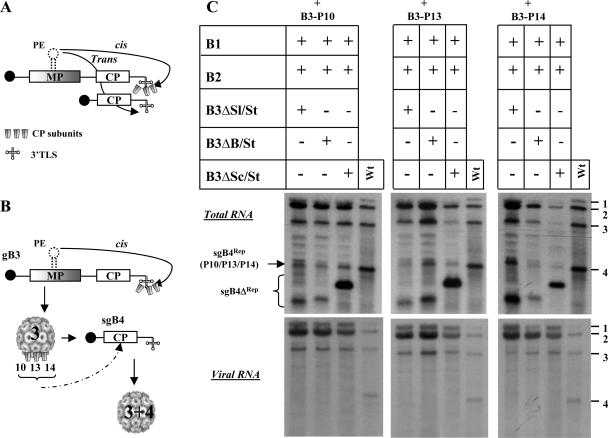
(A) Schematic model showing copackaging of gB3 and sgB4 mediated by RNA-RNA interactions. Following nucleation of CP subunits by the 3′ TLS of gB3, its packaging is mediated through a stem-loop structure functioning as a cis-acting packaging element (10). RNA-RNA interaction is mediated by the PE of gB3 functioning in trans, leading to copackaging. (B) Schematic model showing gB3 and sgB4 copackaging mediated by CP-RNA interactions. After initial packaging of gB3 as described for panel A, the N-arginine-rich region of BMV CP is transiently exposed on the surface of the assembled virion, allowing the interaction of sgB4 with a set of amino acid determinants (P10, P13, and P14) specific for this RNA species. (C) Demonstration in vivo of required specific interaction between sgB4 and N-terminal amino acid determinants of BMV CP promoting copackaging. Leaves of N. benthamiana were infiltrated with the indicated set of Agrobacterium transformant cultures. Total and virion RNAs were subjected to Northern blot hybridization as described in the legend to Fig. 3. The positions of four wt BMV RNAs used as size markers are shown to the right of each panel. The positions of sgB4Rep harboring either P10, P13, or P14 and each of the three sgB4ΔRep are shown to the left.
FIG. 9.
FIG. 9.
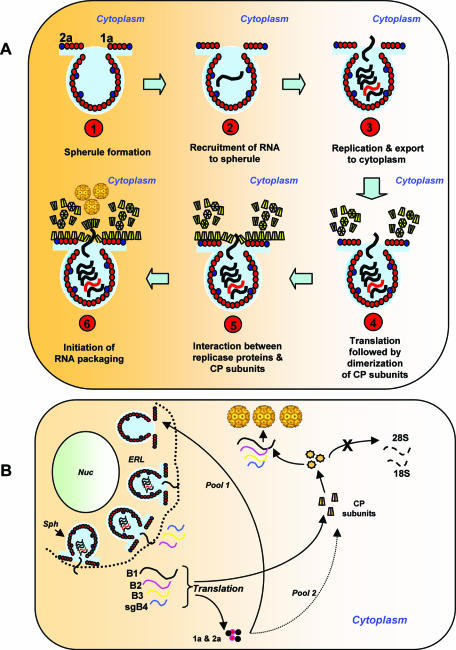
Schematic diagram illustrating two possible models of BMV RNA packaging mediated by interaction between CP and viral replicase proteins. (A) Viral replicase protein 1a induces spherules (step 1), and replicase protein 2a interacts with 1a and recruits RNA to spherules to initiate viral replication (step 2). The necks connecting spherules serve as channels to export newly synthesized progeny RNA to the cytoplasm for translation (step 3). Since CP has been found to copurify with active replicase complex (6), we hypothesize that CP must be synthesized near the necks of spherules (step 4). This scenario provides a transient association between viral replicase proteins and CP resulting in increased specificity of BMV RNA packaging (steps 4 to 6). (B) As mentioned above, induction of spherules (sph) along the endoplasmic reticulum lumen (ERL) and replication viral RNAs occurs in spherules (34). Transportation of newly synthesized BMV RNAs to cytoplasm results in the synthesis of replicase proteins 1a and 2a and CP at an unspecified location in the cytoplasm. One pool of the replicase proteins continues to induce new spherules along ERL, while the other pool transiently interacts with CP to increase specificity. As a result, packaging of cellular RNA is inhibited, while that of viral progeny RNA is enhanced. Nuc, nucleus.

References

    1. Annamalai, P., S. Apte, S. Wilkens, and A. L. Rao. 2005. Deletion of highly conserved arginine-rich RNA binding motif in cowpea chlorotic mottle virus capsid protein results in virion structural alterations and RNA packaging constraints. J. Virol. 79:3277-3288. - PMC - PubMed
    1. Annamalai, P., and A. L. Rao. 2006. Delivery and expression of functional viral RNA genomes in planta by agroinfiltration, p. 16B.2.1-2.15. In T. Downey (ed.), Current protocols in microbiology, vol. 1. John Wiley & Sons, Inc., Hoboken, N.J. - PubMed
    1. Annamalai, P., and A. L. Rao. 2005. Replication-independent expression of genome components and capsid protein of brome mosaic virus in planta: a functional role for viral replicase in RNA packaging. Virology 338:96-111. - PubMed
    1. Basnayake, V. R., T. L. Sit, and S. A. Lommel. 2006. The genomic RNA packaging scheme of Red clover necrotic mosaic virus. Virology 345:532-539. - PubMed
    1. Berkowitz, R., J. Fisher, and S. P. Goff. 1996. RNA packaging. Curr. Top. Microbiol. Immunol. 214:177-218. - PubMed

Publication types