Proposal for standardization of optimized mycobacterial interspersed repetitive unit-variable-number tandem repeat typing of Mycobacterium tuberculosis
- PMID: 17005759
- PMCID: PMC1698431
- DOI: 10.1128/JCM.01392-06
Proposal for standardization of optimized mycobacterial interspersed repetitive unit-variable-number tandem repeat typing of Mycobacterium tuberculosis
Abstract
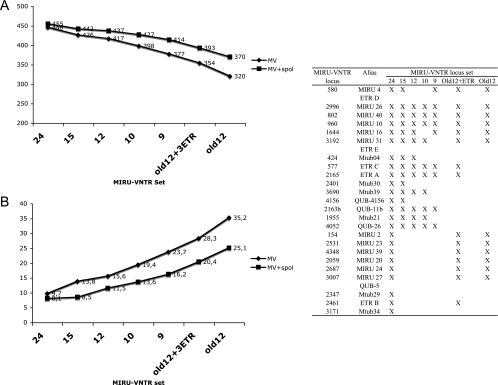
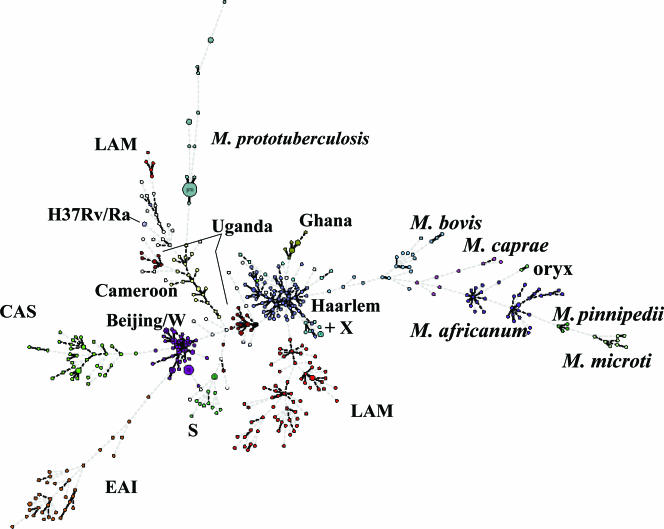
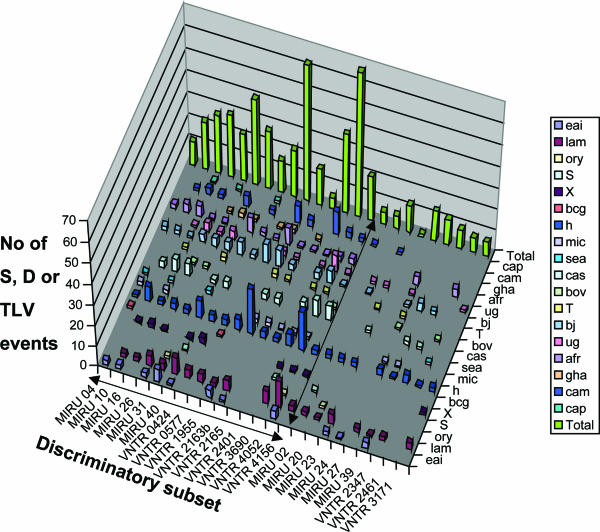
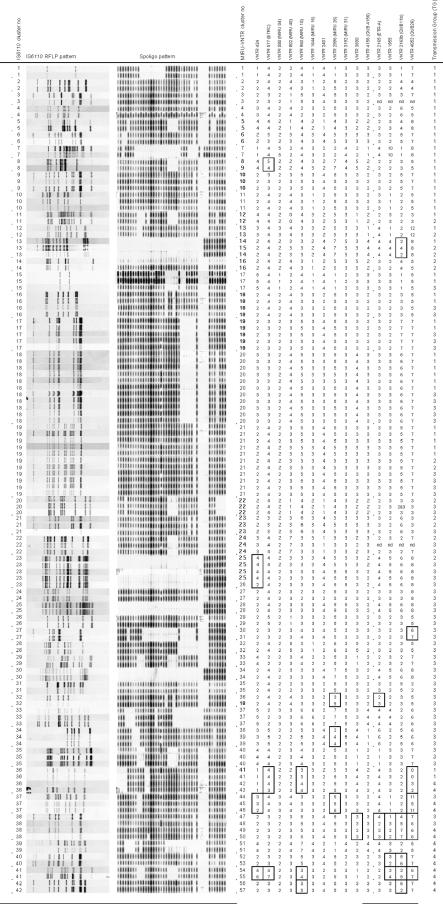
Molecular typing based on 12 loci containing variable numbers of tandem repeats of mycobacterial interspersed repetitive units (MIRU-VNTRs) has been adopted in combination with spoligotyping as the basis for large-scale, high-throughput genotyping of Mycobacterium tuberculosis. However, even the combination of these two methods is still less discriminatory than IS6110 fingerprinting. Here, we define an optimized set of MIRU-VNTR loci with a significantly higher discriminatory power. The resolution and the stability/robustness of 29 loci were analyzed, using a total of 824 tubercle bacillus isolates, including representatives of the main lineages identified worldwide so far. Five loci were excluded for lack of robustness and/or stability in serial isolates or isolates from epidemiologically linked patients. The use of the 24 remaining loci increased the number of types by 40%--and by 23% in combination with spoligotyping--among isolates from cosmopolitan origins, compared to those obtained with the original set of 12 loci. Consequently, the clustering rate was decreased by fourfold--by threefold in combination with spoligotyping--under the same conditions. A discriminatory subset of 15 loci with the highest evolutionary rates was then defined that concentrated 96% of the total resolution obtained with the full 24-locus set. Its predictive value for evaluating M. tuberculosis transmission was found to be equal to that of IS6110 restriction fragment length polymorphism typing, as shown in a companion population-based study. This 15-locus system is therefore proposed as the new standard for routine epidemiological discrimination of M. tuberculosis isolates and the 24-locus system as a high-resolution tool for phylogenetic studies.
Figures
References
-
- Allix, C., P. Supply, and M. Fauville-Dufaux. 2004. Utility of fast mycobacterial interspersed repetitive unit-variable number tandem repeat genotyping in clinical mycobacteriological analysis. Clin. Infect. Dis. 39:783-789. - PubMed
-
- Allix, C., K. Walravens, C. Saegerman, J. Godfroid, P. Supply, and M. Fauville-Dufaux. 2006. Evaluation of the epidemiological relevance of variable-number tandem-repeat genotyping of Mycobacterium bovis and comparison of the method with IS6110 restriction fragment length polymorphism analysis and spoligotyping. J. Clin. Microbiol. 44:1951-1962. - PMC - PubMed
-
- Bifani, P. J., B. Mathema, N. E. Kurepina, and B. N. Kreiswirth. 2002. Global dissemination of the Mycobacterium tuberculosis W-Beijing family strains. Trends Microbiol. 10:45-52. - PubMed
-
- Brudey, K., J. R. Driscoll, L. Rigouts, W. M. Prodinger, A. Gori, S. A. Al-Hajoj, C. Allix, L. Aristimuno, J. Arora, V. Baumanis, L. Binder, P. Cafrune, A. Cataldi, S. Cheong, R. Diel, C. Ellermeier, J. T. Evans, M. Fauville-Dufaux, S. Ferdinand, D. Garcia de Viedma, C. Garzelli, L. Gazzola, H. M. Gomes, M. C. Guttierez, P. M. Hawkey, P. D. van Helden, G. V. Kadival, B. N. Kreiswirth, K. Kremer, M. Kubin, S. P. Kulkarni, B. Liens, T. Lillebaek, M. L. Ho, C. Martin, C. Martin, I. Mokrousov, O. Narvskaia, Y. F. Ngeow, L. Naumann, S. Niemann, I. Parwati, Z. Rahim, V. Rasolofo-Razanamparany, T. Rasolonavalona, M. L. Rossetti, S. Rusch-Gerdes, A. Sajduda, S. Samper, I. G. Shemyakin, U. B. Singh, A. Somoskovi, R. A. Skuce, D. van Soolingen, E. M. Streicher, P. N. Suffys, E. Tortoli, T. Tracevska, V. Vincent, T. C. Victor, R. M. Warren, S. F. Yap, K. Zaman, F. Portaels, N. Rastogi, and C. Sola. 2006. Mycobacterium tuberculosis complex genetic diversity: mining the fourth international spoligotyping database (SpolDB4) for classification, population genetics and epidemiology. BMC Microbiol. 6:23. - PMC - PubMed
Publication types
MeSH terms
Substances
LinkOut - more resources
Full Text Sources
Other Literature Sources