A prospective comparative study of narrow-band imaging, chromoendoscopy, and conventional colonoscopy in the diagnosis of colorectal neoplasia
- PMID: 17005766
- PMCID: PMC1856788
- DOI: 10.1136/gut.2006.099614
A prospective comparative study of narrow-band imaging, chromoendoscopy, and conventional colonoscopy in the diagnosis of colorectal neoplasia
Abstract
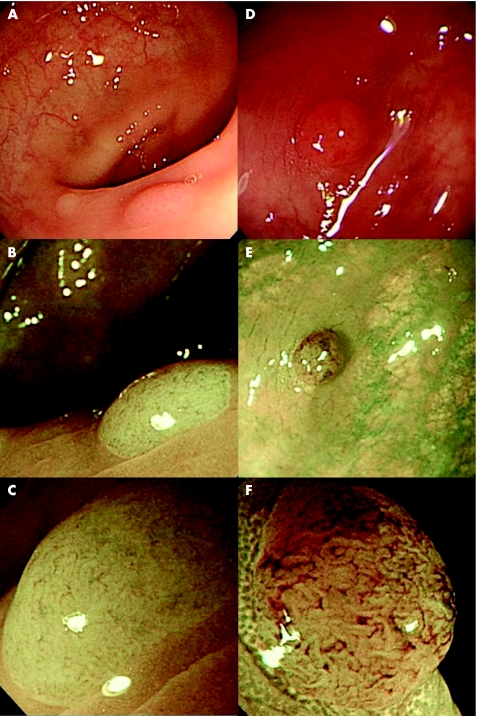
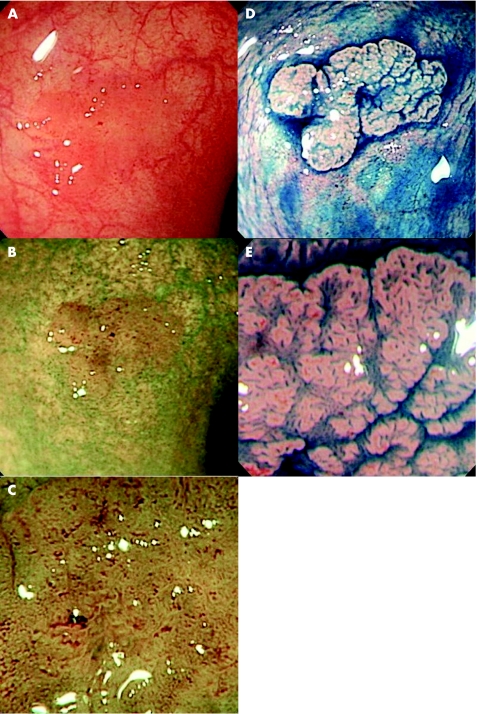
Background: Discrimination between neoplastic and non-neoplastic lesions is crucial in colorectal cancer screening. Application of narrow-band imaging (NBI) in colonoscopy visualises mucosal vascular networks in neoplastic lesions and may improve diagnostic accuracy.
Aim: To compare the diagnostic efficacy of NBI in differentiating neoplastic from non-neoplastic colorectal lesions with diagnostic efficacies of standard modalities, conventional colonoscopy, and chromoendoscopy.
Methods: In this prospective study, 180 colorectal lesions from 133 patients were observed with conventional colonoscopy, and under low-magnification and high-magnification NBI and chromoendoscopy. Lesions were resected for histopathological analysis. Endoscopic images were stored electronically and randomly allocated to two readers for evaluation. Sensitivity, specificity and diagnostic accuracy of each endoscopic modality were assessed by reference to histopathology.
Results: NBI and chromoendoscopy scored better under high magnification than under low magnification in comparison with conventional colonoscopy. The diagnostic accuracy of NBI with low or high magnification was significantly higher than that of conventional colonoscopy (low magnification: p = 0.0434 for reader 1 and p = 0.004 for reader 2; high magnification: p<0.001 for both readers) and was comparable to that of chromoendoscopy.
Conclusion: Both low-magnification and high-magnification NBI were capable of distinguishing neoplastic from non-neoplastic colorectal lesions; the diagnostic accuracy of NBI was better than that of conventional colonoscopy and equivalent to that of chromoendoscopy. The role of NBI in screening colonoscopy needs further evaluation.
Conflict of interest statement
Competing interests: None.
References
Publication types
MeSH terms
Substances
LinkOut - more resources
Full Text Sources
Medical