. 2006 Oct;50(10):3297-304.
doi: 10.1128/AAC.00251-06.

Mechanism of active renal tubular efflux of tenofovir

Affiliations

Mechanism of active renal tubular efflux of tenofovir

Adrian S Ray et al. Antimicrob Agents Chemother. 2006 Oct.

Abstract

Tenofovir (TFV) undergoes renal elimination by a combination of glomerular filtration and active tubular secretion. While transporter-mediated uptake of TFV from the blood into proximal-tubule cells has been well characterized, comparatively little is known about the efflux system responsible for transporting TFV into the lumen during active tubular secretion. Therefore, members of the ATP-binding cassette family of efflux pumps expressed at the apical side of proximal-tubule cells were studied for the ability to transport TFV. Studies in multiple independent in vitro systems show TFV not to be a substrate for P glycoprotein (Pgp) or multidrug resistance protein type 2 (MRP2). In contrast to Pgp and MRP2, TFV was observed to be a substrate for MRP4. TFV accumulated to fivefold lower levels in MRP4-overexpressing cells, and its accumulation could be increased by an MRP inhibitor. Furthermore, MRP4-overexpressing cells were found to be 2.0- to 2.5-fold less susceptible to cytotoxicity caused by TFV. ATP-dependent uptake of TFV was observed in membrane vesicles containing MRP4 but not in vesicles lacking the transporter. On the basis of these and previous results, the molecular transport pathway for the active tubular secretion of TFV through renal proximal-tubule cells involves uptake from the blood mediated by human organic anion transporters 1 and 3 and efflux into urine by MRP4. A detailed understanding of the molecular mechanism of TFV active tubular secretion will facilitate the assessment of potential renal drug-drug interactions with coadministered agents.


Figures

FIG. 1.
FIG. 1.
Forward and reverse permeability of 10 μM digoxin (A) or 50 μM TFV (B) in the presence or absence of CsA through Caco-2 monolayers. The Pgp substrate digoxin, when incubated alone, had a reverse permeability 9.9-fold higher than its forward permeability (***, P < 0.001 by Student's unpaired two-tailed t test assuming equal variance), and a marked change in permeability was observed upon addition of CsA. No significant difference in TFV forward and reverse permeability or effect of CsA was observed (all P values, >0.05). Similar results for TFV were obtained when it was incubated at 5 μM (data not shown). Values represent the mean ± standard deviation from three independent studies done in duplicate.
FIG. 2.
FIG. 2.
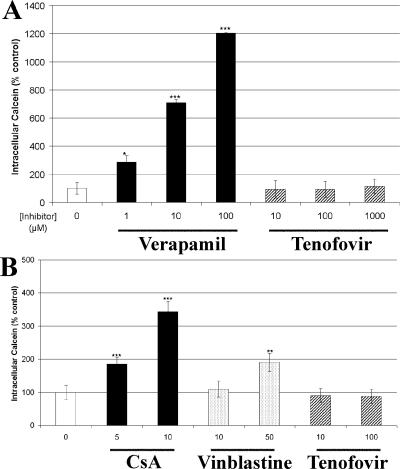
Effects of TFV and transport inhibitors on accumulation of the fluorescent substrate calcein after incubation of Pgp-transfected (A) or MRP2-transfected (B) MDCKII cells with calcein AM. The Pgp inhibitor verapamil and the MRP2 inhibitors CsA and vinblastine were used as positive controls. TFV, at all of the concentrations tested, showed no effect on the activity of either Pgp or MRP2. Values are the mean ± standard deviation from at least two independent experiments done in duplicate. Statistical significance was assessed by Student's unpaired two-tailed t test assuming equal variance (*, P < 0.05; **, P < 0.01; ***, P < 0.001).
FIG. 3.
FIG. 3.
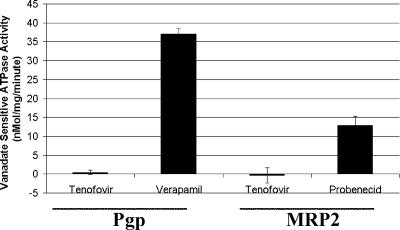
Stimulation of vanadate-sensitive ATPase activity in isolated insect membranes overexpressing Pgp or MRP2 by known substrates and TFV. While verapamil was able to markedly increase the amount of vanadate-sensitive ATPase activity, TFV at a concentration of 1,000 μM was unable to stimulate ATP hydrolysis by Pgp-overexpressing membranes (A). While probenecid caused a marked increase in the amount of vanadate-sensitive ATPase activity, TFV at a concentration of 1,000 μM was unable to stimulate ATP hydrolysis by MRP2-overexpressing membranes (B). Values represent the mean ± standard deviation of at least two independent experiments done in duplicate.
FIG. 4.
FIG. 4.
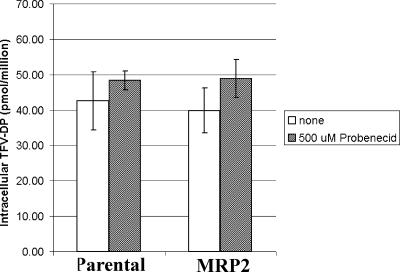
Effect of MRP2 expression on TFV-diphosphate (DP) accumulation in 2008 cells. Parental or MRP2-overexpressing 2008 cells were incubated with 1 μM TDF in the presence or absence of the MRP2 inhibitor probenecid. No significant difference in TFV-DP levels was observed between parental and MRP2-overexpressing cells. Addition of probenecid caused a slight increase in TFV-DP levels in both parental and MRP2-overexpressing 2008 cells. Values represent the mean ± standard deviation of three independent experiments done in duplicate. Experiments with the positive control compound calcein AM showed fivefold lower accumulation in 2008 cells overexpressing MRP2 relative to nontransfected cells (data not shown).
FIG. 5.
FIG. 5.
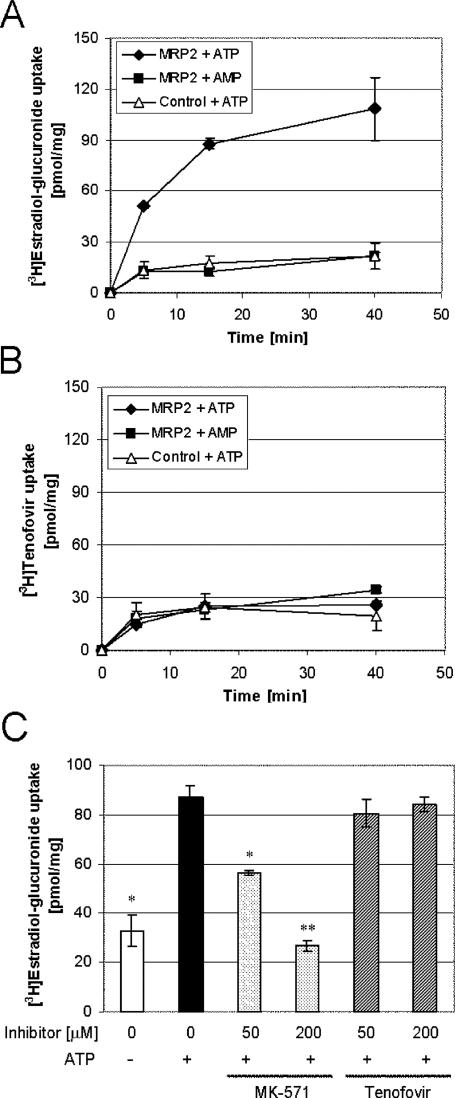
Uptake of estradiol-17-β-d-glucuronide and TFV into membrane vesicles derived from insect cells. Addition of ATP, but not AMP, stimulated the uptake of estradiol-17-β-d-glucuronide into MRP2 vesicles (A). No specific increase in the accumulation of TFV was noted in MRP2 vesicles upon addition of ATP (B). While addition of 200 μM MK571 was able to reduce the transport of estradiol-17-β-d-glucuronide to levels observed in the absence of ATP, TFV at a concentration of 50 or 200 μM was unable to inhibit estradiol-17-β-d-glucuronide accumulation (C). Values represent the mean ± standard deviation of two independent experiments performed in duplicate. Statistical significance was assessed by Student's unpaired two-tailed t test assuming equal variance (*, P < 0.05; **, P < 0.01).
FIG. 6.
FIG. 6.
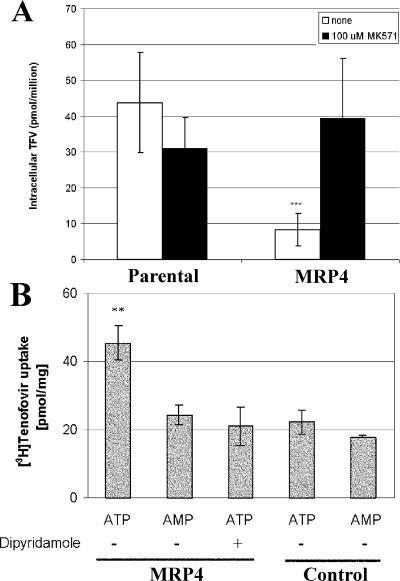
Effect of MRP4 expression on TFV accumulation in MRP4-overexpressing cells (A) or vesicles (B). Parental and MRP4-overexpressing cells (CEM-SS and -R1, respectively) were treated with TDF for 1 h in the presence or absence of the MRP inhibitor MK571 at 100 μM. MRP4-overexpressing cells were found to accumulate fivefold less TFV than parental cells (***, P < 0.001, based on Student's unpaired two-tailed t test assuming equal variance). Values are the mean ± standard deviation of six independent experiments done in duplicate. Addition of MK571 increased TFV concentrations in MRP4-overexpressing cells to levels similar to those observed in parental cells. Levels in the presence of MK571 represent the mean ± standard deviation of three independent experiments done in duplicate. Panel B shows MRP4-mediated uptake of TFV into membrane vesicles. MRP4 and control vesicles were incubated in parallel with 5 μM [3H]TFV in the presence of ATP or AMP for 10 min. Where indicated, 50 μM dipyridamole was added to the reaction mixture. TFV uptake into MRP4 vesicles in the presence of ATP was significantly higher than that observed in all of the other samples (**, P < 0.05, based on Student's unpaired two-tailed t test assuming equal variance). Values are the mean ± standard deviation of two independent experiments done in duplicate.
FIG. 7.
FIG. 7.
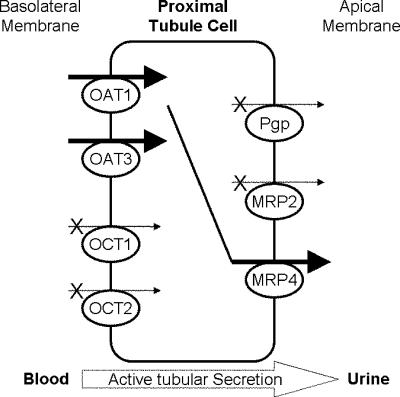
Mechanism of active tubular secretion of TFV. TFV is transported from the blood into proximal-tubule cells by the parallel action of basolateral transporters hOAT1 and hOAT3. Subsequently, TFV is effluxed from proximal-tubule cells into urine by the MRP4 efflux pump expressed on the apical membrane. Neither hOCT1, hOCT2, MRP2, nor Pgp is involved in active tubular secretion of TFV.

References

    1. Barditch-Crovo, P., S. G. Deeks, A. Collier, S. Safrin, D. F. Coakley, M. Miller, B. P. Kearney, R. L. Coleman, P. D. Lamy, J. O. Kahn, I. McGowan, and P. S. Lietman. 2001. Phase I/II trial of the pharmacokinetics, safety, and antiretroviral activity of tenofovir disoproxil fumarate in human immunodeficiency virus-infected adults. Antimicrob. Agents Chemother. 45:2733-2739. - PMC - PubMed
    1. Birkus, G., M. J. M. Hitchcock, and T. Cihlar. 2002. Assessment of mitochondrial toxicity in human cells treated with tenofovir: comparison with other nucleoside reverse transcriptase inhibitors. Antimicrob. Agents Chemother. 46:716-723. - PMC - PubMed
    1. Bonate, P. L., K. Reith, and S. Weir. 1998. Drug interactions at the renal level. Implications for drug development. Clin. Pharmacokinet. 34:375-404. - PubMed
    1. Chen, Z. S., K. Lee, S. Walther, R. B. Raftogianis, M. Kuwano, H. Zeng, and G. D. Kruh. 2002. Analysis of methotrexate and folate transport by multidrug resistance protein 4 (ABCC4): MRP4 is a component of the methotrexate efflux system. Cancer Res. 62:3144-3150. - PubMed
    1. Cihlar, T., G. Birkus, D. E. Greenwalt, and M. J. M. Hitchcock. 2002. Tenofovir exhibits low cytotoxicity in various human cell types: comparison with other nucleoside reverse transcriptase inhibitors. Antiviral Res. 54:37-45. - PubMed