Review
. 2006 Dec 15;577(Pt 3):769-77.
doi: 10.1113/jphysiol.2006.120584. Epub 2006 Sep 28.

Molecular system bioenergetics: regulation of substrate supply in response to heart energy demands

Affiliations
Review

Molecular system bioenergetics: regulation of substrate supply in response to heart energy demands

Valdur Saks et al. J Physiol. .

Abstract

This review re-evaluates regulatory aspects of substrate supply in heart. In aerobic heart, the preferred substrates are always free fatty acids, and workload-induced increase in their oxidation is observed at unchanged global levels of ATP, phosphocreatine and AMP. Here, we evaluate the mechanisms of regulation of substrate supply for mitochondrial respiration in muscle cells, and show that a system approach is useful also for revealing mechanisms of feedback signalling within the network of substrate oxidation and particularly for explaining the role of malonyl-CoA in regulation of fatty acid oxidation in cardiac muscle. This approach shows that a key regulator of fatty acid oxidation is the energy demand. Alterations in malonyl-CoA would not be the reason for, but rather the consequence of, the increased fatty acid oxidation at elevated workloads, when the level of acetyl-CoA decreases due to shifts in the kinetics of the Krebs cycle. This would make malonyl-CoA a feedback regulator that allows acyl-CoA entry into mitochondrial matrix space only when it is needed. Regulation of malonyl-CoA levels by AMPK does not seem to work as a master on-off switch, but rather as a modulator of fatty acid import.


Figures
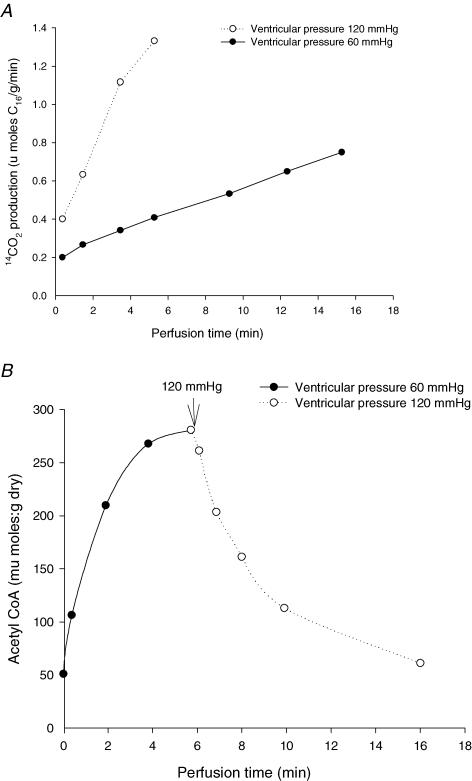
Figure 1
Figure 1. Workload-dependent increase of fatty acid oxidation and simultaneous decrease of acetyl-CoA in cardiac
A, increase of the 14CO2 production from [U-14C]palmitate in Langendorff-perfused isolated rat hearts with elevation of aortic perfusion pressure from 60 mmHg (continuous line) to 120 mmHg (dotted line). Hearts were perfused with a buffer containing 11 mm glucose, albumin (3%) and 1.4 mm[U-14C]palmitate. The oxygen consumption rate increased from 30 to 70 μmol min−1 gdw−1 after ventricular pressure development was increased as shown above. Data are taken from Oram et al. (1973). B, effect of ventricular pressure development on the tissue levels of acetyl-CoA in Langendorff-perfused isolated rat hearts. Hearts were perfused with buffer containing 11 mm glucose, albumin (3%) and 1.2 mm palmitate. After 6 min of perfusion with aortic perfusion pressure 60 mmHg (continuous line) the pressure was elevated to 120 mmHg (dotted line). Data are taken from Oram et al. (1973).
Figure 2
Figure 2. The scheme of substrate supply for mitochondrial respiration and the mechanisms of feedback regulation of fatty acid and glucose oxidation during workload elevation in oxidative muscle cells: central role of TCA cycle intermediates
FFAs are taken up by a family of plasma membrane proteins (fatty acid transporter protein (FATP1), fatty acid translocase (CD36)) and in cytoplasm associated with fatty acid binding protein (FABP). FFAs are esterified to acyl-CoA via fatty acyl-CoA synthetase. The resulting acyl-CoA is then transported through the inner membrane of the mitochondrion, via the exchange of CoA for carnitine by carnitine palmitolyltransferase I (CPT I). Acylcarnitine is then transported by carnitine acylcarnitine translocase into the mitochondrial matrix where a reverse exchange takes place through the action of carnitine palmitoyltransferae II (CPT II). Once inside the mitochondrion acyl-CoA is a substrate for the β-oxidation pathway, resulting in acetyl-CoA production. Each round of β-oxidation produces 1 molecule of NADH, 1 molecule of FADH2 and 1 molecule of acetyl-CoA. Acetyl-CoA enters the TCA cycle, where it is further oxidized to CO2 with the concomitant generation of 3 molecules of NADH, 1 molecule of FADH2 and 1 molecule of ATP. Acetyl-CoA, which is formed in the mitochondrial matrix, can be transferred into the cytoplasm with participation of carnitine, carnitine acetyltransferases and carnitine acetyltranslocase (carnitine acetylcarnitine carrier complex, CAC). Glucose (GLU) is taken up by glucose transporter-4 (GLUT-4) and enters the Embden-Meyerhof pathway, which converts glucose via a series of reactions into 2 molecules of pyruvate (PYR). As a result of these reactions, a small amount of ATP and NADH are produced. G6P – glucose 6-phosphate; HK – hexokinase; PFK – phosphofructokinase; GLY – glycogen; F1,6diP – fructose-1,6-bisphosphate; GAPDH – glyceralhehydephosphate dehydrogenase; 1,3DPG – 1,3 diphosphoglycerate. The redox potential of NADH is transferred into the mitochondrial matrix via the malate–aspartate shuttle. OAA – oxaloacetate; Glut – glutamate; αKG –α-ketoglutarate; ASP – aspartate. Malate generated in the cytosol enters the matrix in exchange for α-ketoglutarate (αKG) and can be used to produce matrix NADH. Matrix oxaloacetate (OAA) is returned to the cytosol by conversion to ASP and exchange with glutamate (Glut). Most of the metabolic energy derived from glucose can come from the entry of pyruvate into the Krebs cycle and oxidative phosphorylation via acetyl-CoA production. NADH and FADH2 are oxidized in the respiratory chain (complexes I, II, III and IV). These pathways occur under aerobic conditions. Under anaerobic conditions, pyruvate can be converted to lactate. Feedback regulation of substrate supply occurs in the following way. A glucose–fatty acid cycle (Randle hypothesis): if glucose and FFAs are both present, FFAs inhibit the transport of glucose across the plasma membrane, acyl-CoA oxidation increases the mitochondrial ratios of acetyl-CoA/CoA and of NADH/NAD+, which inhibit the pyruvate dehydrogenase (PDH) complex, and increased citrate (produced in the Krebs cycle) can inhibit phosphofructokinase (PFK). These changes would slow down oxidation of glucose and pyruvate (PYR) and increase glucose-6-phosphate (G6P), which would inhibit hexokinase (HK), and decrease glucose transport. The mitochondrial creatine kinase (miCK) catalyses the direct transphosphorylation of intramitochondrially produced ATP and cytosolic creatine (Cr) into ADP and phosphocreatine (PCr). ADP enters the matrix space to stimulate oxidative phosphorylation, while PCr is transferred via cytosolic Cr/PCr shuttle to be used by functional coupling of CK with ATPases (acto-myosin ATPase and ion pumps); If the workload increases, ATP production and respiration are increased due to feedback signalling via the creatine kinase (CK) system, leading to decreased mitochondrial content of acetyl-CoA, which is transferred into the cytoplasm with participation of carnitine acetyl carrier (CAC). Acetyl-CoA carboxylase (ACC) is responsible for converting acetyl-CoA to malonyl-CoA, a potent inhibitor of CPT I, with the aim to avoid overloading the mitochondria with fatty acid oxidation intermediates, when the workload is decreased. Inactivation of ACC occurs via phosphorylation catalysed by AMP-activated protein kinase (AMPK). Phosphorylation and inactivation of ACC leads to a decrease in the concentration of malonyl-CoA. A fall in malonyl-CoA levels disinhibits CPT I, resulting in increased fatty acid oxidation. Malonyl-CoA is also converted back into acetyl-CoA in the malonyl-CoA decarboxylase (MCD) reaction. Increase in the workload increases the rate of acetyl-CoA consumption and that automatically decreases the malonyl-CoA content. The ACC and MCD regulation occur under stress conditions when the AMP/ATP ratios are increased, but are unlikely to occour under normal work-load conditions of the heart. Thus, AMPK may be envisaged as a modulator, under situations of cellular stress, rather than as a master on–off switch of fatty acid oxidation.

References

    1. Assifi MM, Suchankova G, Constant S, Prentki M, Saha AK, Ruderman NB. AMP-activated protein kinase and coordination of hepatic fatty acid metabolism of starved/carbohydrate-refed rats. Am J Physiol Endocrinol Metab. 2005;289:E794–E800. - PubMed
    1. Balaban RS, Heineman FW. Interaction of oxidative phosphorylation and work in the heart in vivo. News Physiol Sci. 1989;4:215–218.
    1. Balaban RS, Kantor HL, Katz LA, Briggs RW. Relation between work and phosphate metabolites in the in vivo paced mammalian heart. Science. 1986;232:1121–1123. - PubMed
    1. Beauloye C, Marsin AS, Bertrand L, Vanoverschelde JL, Rider MH, Hue L. The stimulation of heart glycolysis by increased workload does not require AMP activated protein kinase but a wortmannin-sensitive mechanism. FEBS Lett. 2002;531:324–328. - PubMed
    1. Bing RJ. Cardiac metabolism. Physiol Rev. 1965;45:171–213. - PubMed

Publication types

LinkOut - more resources
