Mobilisation with movement and exercise, corticosteroid injection, or wait and see for tennis elbow: randomised trial
- PMID: 17012266
- PMCID: PMC1633771
- DOI: 10.1136/bmj.38961.584653.AE
Mobilisation with movement and exercise, corticosteroid injection, or wait and see for tennis elbow: randomised trial
Abstract
Objective: To investigate the efficacy of physiotherapy compared with a wait and see approach or corticosteroid injections over 52 weeks in tennis elbow.
Design: Single blind randomised controlled trial.
Setting: Community setting, Brisbane, Australia.
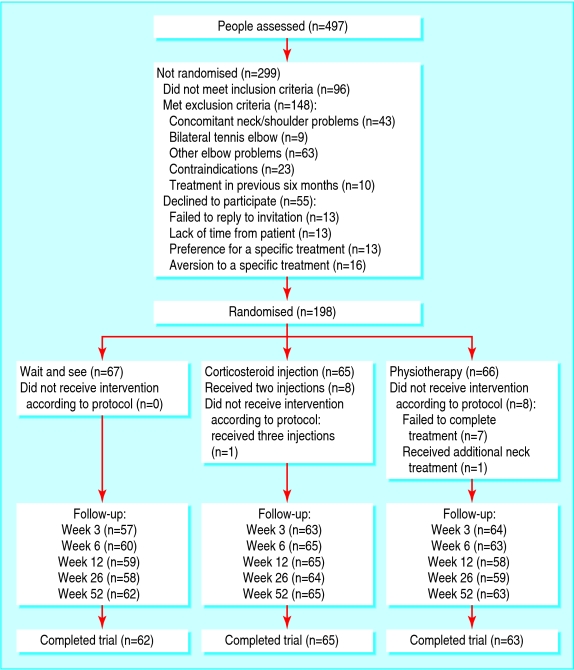
Participants: 198 participants aged 18 to 65 years with a clinical diagnosis of tennis elbow of a minimum six weeks' duration, who had not received any other active treatment by a health practitioner in the previous six months.
Interventions: Eight sessions of physiotherapy; corticosteroid injections; or wait and see.
Main outcome measures: Global improvement, grip force, and assessor's rating of severity measured at baseline, six weeks, and 52 weeks.
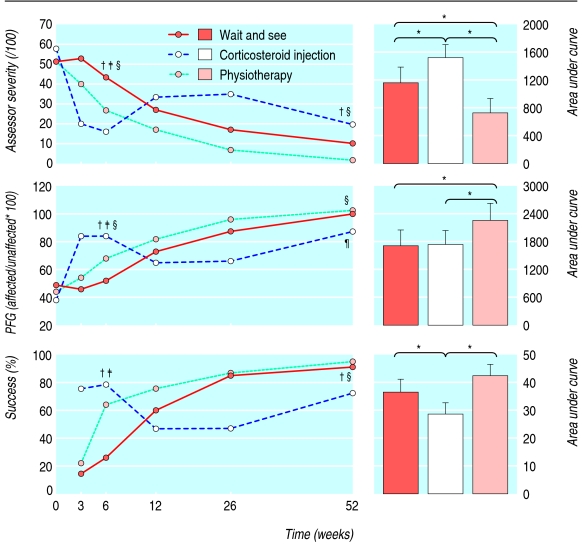
Results: Corticosteroid injection showed significantly better effects at six weeks but with high recurrence rates thereafter (47/65 of successes subsequently regressed) and significantly poorer outcomes in the long term compared with physiotherapy. Physiotherapy was superior to wait and see in the short term; no difference was seen at 52 weeks, when most participants in both groups reported a successful outcome. Participants who had physiotherapy sought less additional treatment, such as non-steroidal anti-inflammatory drugs, than did participants who had wait and see or injections.
Conclusion: Physiotherapy combining elbow manipulation and exercise has a superior benefit to wait and see in the first six weeks and to corticosteroid injections after six weeks, providing a reasonable alternative to injections in the mid to long term. The significant short term benefits of corticosteroid injection are paradoxically reversed after six weeks, with high recurrence rates, implying that this treatment should be used with caution in the management of tennis elbow.
Figures
Comment in
-
Tennis elbow in primary care.BMJ. 2006 Nov 4;333(7575):927-8. doi: 10.1136/bmj.39017.396389.BE. BMJ. 2006. PMID: 17082522 Free PMC article. No abstract available.
-
Physiotherapy interventions improve tennis elbow with superior long-term outcomes to corticosteroid injections.Aust J Physiother. 2007;53(1):61. doi: 10.1016/s0004-9514(07)70063-6. Aust J Physiother. 2007. PMID: 17326740 No abstract available.
-
Corticosteroid injections or physiotherapy were not more effective than wait and see for tennis elbow at 1 year.Evid Based Med. 2007 Apr;12(2):39. doi: 10.1136/ebm.12.2.39. Evid Based Med. 2007. PMID: 17400631 No abstract available.
-
Tennis elbow: injections, PT, or wait-and-see?J Fam Pract. 2007 Feb;56(2):98. J Fam Pract. 2007. PMID: 17607826 No abstract available.
-
Short- and long-term improvement in lateral epicondylitis.Clin J Sport Med. 2007 Nov;17(6):513-4. doi: 10.1097/JSM.0b013e31815bddd0. Clin J Sport Med. 2007. PMID: 17993800 No abstract available.
References
-
- Allander E. Prevalence, incidence and remission rates of some common rheumatic diseases or syndromes. Scand J Rheumatol 1974;3: 145-53. - PubMed
-
- Walker-Bone K, Palmer K, Reading I, Coggon D, Cooper C. Prevalence and impact of musculoskeletal disorders of the upper limb in the general population. Arthritis Rheum 2004;51: 642-51. - PubMed
-
- Chiang HC, Ko YC, Chen SS, Yu HS, Wu TN, Chang PY. Prevalence of shoulder and upper limb disorders among workers in the fish-processing industry. Scand J Work Environ Health 1993;19: 126-31. - PubMed
-
- Kurppa K, Viikari Juntura E, Kuosma E, Huuskonen M, Kivi P. Incidence of tenosynovitis or peritendinitis and epicondylitis in a meat-processing factory. Scand J Work Environ Health 1991;17: 32-7. - PubMed
Publication types
MeSH terms
Substances
LinkOut - more resources
Full Text Sources
Other Literature Sources
Medical