


Robust analysis of 5'-transcript ends (5'-RATE): a novel technique for transcriptome analysis and genome annotation
- PMID: 17012272
- PMCID: PMC1636456
- DOI: 10.1093/nar/gkl522
Robust analysis of 5'-transcript ends (5'-RATE): a novel technique for transcriptome analysis and genome annotation
Abstract
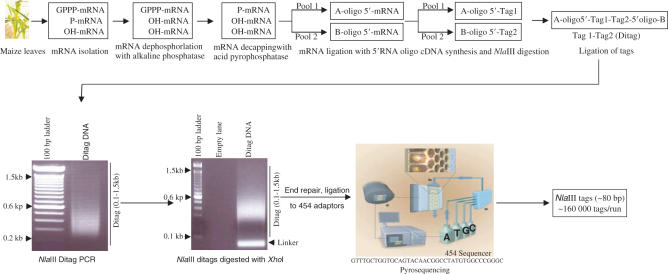
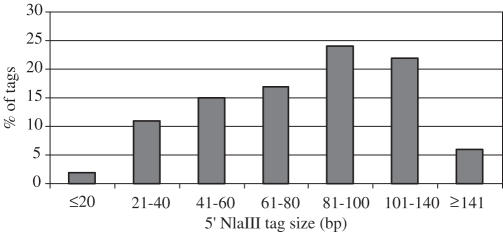
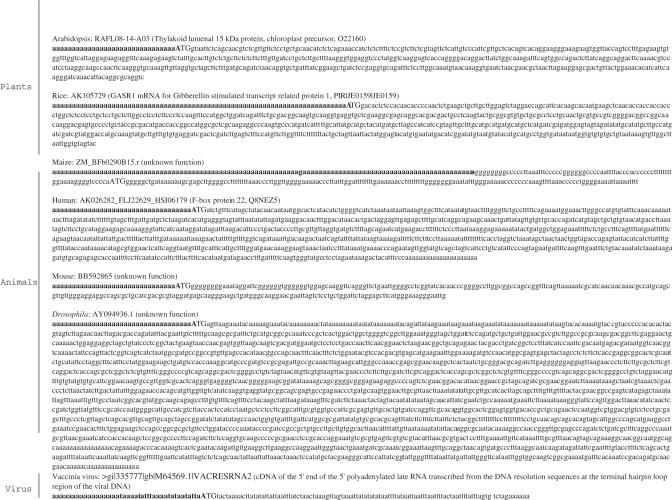
Complicated cloning procedures and the high cost of sequencing have inhibited the wide application of serial analysis of gene expression and massively parallel signature sequencing for genome-wide transcriptome profiling of complex genomes. Here we describe a new method called robust analysis of 5'-transcript ends (5'-RATE) for rapid and cost-effective isolation of long 5' transcript ends (approximately 80 bp). It consists of three major steps including 5'-oligocapping of mRNA, NlaIII tag and ditag generation, and pyrosequencing of NlaIII tags. Complicated steps, such as purification and cloning of concatemers, colony picking and plasmid DNA purification, are eliminated and the conventional Sanger sequencing method is replaced with the newly developed pyrosequencing method. Sequence analysis of a maize 5'-RATE library revealed complex alternative transcription start sites and a 5' poly(A) tail in maize transcripts. Our results demonstrate that 5'-RATE is a simple, fast and cost-effective method for transcriptome analysis and genome annotation of complex genomes.
Figures

References
-
- Adams M.D., Kerlavage A.R., Fleischmann R.D., Fuldner R.A., Bult C.J., Lee N.H., Kirkness E.F., Weinstock K.G., Gocayne J.D., White O., et al. Initial assessment of human gene diversity and expression patterns based upon 83 million nucleotides of cDNA sequence. Nature. 1995;377:3–174. - PubMed
-
- Seki M., Narusaka M., Kamiya A., Ishida J., Satou M., Sakurai T., Nakajima M., Enju A., Akiyama K., Oono Y., et al. Functional annotation of a full-length Arabidopsis cDNA collection. Science. 2002;296:141–145. - PubMed
-
- Kikuchi S., Satoh K., Nagata T., Kawagashira N., Doi K., Kishimoto N., Yazaki J., Ishikawa M., Yamada H., Ooka H., et al. Collection, mapping, and annotation of 28 000 full-length cDNA clones from Japonica rice. Science. 2003;301:376–379. - PubMed
-
- Velculescu V.E., Zhang L., Vogelstein B., Kinzler K.W. Serial analysis of gene expression. Science. 1995;270:484–487. - PubMed
Publication types
MeSH terms
Substances
LinkOut - more resources
Full Text Sources
Other Literature Sources
