


Are apes really inequity averse?
- PMID: 17015338
- PMCID: PMC1679898
- DOI: 10.1098/rspb.2006.3693
Are apes really inequity averse?
Abstract
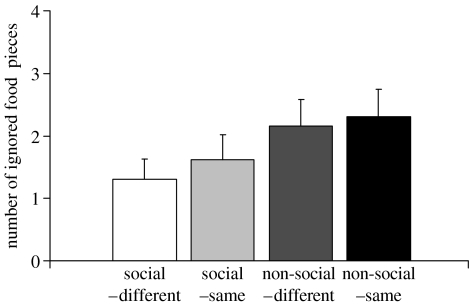
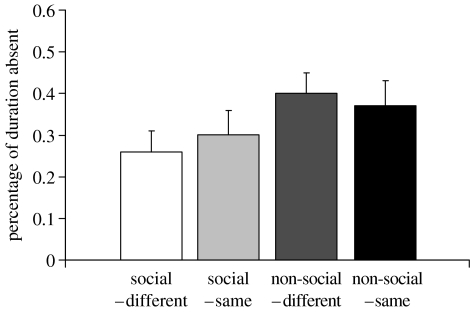
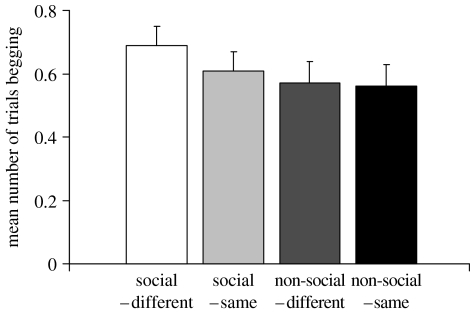
Brosnan et al. (Brosnan, S. F. Schiff, H. C. & de Waal, F. B. M. 2005 Tolerance for inequity may increase with social closeness in chimpanzees. Proc. R. Soc. B272, 253-258) found that chimpanzees showed increased levels of rejection for less-preferred food when competitors received better food than themselves and postulated as an explanation inequity aversion. In the present study, we extended these findings by adding important control conditions, and we investigated whether inequity aversion could also be found in the other great ape species and whether it would be influenced by subjects' relationship with the competitor. In the present study, subjects showed a pattern of food rejection opposite to the subjects of the above study by Brosnan et al. (2005). Our apes ignored fewer food pieces and stayed longer in front of the experimenter when a conspecific received better food than themselves. Moreover, chimpanzees begged more vigorously when the conspecific got favoured food. The most plausible explanation for these results is the food expectation hypothesis - seeing another individual receive high-quality food creates the expectation of receiving the same food oneself - and not inequity aversion.
Figures
References
-
- Addessi E, Visalberghi E. How social influences affect food neophobia in captive chimpanzees: a comparative approach. In: Matsuzawa T, Tomonaga M, Tanaka M, editors. Cognitive development in chimpanzees. Springer; Tokyo, Japan: 2006. pp. 246–264.
-
- Amsel A. Precis of frustration theory: an analysis of dispositional learning and memory. Psychonomic Bull. Rev. 1994;1:280–296. - PubMed
-
- Amsel A, Roussel J. Motivational properties of frustration. I. Effect on a running response of the addition of frustration to the motivational complex. J. Exp. Psychol. 1952;43:363–368. doi:10.1037/h0059393 - DOI - PubMed
-
- Brosnan S.F, de Waal F.B. Monkeys reject unequal pay. Nature. 2003;425:297–299. doi:10.1038/nature01963 - DOI - PubMed
-
- Brosnan S.F, de Waal F.B. Partial support from a nonreplication: comment on Roma, Silberberg, Ruggiero, and Suomi (2006) J. Comp. Psychol. 2006;120:74–75. doi:10.1037/0735-7036.120.1.74 - DOI - PubMed
MeSH terms
LinkOut - more resources
Full Text Sources
Research Materials
Miscellaneous
