. 2006 Dec 7;273(1604):2935-44.
doi: 10.1098/rspb.2006.3671.

Global phylogeographic limits of Hawaii's avian malaria

Affiliations

Global phylogeographic limits of Hawaii's avian malaria

Jon S Beadell et al. Proc Biol Sci. .

Abstract

The introduction of avian malaria (Plasmodium relictum) to Hawaii has provided a model system for studying the influence of exotic disease on naive host populations. Little is known, however, about the origin or the genetic variation of Hawaii's malaria and traditional classification methods have confounded attempts to place the parasite within a global ecological and evolutionary context. Using fragments of the parasite mitochondrial gene cytochrome b and the nuclear gene dihydrofolate reductase-thymidylate synthase obtained from a global survey of greater than 13000 avian samples, we show that Hawaii's avian malaria, which can cause high mortality and is a major limiting factor for many species of native passerines, represents just one of the numerous lineages composing the morphological parasite species. The single parasite lineage detected in Hawaii exhibits a broad host distribution worldwide and is dominant on several other remote oceanic islands, including Bermuda and Moorea, French Polynesia. The rarity of this lineage in the continental New World and the restriction of closely related lineages to the Old World suggest limitations to the transmission of reproductively isolated parasite groups within the morphological species.


Figures
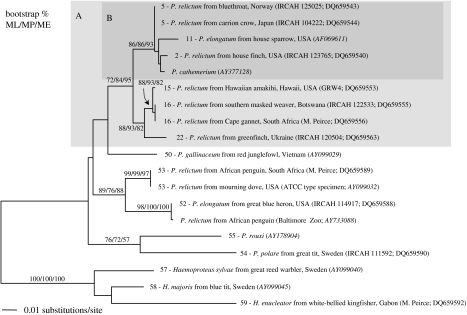
Figure 1
Figure 1
Phylogenetic relationships among morphologically identified species of Plasmodium estimated using ML, MP and ME with cyt b sequences. Numbers above branches indicate bootstrap support based on 1000 replicates. Numbers before species names correspond to mitochondrial lineage numbers in figure 3. Sequences were obtained directly from GenBank (accession number in italics) or from extracts of blood smears obtained from IRCAH and M. Peirce.
Figure 2
Figure 2
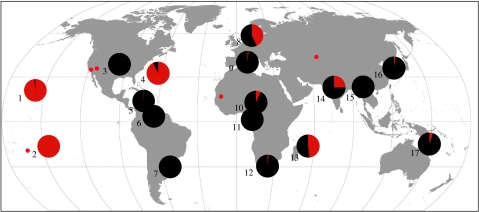
Map depicting the global distribution of the single mitochondrial lineage of malaria parasite (GRW4) found in resident Hawaiian passerines. Pie charts indicate the proportion of all sequenced Plasmodium infections in a given region that were identical to GRW4 (red). Details concerning locations and sampling effort are in table 1. Red dots indicate additional locations in which GRW4 has been reported previously (Schrenzel et al. 2003; Mendes et al. 2005; Ishtiaq et al. 2006; M. Kimura, personal communication) or in which GRW4 was recovered from a relatively small group of samples (Kazakhstan).
Figure 3
Figure 3
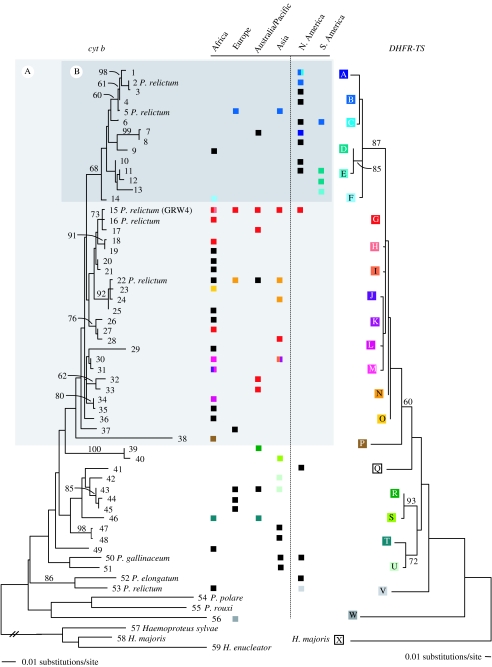
Phylogenetic trees of parasite mitochondrial lineages (cyt b; left; numbered) and associated nuclear haplotypes (DHFR-TS; right; lettered), constructed using maximum likelihood (GTR+I+G for both markers). The distribution of mitochondrial lineages across global regions is indicated with squares, colour-coded to help identify the associated DHFR-TS sequence (when available, otherwise black). Background shading reflects the limits of two clades with good support in analysis of combined data (figure 4). Mitochondrial lineages which derived from at least one parasite identified as P. relictum by morphology are indicated on the left. Bootstrap support values (greater than or equal to 60) are indicated above branches.
Figure 4
Figure 4
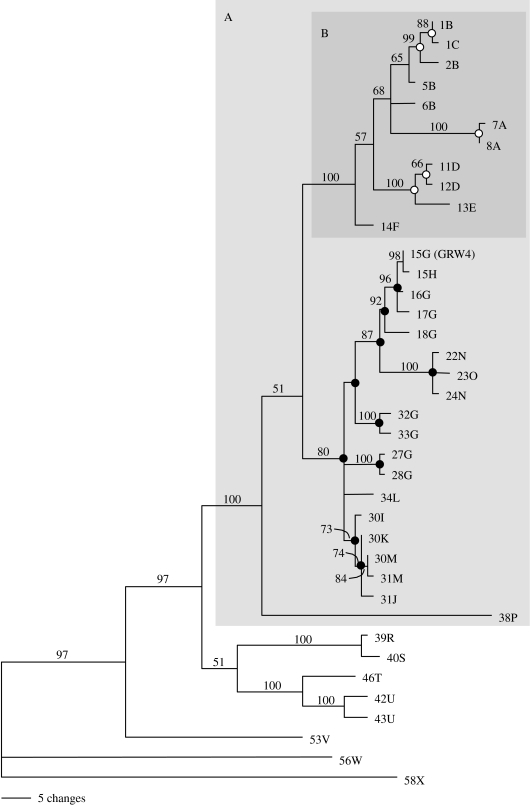
Majority rule consensus tree of avian malaria parasite lineages generated by Bayesian analysis of combined mitochondrial (cyt b) and nuclear (DHFR-TS) sequence. Parasite genotypes are identified by their respective cyt b lineage (number) and DHFR-TS haplotype (letter), which are depicted separately in figure 3. Clade credibility values are indicated above branches. Background shading identifies two well-supported clades (A and B) referenced in the text. Dots within clade A indicate nodes for which New World (open circle) or non-New World (black) origin could be confidently assigned based on ancestral trait reconstruction performed with Mesquite.
Figure 5
Figure 5
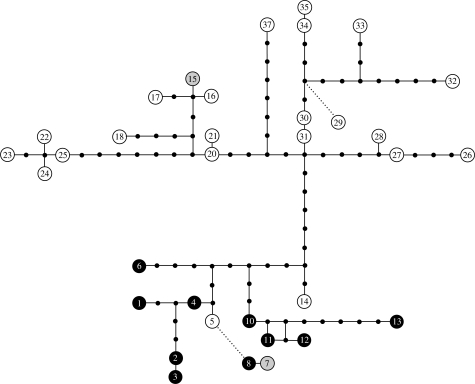
Statistical parsimony network of Plasmodium mitochondrial lineages related to the Hawaiian strain (lineage 15). Sampled haplotypes are numbered as in figure 3 and inferred haplotypes are indicated by black dots. Shading indicates whether the lineage was detected in the Old World (white), New World (black) or in both regions (grey). Lineages 9, 19 and 36 were not included due to missing sequence. Lineages 7, 8 and 29 were joined at the 90% connection limit (13 substitutions).

References

    1. Atkinson C.T, Woods K.L, Dusek R.J, Sileo L.S, Iko W.M. Wildlife disease and conservation in Hawaii: pathogenicity of avian malaria (Plasmodium relictum) in experimentally infected iiwi (Vestiaria coccinea) Parasitology. 1995;111:S59–S69. - PubMed
    1. Beadell J, Fleischer R. A restriction enzyme-based assay to distinguish between avian hemosporidians. J. Parasitol. 2005;91:683–685. doi:10.1645/GE-3412RN - DOI - PubMed
    1. Beadell J.S, Gering E, Austin J, Dumbacher J.P, Peirce M, Pratt T.K, Atkinson C.T, Fleischer R.C. Prevalence and differential host-specificity of two avian blood parasite genera in the Australo-Papuan region. Mol. Ecol. 2004;13:3829–3844. doi:10.1111/j.1365-294X.2004.02363.x - DOI - PubMed
    1. Bennett G.F, Bishop M.A, Peirce M.A. Checklist of the avian species of Plasmodium Marchiafava & Celli, 1885 (Apicomplexa) and their distribution by avian family and Wallacean life zones. Syst. Parasitol. 1993;26:171–179. doi:10.1007/BF00009724 - DOI
    1. Bensch S, Stjernman M, Hasselquist D, Ostman O, Hansson B, Westerdahl H, Pinheiro R.T. Host specificity in avian blood parasites: a study of Plasmodium and Haemoproteus mitochondrial DNA amplified from birds. Proc. R. Soc. B. 2000;267:1583–1589. doi:10.1098/rspb.2000.1181 - DOI - PMC - PubMed

Publication types

Substances