. 2006 Nov;149(6):775-85.
doi: 10.1038/sj.bjp.0706925. Epub 2006 Oct 3.

Sensitivity of glycogen phosphorylase isoforms to indole site inhibitors is markedly dependent on the activation state of the enzyme

Affiliations

Sensitivity of glycogen phosphorylase isoforms to indole site inhibitors is markedly dependent on the activation state of the enzyme

S Freeman et al. Br J Pharmacol. 2006 Nov.

Abstract

Background and purpose: Inhibition of hepatic glycogen phosphorylase is a potential treatment for glycaemic control in type 2 diabetes. Selective inhibition of the liver phosphorylase isoform could minimize adverse effects in other tissues. We investigated the potential selectivity of two indole site phosphorylase inhibitors, GPi688 and GPi819.

Experimental approach: The activity of glycogen phosphorylase was modulated using the allosteric effectors glucose or caffeine to promote the less active T state, and AMP to promote the more active R state. In vitro potency of indole site inhibitors against liver and muscle glycogen phosphorylase a was examined at different effector concentrations using purified recombinant enzymes. The potency of GPi819 was compared with its in vivo efficacy at raising glycogen concentrations in liver and muscle of Zucker (fa/fa) rats.

Key results: In vitro potency of indole site inhibitors depended upon the activity state of phosphorylase a. Both inhibitors showed selectivity for liver phosphorylase a when the isoform specific activities were equal. After 5 days dosing of GPi819 (37.5 micromol kg(-1)), where free compound levels in plasma and tissue were at steady state, glycogen elevation was 1.5-fold greater in soleus muscle than in liver (P < 0.05).

Conclusions and implications: The in vivo selectivity of GPi819 did not match that seen in vitro when the specific activities of phosphorylase a isoforms are equal. This suggests T state promoters may be important physiological regulators in skeletal muscle. The greater efficacy of indole site inhibitors in skeletal muscle has implications for the overall safety profile of such drugs.


Figures
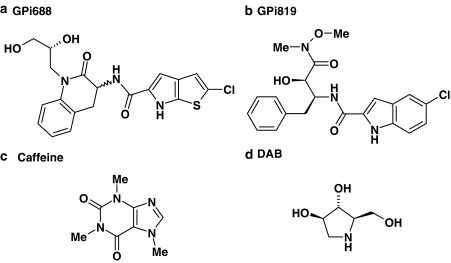
Figure 1
Figure 1
(a) GPi688 (2-chloro-N-{1-[(2R)-2,3-dihydroxypropyl]-(3R/S)-2-oxo-1,2,3,4-tetrahydroquinolin-3-yl}-6H-thieno[2,3-b]pyrrole-5-carboxamide); (b) GPi819 (N-{(1S,2R)-1-benzyl-2-hydroxy-3-[methoxy(methyl)amino]-3-oxopropyl}-5-chloro-1H-indole-2-carboxamide); (c) caffeine; (d) DAB.
Figure 2
Figure 2
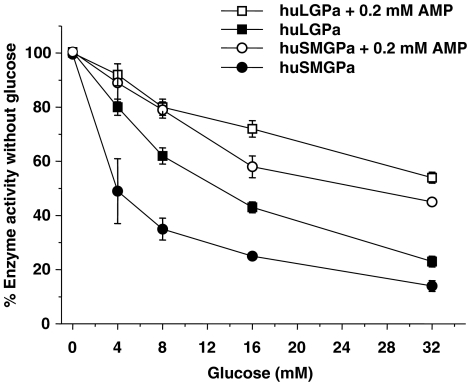
Glucose inhibited liver (huLGPa) and skeletal muscle (huSMGPa) phosphorylase a in a concentration-dependent manner. Phosphorylase activities were determined from the change in fluorescence in the conversion of NAD+ to NADH at 0, 4, 8, 16 and 32 mM glucose in the presence and absence of 0.2 mM AMP. Note that in the absence of glucose, the specific activities for each isoform in the presence or absence of AMP were different. Values are arithmetic mean and s.e.mean from at least three independent experiments.
Figure 3
Figure 3
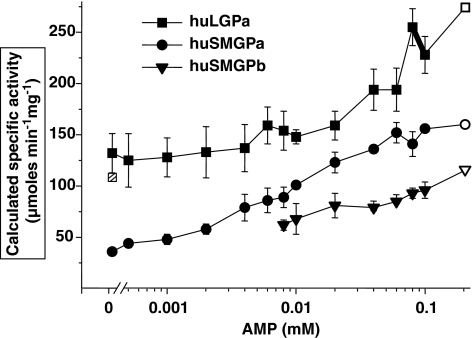
AMP increased activity of phosphorylated skeletal muscle (huSMGPa), dephosphorylated skeletal muscle (huSMGPb) and phosphorylated liver (huLGPa) glycogen phosphorylase. Glucose was present at 8 mM with liver phosphorylase and 15 mM with muscle phosphorylase. Activities were measured as described previously for glucose inhibition. Activity is expressed as calculated specific activity from specific activity measured at 0.2 mM AMP. The measured specific activities at 0.2 mM AMP for each enzyme are shown in the figure with open symbols and were 167±11, 116±9 and 274±12, μmol min−1 mg−1 for skeletal muscle phosphorylase a, skeletal muscle phosphorylase b and liver phosphorylase a, respectively. The calculated specific activity for liver phosphorylase a without AMP was 132±32 μmol, which agreed with the measured specific activity of 109±16 μmol min−1 mg−1. The measured value is shown in the figure with the hatched box. Values are mean and s.e.mean from three independent experiments.
Figure 4
Figure 4
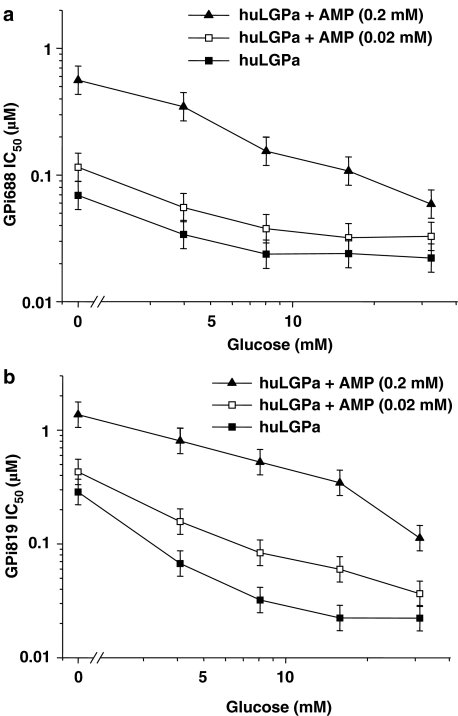
The IC50 for indole site inhibitors (a) GPi688 and (b) GPi819 decreased with glucose against phosphorylated liver phosphorylase (huLGPa) in the absence and presence of AMP. Glucose was present at 8 mM with liver phosphorylase a. The figure shows the geometric mean and LSD bars for at least three separate IC50 determinations.
Figure 5
Figure 5
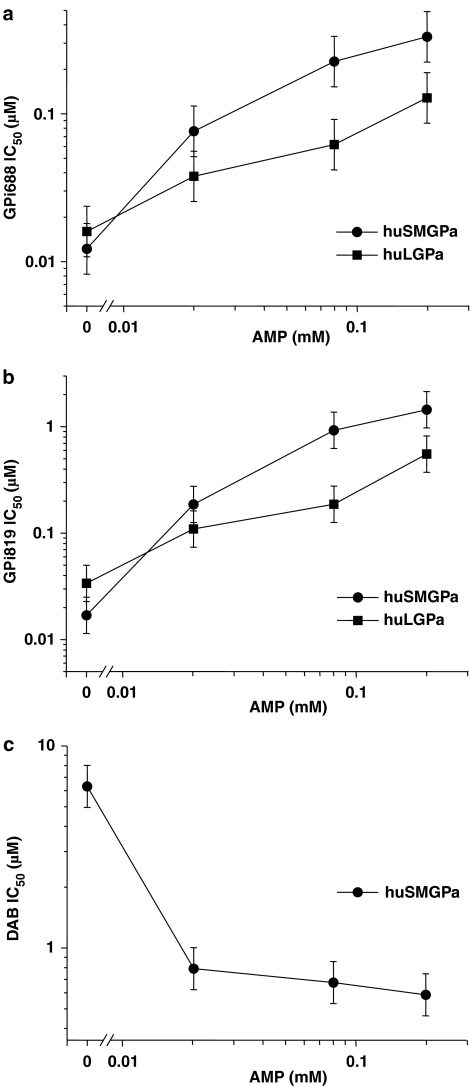
AMP reduced the potency of (a) GPi688 and (b) GPi819 against liver (huLGPa) and skeletal muscle phosphorylase a (huSMGPa), but increased the potency of (c) DAB against skeletal muscle phosphorylase a (huSMGPa). Glucose was present at 8 mM with liver phosphorylase a and 15 mM with muscle phosphorylase a. The figure shows the geometric mean and LSD bars for at least three separate IC50 determinations.
Figure 6
Figure 6
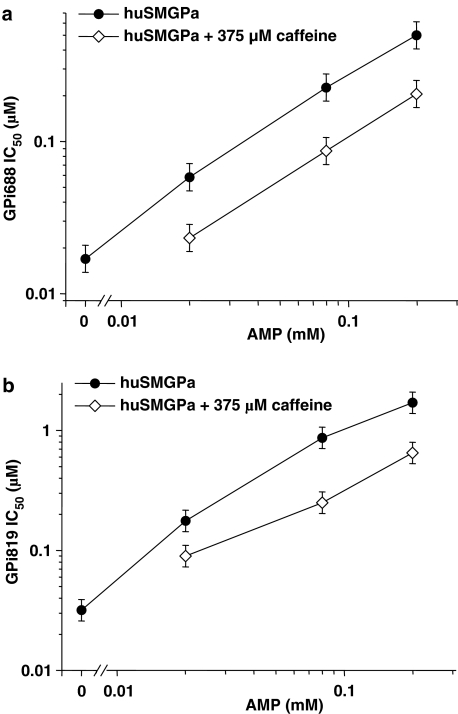
Effect of caffeine (375 μM) on the potency of (a) GPi688 and (b) GPi819 against skeletal muscle phosphorylase a (huSMGPa) in the presence of increasing AMP and 15 mM glucose. The figure shows the geometric mean and LSD bars for at least three separate IC50 determinations.
Figure 7
Figure 7
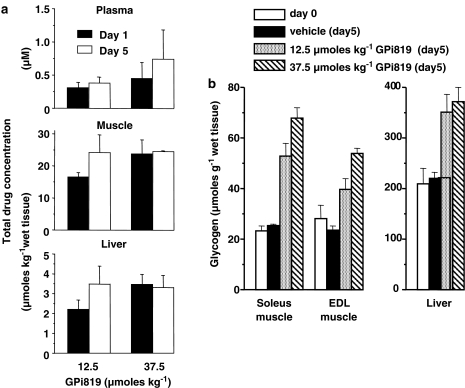
In vivo efficacy of GPi819 on skeletal muscle and liver glycogen content in Zucker (fa/fa) rats. (a) Total compound concentration in plasma, muscle and liver at the dose interval on days 1 and 5 of treatment. (b) Glycogen content in liver and muscle tissue before treatment at day 0, and after 5 days oral treatment with vehicle (0.25% polyvinyl pyrrolidine/0.05% sodium dodecyl sulphate) alone, or with vehicle+GPi819 at 12.5 or 37.5 μmol kg−1. Animals were housed in pairs on a 12:12 h light cycle with free access to water and breeding diet. Animals were gavaged for 3 days with vehicle (5 ml kg−1), followed by 5 days treatment with vehicle±GPi819. The values shown are mean±s.e.mean (n=4).

References

    1. Arabadjis PG, Tullson PC, Terjung RL. Purine nucleoside formation in rat skeletal muscle fiber types. Am J Physiol Cell Physiol. 1993;264:C1246–C1251. - PubMed
    1. AstraZeneca Heterocyclic amide derivatives as inhibitors of glycogen phosphorylase World Intellectual Property Organisation 2003. WO 03/074532 A1
    1. Baker DJ, Timmons JA, Greenhaff PL. Glycogen phosphorylase inhibition in type 2 diabetes therapy. A systematic evaluation of metabolic and functional effects in rat skeletal muscle. Diabetes. 2005;54:2453–2459. - PubMed
    1. Bradford MM. A rapid and sensitive method for the quantitation of microgram quantities of protein utilizing the principle of protein–dye binding. Anal Biochem. 1976;72:248–254. - PubMed
    1. Buchbinder JL, Rath VL, Fletterick RJ. Structural relationships among regulated and unregulated phosphorylases. Annu Rev Biophy Biomol Struct. 2001;30:191–209. - PubMed

MeSH terms