Effect of physical inactivity on the oxidation of saturated and monounsaturated dietary Fatty acids: results of a randomized trial
- PMID: 17016547
- PMCID: PMC1584255
- DOI: 10.1371/journal.pctr.0010027
Effect of physical inactivity on the oxidation of saturated and monounsaturated dietary Fatty acids: results of a randomized trial
Abstract
Objectives: Changes in the way dietary fat is metabolized can be considered causative in obesity. The role of sedentary behavior in this defect has not been determined. We hypothesized that physical inactivity partitions dietary fats toward storage and that a resistance exercise training program mitigates storage.
Design: We used bed rest, with randomization to resistance training, as a model of physical inactivity.
Setting: The trial took place at the Space Clinic (Toulouse, France).
Participants: A total of 18 healthy male volunteers, of mean age +/- standard deviation 32.6 +/- 4.0 y and body mass index 23.6 +/- 0.7 kg/m(2), were enrolled.
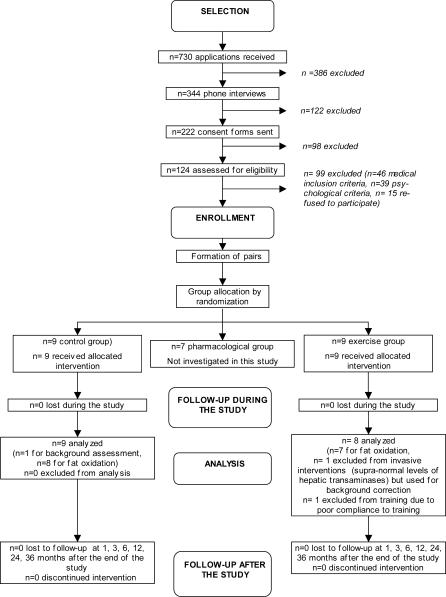
Interventions: An initial 15 d of baseline data collection were followed by 3 mo of strict bed-rest alone (control group, n = 9) or with the addition of supine resistance exercise training every 3 d (exercise group, n = 9).
Outcome measures: Oxidation of labeled [d(31)]palmitate (the main saturated fatty acid of human diet) and [1-(13)C]oleate (the main monounsaturated fatty acid), body composition, net substrate use, and plasma hormones and metabolites were measured.
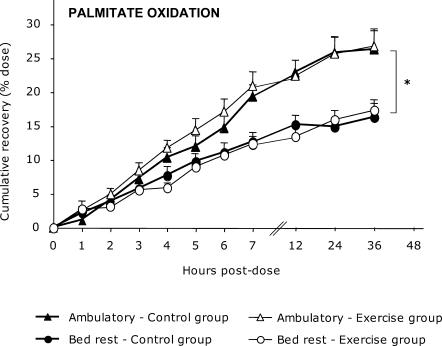
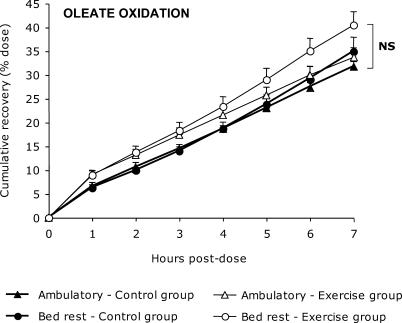
Results: Between-group comparisons showed that exercise training did not affect oxidation of both oleate (mean difference 5.6%; 95% confidence interval [95% CI], -3.3% to 14.5%; p = 0.20) and palmitate (mean difference -0.2%; 95% CI, -4.1% to 3.6%; p = 0.89). Within-group comparisons, however, showed that inactivity changed oxidation of palmitate in the control group by -11.0% (95% CI, -19.0% to -2.9%; p = 0.01) and in the exercise group by -11.3% (95% CI, -18.4% to -4.2%; p = 0.008). In contrast, bed rest did not significantly affect oleate oxidation within groups. In the control group, the mean difference in oleate oxidation was 3.2% (95% CI, -4.2% to 10.5%; p = 0.34) and 6.8% (95% CI, -1.2% to 14.7%; p = 0.08) in the exercise group.
Conclusions: Independent of changes in energy balance (intake and/or output), physical inactivity decreased the oxidation of saturated but not monounsaturated dietary fat. The effect is apparently not compensated by resistance exercise training. These results suggest that Mediterranean diets should be recommended in sedentary subjects and recumbent patients.
Conflict of interest statement
Figures
References
-
- Stein CJ, Colditz GA. The epidemic of obesity. J Clin Endocrinol Metab. 2004;89:2522–2525. - PubMed
-
- Binnert C, Pachiaudi C, Beylot M, Hans D, Vandermander J, et al. Influence of human obesity on the metabolic fate of dietary long- and medium-chain triacylglycerols. Am J Clin Nutr. 1998;67:595–601. - PubMed
-
- Faraj M, Jones P, Sniderman AD, Cianflone K. Enhanced dietary fat clearance in postobese women. J Lipid Res. 2001;42:571–580. - PubMed
-
- Bessesen DH, Rupp CL, Eckel RH. Dietary fat is shunted away from oxidation, toward storage in obese Zucker rats. Obes Res. 1995;3:179–189. - PubMed
-
- Egger GJ, Vogels N, Westerterp KR. Estimating historical changes in physical activity levels. Med J Aust. 2001;175:635–636. - PubMed
Grants and funding
LinkOut - more resources
Full Text Sources