. 2006;34(19):5498-507.
doi: 10.1093/nar/gkl709. Epub 2006 Oct 4.

Identification of multiple transcription initiation, polyadenylation, and splice sites in the Drosophila melanogaster TART family of telomeric retrotransposons

Affiliations

Identification of multiple transcription initiation, polyadenylation, and splice sites in the Drosophila melanogaster TART family of telomeric retrotransposons

Patrick H Maxwell et al. Nucleic Acids Res. 2006.

Abstract

The Drosophila non-long terminal repeat (non-LTR) retrotransposons TART and HeT-A specifically retrotranspose to chromosome ends to maintain Drosophila telomeric DNA. Relatively little is known, though, about the regulation of their expression and their retrotransposition to telomeres. We have used rapid amplification of cDNA ends (RACE) to identify multiple transcription initiation and polyadenylation sites for sense and antisense transcripts of three subfamilies of TART elements in Drosophila melanogaster. These results are consistent with the production of an array of TART transcripts. In contrast to other Drosophila non-LTR elements, a major initiation site for sense transcripts was mapped near the 3' end of the TART 5'-untranslated region (5'-UTR), rather than at the start of the 5'-UTR. A sequence overlapping this sense start site contains a good match to an initiator consensus for the transcription start sites of Drosophila LTR retrotransposons. Interestingly, analysis of 5' RACE products for antisense transcripts and the GenBank EST database revealed that TART antisense transcripts contain multiple introns. Our results highlight differences between transcription of TART and of other Drosophila non-LTR elements and they provide a foundation for testing the relationship between exceptional aspects of TART transcription and TART's specialized role at telomeres.


Figures
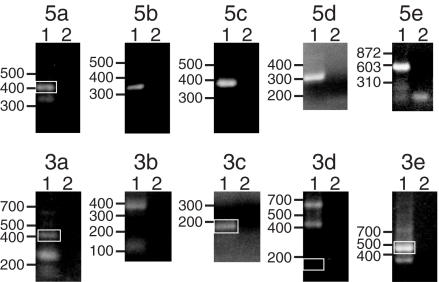
Figure 1
Figure 1
Representative 5′ and 3′ RACE reactions. Each panel is an ethidium bromide stained agarose gel of RACE reactions. Above each panel is a 5′ end or 3′ end designation (5a–5e or 3a–3e, respectively) used for discussion purposes. Lanes 1 and 2 are the experimental and control lanes, respectively. The sources of RNA for the reactions shown were Oregon-R adults (5a, 5c, 5d, 3c, 3d and 3e), S2 cells (5b and 3b), Mk-G(II)12 adults (5e) or Mk-G(II)12 third instar larvae (3a). The TART primers used for the reactions shown were as follows (both outer and inner primers are listed for reactions in which two rounds of PCR with nested primers were used): 5a: TR1 + TR2; 5b: TR6 + TR7; 5c: TCR1 + TCR2; 5d: TAB1; 5e: ADR1 + ADR2; 3a: TA53 + TA54; 3b: TA51 + TA52; 3c: TA3; 3d: TR8 + TR9; and 3e: TA31. White boxes indicate products (which in some cases are very faint) that either corresponded to the major 5′ end used for sequence comparisons (5a) or that met our criteria for representing polyadenylation sites (3a, 3c, 3d and 3e), as determined by sequencing of cloned products (see Materials and Methods). The migration of DNA standards (in bp) is indicated to the left of each panel.
Figure 2
Figure 2
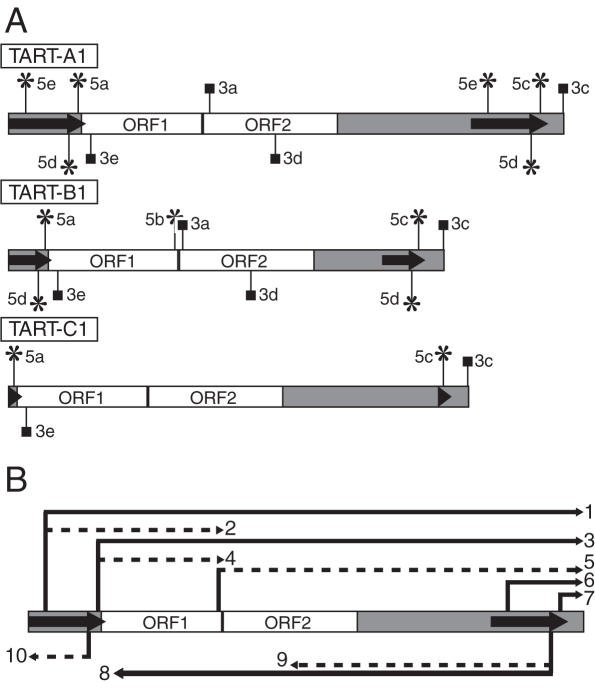
Relative positions of the 5′ and 3′ ends suggested by RACE analysis and a putative transcript array for TART. Schematic representations of the positions of 5′ and 3′ ends and a putative array of TART transcripts are shown. TART ORFs are indicated by white boxes, the UTRs are indicated by gray regions and the direct repeats are indicated by arrows. The relative lengths of the UTRs correspond to those of TART-A1, -B1 and -C1, but the lengths of UTR sequences vary for other members of each subfamily. (A) Vertical lines ending in asterisks or squares indicate 5′ and 3′ ends, respectively. Each end is distinguished using designations introduced in Figure 1 that appear to the left or right of each vertical line. Those ends drawn above each element correspond to sense transcripts and those drawn below to antisense transcripts. Note that in a few cases a particular end was only identified for one of the three subfamilies (see text). (B) A generic TART element is diagrammed. Arrows above and below the element correspond to potential sense and antisense transcripts, respectively, that could be produced if all the ends shown in (A) are considered. Solid lines represent transcripts supported by previous northern blots of TART transcripts (19) and dotted lines represent transcripts not clearly supported by those same northern blots. Each transcript is numbered at its 3′ end for discussion purposes (see Discussion).
Figure 3
Figure 3
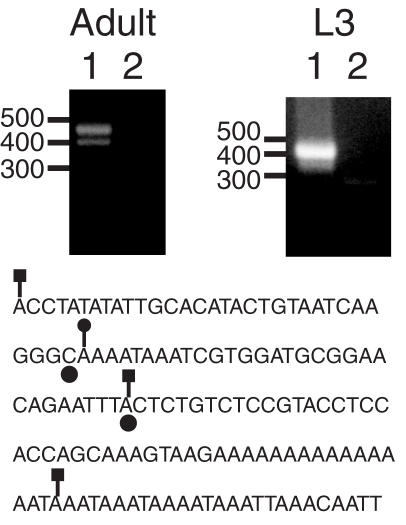
5′ RACE confirms the location of transcription intiation in HeT-A. The two panels show ethidium bromide stained agarose gels of 5′ RACE reactions using the HeT-A outer and inner primers HR1 and HR2. The sources of RNA were Oregon-R adults or third instar larvae, as indicated. Lanes 1 and 2 correspond to the experimental and control lanes, respectively. The migration of DNA standards (in bp) is indicated to the left of each panel. Below the panels is a sequence corresponding to the largest cloned RACE product obtained from adult RNA. Positions 1–92 and 111–137 are 91/92 and 27/27 matches, respectively, to positions 6999–7090 and 7136–7162 in HeT-A 23Zn (accession no. U06920). Filled circles below two bases indicate the previously identified transcription initiation sites (18). Lines ending in squares indicate the sites corresponding to three RACE products obtained from adult RNA and a line ending in a circle indicates the site corresponding to the major RACE product from L3 RNA.
Figure 4
Figure 4
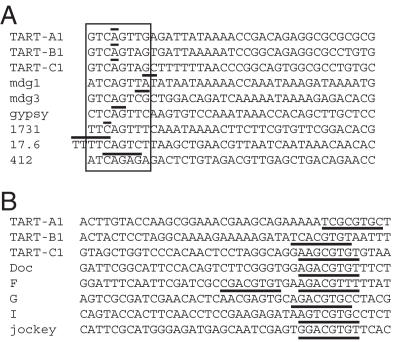
Alignment of TART transcription initiation sites with initiation sites of other Drosophila retrotransposons. (A) The 5a end of each TART subfamily is aligned with the 5′ start sites of several D.melanogaster LTR retrotransposons. An 8 nt sequence that is a close match to a consensus D.melanogaster initiator sequence, A/G/T-T-C-A-G/T-T-C/T-G (27), is boxed in all of the sequences. Experimentally determined transcription initiation sites are indicated with horizontal lines above one or more bases; for the TART sequences only the most common start site is indicated (bold positions in Table 2). Each sequence begins with the initiator consensus or the transcription initiation site. References for these sites are: mdg1, mdg3 and gyspy (40), 1731 (41), 17.6 (42) and 412 (43). (B) The 5d end of each TART subfamily is aligned with the 5′ start sites of several D.melanogaster non-LTR retrotransposons. Each alignment begins with the transcription initiation site. The corresponding sites for TART-A1, -B1 and -C1 are 12 645, 9749 and 10 133, respectively and the sequences shown are the antisense strand. As described in the text, the start site for TART-C1 end 5d was taken from an EST sequence in the GenBank database. Underlined sequences match an extended version of a downstream promoter element (13,17,44). References for the other non-LTRs are: Doc (13), F (10), G (17,45), I (11) and jockey (8).
Figure 5
Figure 5
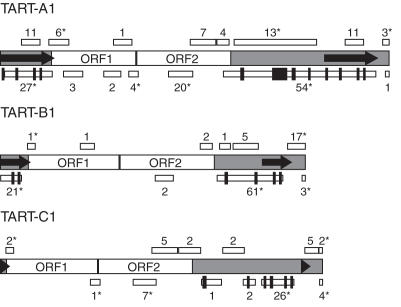
Regions of TART sequence represented in the GenBank EST database and positions of antisense introns. TART elements are drawn as in previous figures and each drawing is to scale. White boxes above and below each drawing indicate regions of TART sense and antisense sequences, respectively represented in the EST database (note that some boxes are so small that they appear as vertical lines). A number near each box is the number of ESTs with sequences corresponding to the given region of TART. ESTs containing only direct repeat sequences were included in the totals for both the 5′ and 3′ direct repeat regions. Asterisks indicate that the number of ESTs listed includes one or more ESTs that contained sequences from non-contiguous segments of TART and that were counted as representing each of those non-contiguous segments. Black boxes (some of which look like vertical lines) that are taller than the white boxes mark the positions of intron sequences not present in many of the ESTs corresponding to antisense transcripts.

References

    1. Biessmann H., Mason J.M. The unusual telomeres of Drosophila. Trends Genet. 1995;11:58–62. - PubMed
    1. Pardue M.L., DeBaryshe P.G. Retrotransposons provide an evolutionarily robust non-telomerase mechanism to maintain telomeres. Annu. Rev. Genet. 2003;37:485–511. - PubMed
    1. Levis R.W., Ganesan R., Houtchens K., Tolar L.A., Sheen F.M. Transposons in place of telomeric repeats at a Drosophila telomere. Cell. 1993;75:1083–1093. - PubMed
    1. McEachern M.J., Krauskopf A., Blackburn E.H. Telomeres and their control. Annu. Rev. Genet. 2000;34:331–358. - PubMed
    1. Abad J.P., De Pablos B., Osoegawa K., De Jong P.J., Martin-Gallardo A., Villasante A. TAHRE, a novel telomeric retrotransposon from Drosophila melanogaster, reveals the origin of Drosophila telomeres. Mol. Biol. Evol. 2004;21:1620–1624. - PubMed

Publication types

Associated data