Comparative Study
. 2006 Dec;80(24):12171-86.
doi: 10.1128/JVI.00990-06. Epub 2006 Oct 4.

Kaposi's sarcoma-associated herpesvirus ori-Lyt-dependent DNA replication: dual role of replication and transcription activator

Affiliations
Comparative Study

Kaposi's sarcoma-associated herpesvirus ori-Lyt-dependent DNA replication: dual role of replication and transcription activator

Yan Wang et al. J Virol. 2006 Dec.

Abstract

Lytic replication of Kaposi's sarcoma-associated herpesvirus (KSHV) is essential for viral propagation and pathogenicity. In Kaposi's sarcoma lesions, constant lytic replication plays a role in sustaining the population of latently infected cells that otherwise are quickly lost by segregation of latent viral episomes as spindle cells divide. Lytic DNA replication initiates from an origin (ori-Lyt) and requires trans-acting elements. Two functional ori-Lyts have been identified in the KSHV genome. Some cis-acting and trans-acting elements for ori-Lyt-dependent DNA replication have been found. Among these, K8 binding sites, a cluster of C/EBP binding motifs, and a replication and transcription activator (RTA) responsive element (RRE) are crucial cis-acting elements. Binding of K8 and RTA proteins to these motifs in ori-Lyt DNA was demonstrated to be absolutely essential for DNA replication. In the present study, functional roles of RTA in ori-Lyt-dependent DNA replication have been investigated. Two distinct functions of RTA were revealed. First, RTA activates an ori-Lyt promoter and initiates transcription across GC-rich tandem repeats. This RTA-mediated transcription is indispensable for DNA replication. Second, RTA is a component of the replication compartment, where RTA interacts with prereplication complexes composed of at least six core machinery proteins and K8. The prereplication complexes are recruited to ori-Lyt DNA through RTA, which interacts with the RRE, as well as K8, which binds to a cluster of C/EBP binding motifs with the aid of C/EBP alpha. The revelation of these two functions of RTA, together with its role in initiation of a transcriptional cascade that leads to transcription of all viral lytic genes, shows that RTA is a critical initiator and regulator of KSHV lytic DNA replication and viral propagation.


Figures

FIG. 1.
FIG. 1.
Effect of premature termination of ori-Lyt-associated transcription on ori-Lyt-dependent DNA replication. (A) Schematic diagram of the constructs in which the SV40 late polyadenylation sequence was inserted at different locations in pOri-A plasmid. (B) Transcription from ori-Lyt in pOri-A and its derivatives, as indicated, was examined by Northern analysis. In addition to the polyadenylation signal insertion mutants, pOri-Δ15.7 and pOri-Δ16.2, in which the RRE and the TATA box in ori-Lyt have been deleted, respectively (31), are included in the experiment as negative controls. pOri-ΔTR and pOri-mTR are derivatives of pOri-A in which the GC-rich tandem repeats have been deleted or replaced with an irrelevant sequence, respectively. Total RNAs were isolated from transfected cells, separated on a 1.0% agarose-formaldehyde gel, and transferred onto a Nytran membrane. The membrane was probed with 32P-labeled GC-rich tandem repeat sequence. (C) The abilities of these constructs and their parental wild-type plasmid, pOri-A, to mediate DNA replication were tested in BCBL-1 cells by using a transient replication assay as described in Materials and Methods. KSHV lytic replication is induced by expression of RTA. Extrachromosomal DNAs were prepared using the Hirt extraction method and used for the assay. DpnI-resistant products of DNA replication were detected by Southern blotting with 32P-labeled pBluescript (pBlue) plasmid. Rep'd, replicated.
FIG. 2.
FIG. 2.
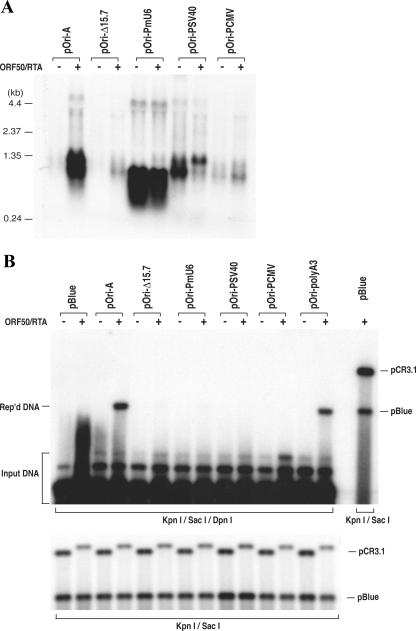
Replacement of the RRE-involved promoter in KSHV ori-Lyt with other promoters abolished ori-Lyt-dependent DNA replication. The ori-Lyt promoter region (nucleotides 24022 to 24252) was replaced by a mouse U6 snRNA promoter, an SV40 early promoter, or an HCMV IE promoter in pOri-A to generate pOri-PmU6, pOri-PSV40, and pOri-PCMV, respectively. (A) The transcription initiated by these promoters was examined by Northern analysis. Total RNAs were isolated from 293 cells that had been transfected with pOri-A and its derivatives, as indicated above each lane. These RNAs were separated on a 1.0% agarose-formaldehyde gel and transferred onto a Nytran membrane. The membrane was probed with a 32P-labeled GC-rich tandem repeat sequence. (B) The abilities of these constructs to mediate DNA replication were tested in BCBL-1 cells by using a transient replication assay as described in Materials and Methods. pBlue, pBluescript; Rep'd, replicated.
FIG. 3.
FIG. 3.
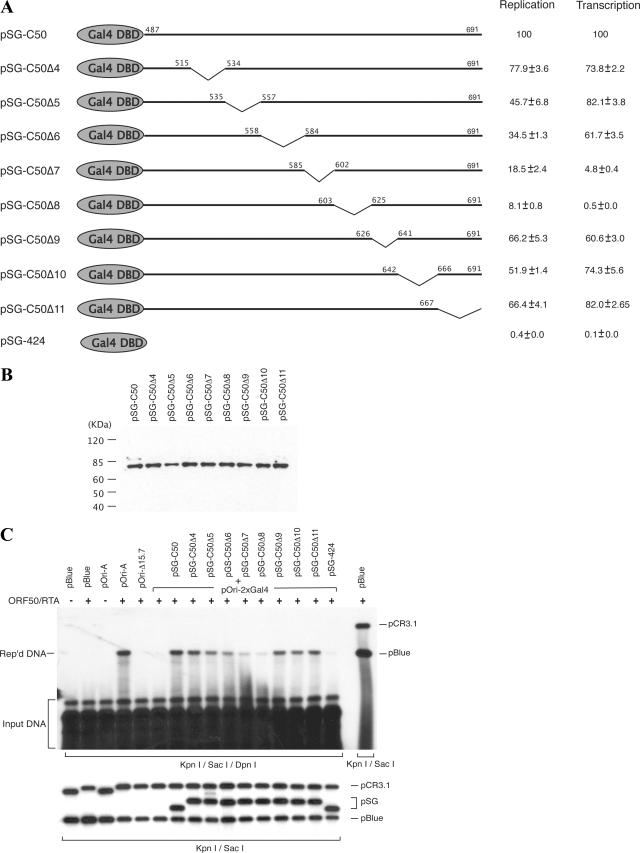
Identification of region of RTA required for DNA replication. (A) Schematic diagram of a set of deletion mutants of pSG-C50. Deleted amino acids are shown by the downward sloping lines. DBD, DNA binding domain. (B) Expression levels of SG-C50 and its derivatives were monitored by Western blotting with an antibody specific to Gal4 protein. (C) pOri-2xGal4 was introduced into BCBL-1 cells along with SG-C50 and a series of its deletion mutants. The RTA expression vectors were included to initiate lytic DNA replication. (C) Replicated (Rep'd) DNA was distinguished from input DNA by DpnI digest and detected by Southern blotting with 32P-labeled pBluescript (pBlue) plasmid. The replication rate of each mutant relative to that of wild-type pOri-A was calculated by comparing the normalized intensity of the replicated DNA band with that of wild-type pOri-A. Each number is the average of results from two independent experiments. The transcription ability of each mutant was determined by a luciferase assay with the 13F-2xGal4 reporter construct (31).
FIG. 4.
FIG. 4.
Identification of the region in RTA that is required for transcription activation. The RTA deletions illustrated in Fig. 3A were introduced into pCR3.1-ORF50. The RTA mutants (designated RtaΔ4, RtaΔ5, etc.) were examined for the ability to activate the ori-Lyt RRE-containing promoter as well as the K8 delayed-early promoter by use of luciferase reporters. The reporter plasmids containing a firefly luciferase gene under control of the ori-Lyt promoter or the K8 delayed-early promoter were introduced into BJAB cells by electroporation or into 293 cells by calcium phosphate precipitation. Renilla luciferase plasmid was included in each transfection as an internal control. At 48 h posttransfection, dual luciferase assays were performed with the lysates of transfected cells. Relative luciferase activities were calculated by dividing the normalized firefly luciferase activity of each reporter by that of pGL3 plasmid in pCR3.1-transfected cells.
FIG. 5.
FIG. 5.
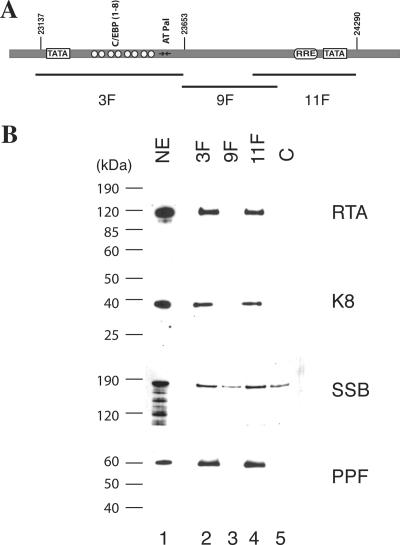
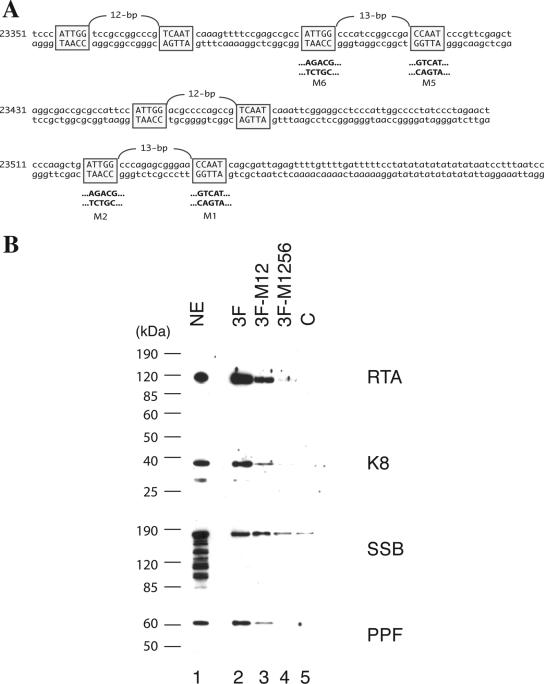
Binding of K8, RTA, and core replication proteins to KSHV ori-Lyt DNA. (A) Schematic of KSHV ori-Lyt core domain and the three DNA fragments that were used in the DNA affinity assay. The C/EBP cluster (K8 binding sites), AT palindrome (AT Pal), RRE, and TATA boxes are illustrated. (B) Nuclear extract (NE) from TPA-induced BCBL-1 cells was subjected to DNA affinity purification with each of the three DNA probes, and the D500 eluates were assayed by Western blotting with antibodies as indicated. An irrelevant DNA (ORF45 coding region) was included as a control, C.
FIG. 6.
FIG. 6.
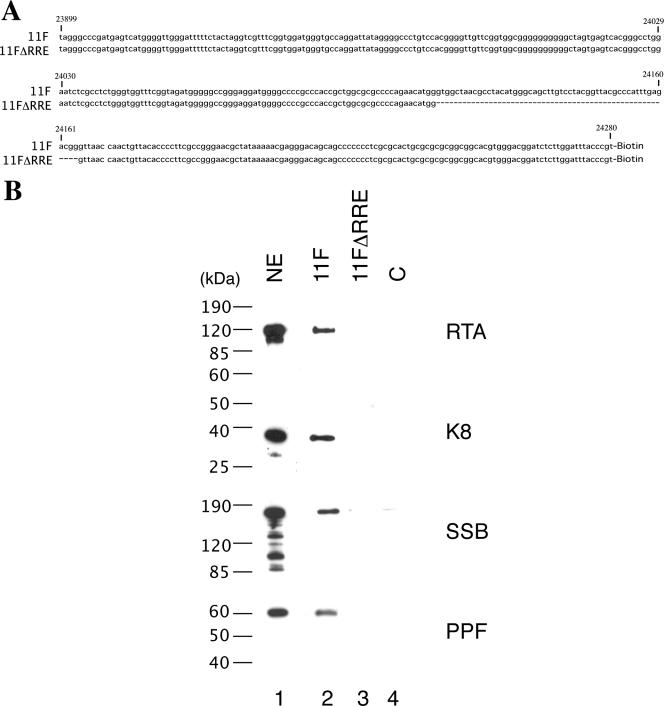
Effect of deletion of RRE from the ori-Lyt fragment (11F) on the recruiting of replication proteins to ori-Lyt DNA. (A) Sequences of 11F and 11FΔRRE DNA fragments used in the DNA affinity assay. (B) Biotinylated DNA fragments were prepared by PCR, with pOri-A (wild-type) DNA and pOri-Δ15.7 (an RRE deletion derivative, which was described by Wang et al. [31]) as templates. TPA-induced BCBL-1 nuclear extract (NE) was incubated with the DNA fragments conjugated on magnetic beads, washed, and eluted with D500 elution buffer. Samples were assayed by Western blotting with antibodies as indicated. An irrelevant DNA was included as a control, C.
FIG. 7.
FIG. 7.
Effects of mutations of the C/EBP motifs in the ori-Lyt fragment (3F) on recruiting of replication proteins to ori-Lyt DNA. (A) Schematic diagram of the sequences and locations of eight C/EBP binding sites that are organized as four spaced palindromes, as well as site-specific mutations on these C/EBP motifs. (B) Biotinylated DNA fragments were prepared by PCR with a pOri-A (wild-type) DNA template as well as pOri-M12 and pOri-M1256, mutations on certain C/EBP motifs, which were described by Wang et al. (31). TPA-induced BCBL-1 nuclear extract (NE) was incubated with the DNA fragments conjugated on magnetic beads, washed, and eluted with D500 elution buffer. Samples were assayed by Western blotting with antibodies as indicated. An irrelevant DNA was included as a control, C.
FIG. 8.
FIG. 8.
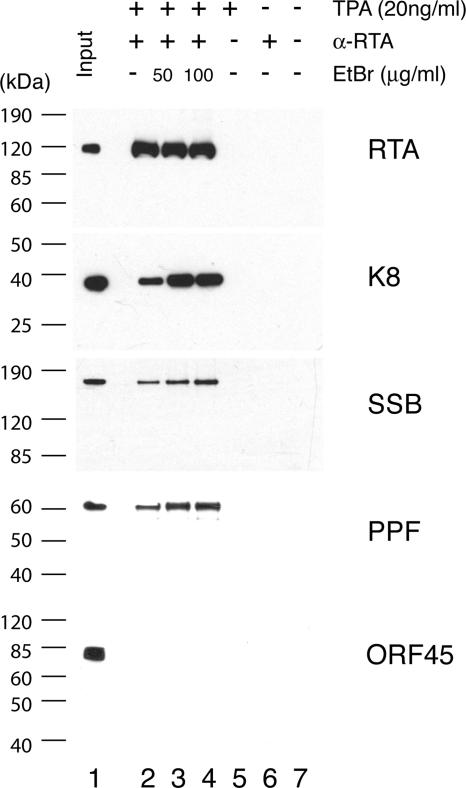
Coimmunoprecipitation of viral core replication proteins with RTA by using an anti-RTA monoclonal antibody. Immunoprecipitations were performed with TPA-induced or uninduced BCBL-1 lysates in the presence and absence of EtBr. Each sample was separated on SDS-PAGE gels and followed by Western analyses using polyclonal antibodies against proteins as indicated.
FIG. 9.
FIG. 9.
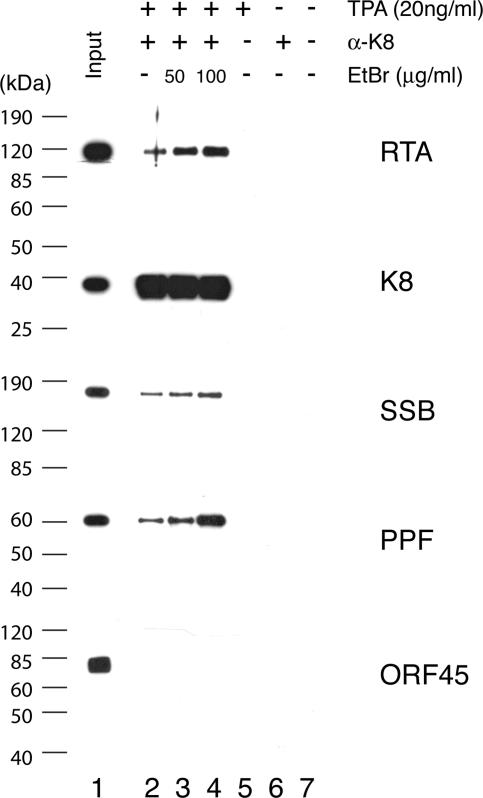
Coimmunoprecipitation of viral core replication proteins with K8 by using an anti-K8 monoclonal antibody. Immunoprecipitations were performed with TPA-induced or uninduced BCBL-1 lysates in the presence and absence of EtBr. Each sample was separated on SDS-PAGE gels and followed by Western analyses using polyclonal antibodies against proteins as indicated.
FIG. 10.
FIG. 10.
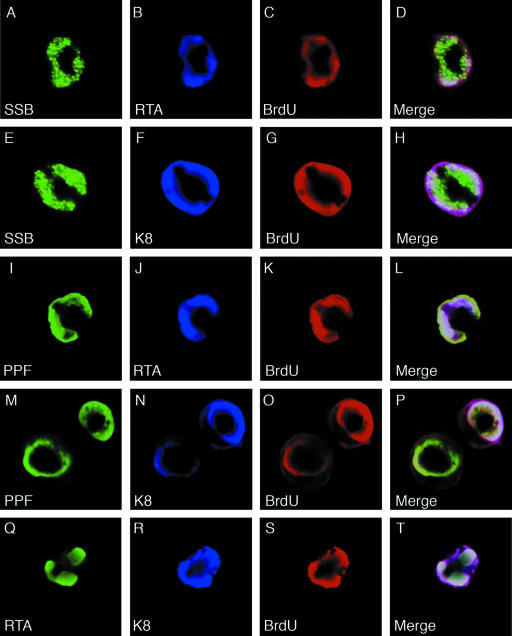
Visualization and characterization of VRC in TPA-induced BCBL-1 cells and localization of RTA and K8 in VRC. BCBL-1 cells were treated with TPA for 48 h and pulse-labeled with BrdU for 60 min. The cells were subjected to triple-label IFA using mouse monoclonal anti-RTA or anti-K8 antibody (Cy5), rabbit polyclonal anti-SSB or anti-PPF antibody (FITC), and sheep anti-BrdU antibody (Texas Red). The triple-label IFA shows that RTA and K8 are colocalized with core replication machinery proteins (SSB and PPF) as well as newly synthesized DNA (BrdU incorporated) in VRC in TPA-induced BCBL-1 cells.
FIG. 11.
FIG. 11.
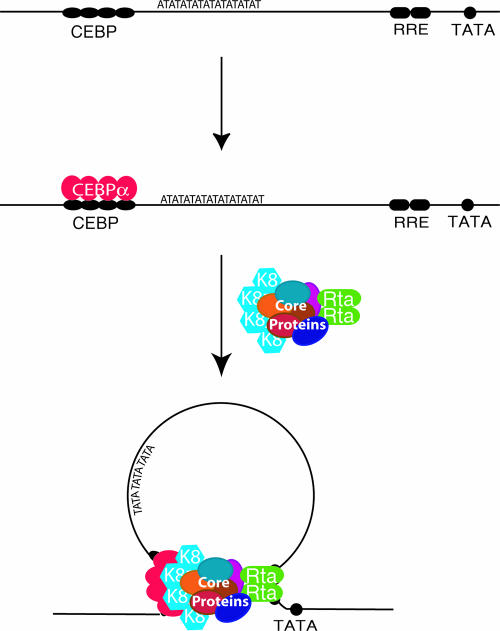
Model for recruitment of core replication proteins to KSHV ori-Lyt DNA through RTA and K8. Six core replication machinery proteins (core proteins), RTA, and K8 form a prereplication complex regardless of the presence of ori-Lyt DNA. The prereplication complex is loaded at a KSHV ori-Lyt by a two-point contact through RTA and K8 that interacts with their respective sites on ori-Lyt.

References

    1. AuCoin, D. P., K. S. Colletti, S. A. Cei, I. Papouskova, M. Tarrant, and G. S. Pari. 2004. Amplification of the Kaposi's sarcoma-associated herpesvirus/human herpesvirus 8 lytic origin of DNA replication is dependent upon a cis-acting AT-rich region and an ORF50 response element and the trans-acting factors ORF50 (K-Rta) and K8 (K-bZIP). Virology 318:542-555. - PubMed
    1. AuCoin, D. P., K. S. Colletti, Y. Xu, S. A. Cei, and G. S. Pari. 2002. Kaposi's sarcoma-associated herpesvirus (human herpesvirus 8) contains two functional lytic origins of DNA replication. J. Virol. 76:7890-7896. - PMC - PubMed
    1. Ballestas, M. E., and K. M. Kaye. 2001. Kaposi's sarcoma-associated herpesvirus latency-associated nuclear antigen 1 mediates episome persistence through cis-acting terminal repeat (TR) sequence and specifically binds TR DNA. J. Virol. 75:3250-3258. - PMC - PubMed
    1. Ballestas, M. E., P. A. Chatis, and K. M. Kaye. 1999. Efficient persistence of extrachromosomal KSHV DNA mediated by latency-associated nuclear antigen. Science 284:641-644. - PubMed
    1. Cesarman, E., P. S. Moore, P. H. Rao, G. Inghirami, D. M. Knowles, and Y. Chang. 1995. In vitro establishment and characterization of two acquired immunodeficiency syndrome-related lymphoma cell lines (BC-1 and BC-2) containing Kaposi's sarcoma-associated herpesvirus-like (KSHV) DNA sequences. Blood 86:2708-2714. - PubMed

Publication types

MeSH terms