


Molecular comparisons of freshwater and marine isolates of the same morphospecies of heterotrophic flagellates
- PMID: 17021215
- PMCID: PMC1610283
- DOI: 10.1128/AEM.02547-05
Molecular comparisons of freshwater and marine isolates of the same morphospecies of heterotrophic flagellates
Abstract
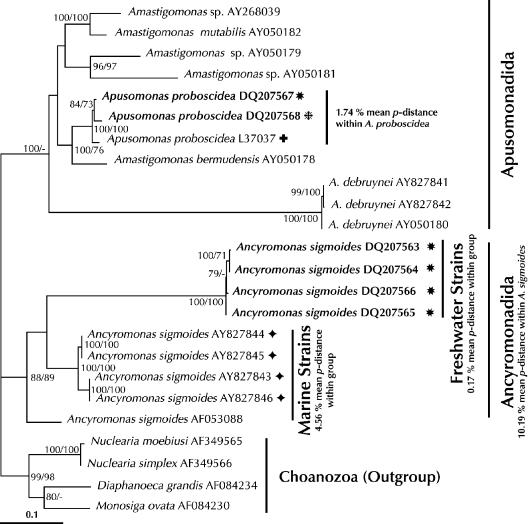
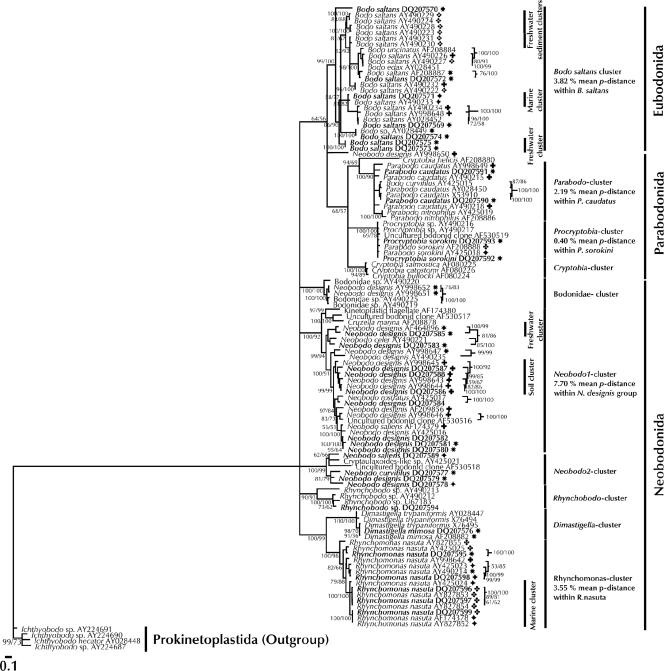
Heterotrophic flagellates are key components of all ecosystems. Understanding the patterns of biodiversity of these organisms is thus particularly important. Here we analyzed the intraspecific diversity of 10 morphospecies of heterotrophic flagellates comprising representatives of the Apusozoa (2 morphospecies) and Kinetoplastea (8 morphospecies), all belonging to the most common flagellates with worldwide distribution. Most morphospecies showed a mixing of lineages isolated from diverse habitats, indicating that some lineages of these morphospecies had been able to colonize different habitats several times. Furthermore, our results revealed remarkable levels of genetic divergence within most of the morphospecies studied, underlining the difficulty of correctly determining species by means of morphology alone. Many cryptic or pseudocryptic species seem to occur. Our results revealed clear divergence between marine and freshwater lineages of the morphospecies Ancyromonas sigmoides, showing that freshwater lineages have not been able to colonize marine environments and marine lineages have not been able to colonize freshwater environments for a long time.
Figures
References
-
- Arndt, H., D. Dietrich, B. Auer, E. J. Cleven, T. Gräfenhan, M. Weitere, and A. P. Mylnikov. 2000. Functional diversity of heterotrophic flagellates in aquatic ecosystems, p. 240-268. In B. S. C. Leadbeater and J. C. Green (ed.), The flagellates. The Systematic Association special volume 59. Unity, diversity and evolution. Taylor & Francis Ltd., London, United Kingdom.
-
- Avise, J. C. 2004. Molecular markers, natural history, and evolution, 2nd ed. Sinauer Associates, Sunderland, MA.
-
- Caron, D. A., P. D. Countway, and M. V. Brown. 2004. The growing contribution of molecular biology and immunology to protistan ecology: molecular signatures as ecological tools. J. Eukaryot. Microbiol. 51:38-48. - PubMed
-
- Clark, C. G. 1992. DNA purification from polysaccharide-rich cells, p. D3.1-D3.2. In J. J. Lee and A. T. Soldo (ed.), Protocols in protozoology. Allen Press, Lawrence, KS.
-
- Coleman, A. W. 2001. Biogeography and speciation in the Pandorina/Volvulina (Chlorophyte) superclade. J. Phycol. 37:836-851.
Publication types
MeSH terms
Substances
LinkOut - more resources
Full Text Sources
Molecular Biology Databases
