. 2007 Feb 20;358(2):303-10.
doi: 10.1016/j.virol.2006.08.038. Epub 2006 Oct 4.

Association of E6AP (UBE3A) with human papillomavirus type 11 E6 protein

Affiliations

Association of E6AP (UBE3A) with human papillomavirus type 11 E6 protein

Nicole Brimer et al. Virology. .

Abstract

The cellular E3 ubiquitin ligase E6AP (UBE3A) interacts with the cancer-associated HPV E6 oncoproteins, where together with the viral E6 oncoprotein it binds and targets the degradation of the p53 tumor suppressor. We find that the HPV-11E6 protein also associates with E6AP in vivo, and thereby can target the degradation of an E6-associated protein. Mutation of an E6-binding LXXLL peptide motif on E6AP eliminated the association, revealing a common mode of interaction between high- and low-risk E6 proteins and E6AP. E6AP was required for the in vivo degradation of DLG1 by both HVP-18 E6 and a chimeric HPV-11E6. The common functional interaction of both cancer-associated and non-cancer-associated E6 proteins with E6AP establishes a common mechanism for E6 proteins trophic to mucosal squamous epithelium.


Figures
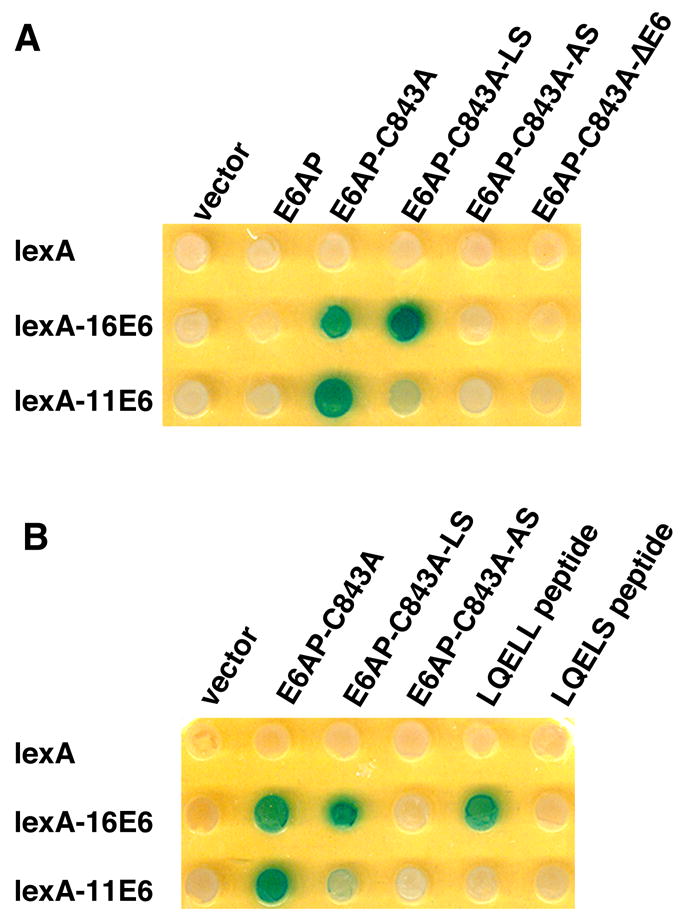
Figure 1
Figure 1. 11E6 interacts with E6AP in a yeast two-hybrid assay
E6AP fusions to the B42 transactivator expressed in the strain YPH500 were introduced by mating to the lexA responsive lacZ and His3 reporter strain TAT7 containing either LexA or LexA fused to 11E6 or 16E6 as previously described (Cooper et al., 2003; Vande Pol, Brown, and Turner, 1998). Diploid yeast were selected on glucose plates by auxotrophic markers and then patched to galactose-XGAL plates to induce expression of the B42 transactivator prey fusion proteins. A. 11E6 binds the same region of E6AP as 16E6. B42 transactivator domain fusions to E6AP, E6AP-C843A (mutated in ubiquitin ligase activity), and E6AP-C843A further mutated in the 16E6-binding site (aa. 409-LQELL-413) LQELS or LQEAS are indicated. E6AP-C843A-ΔE6 contains an in-frame deletion of amino acids 391–408 deleting the entire E6 binding site. Galactose-XGAL plates test for interaction with the indicated lexA fusions with blue color indicating in vivo interaction. B. Interaction of 16E6 but not 11E6 with the isolated E6 binding site of E6AP-C843A. The peptides ELTLQELLGEERR (termed LQELL peptide) or ELTLQELSGEERR (termed LQELS) fused to the HA epitope and the B42 transactivator were tested on Galactose XGAL plates for two-hybrid interaction with the indicated LexA fusions.
Figure 2
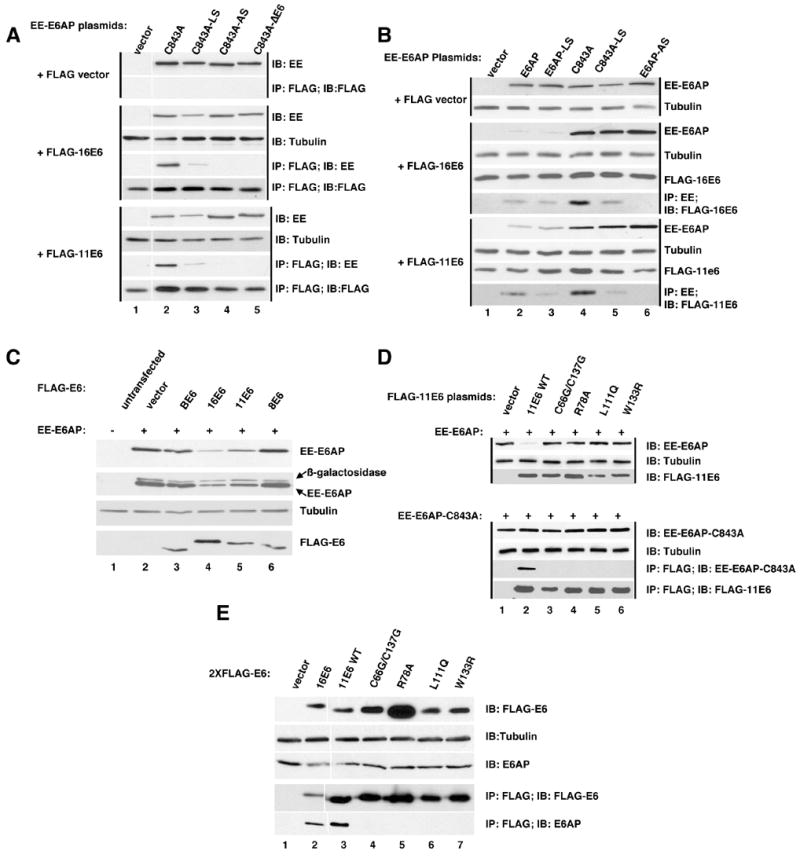
Figure 2. Association of 11E6 and 16E6 with E6AP in mammalian cells. A. Immune precipitation of FLAG-tagged 11E6 and 16E6 co-precipitates E6AP
The indicated plasmids were transiently overexpressed in CV-1 cells by vaccinia pTM1 transfection, protein equalized NP40 soluble lysates prepared and either analyzed by immunoblot with the indicated antibodies or immune precipitated with antibodies directed to indicated epitope tags (Flag or EE) as previously described (Cooper et al., 2003). Black vertical lines group samples transfected with either FLAG vector, FLAG-16E6, or FLAG-11E6. A white vertical line between lanes 1 and 2 indicates the position of a lane excised from the figure. B. Immune precipitation of E6AP co-precipitates 11E6 and 16E6. Performed as in A. Black vertical lines group samples transfected with either FLAG vector, FLAG-16E6, or FLAG-11E6. C. Reduction of E6AP expression by co-expression of 11E6 and 16E6. The indicated plasmids were co-expressed in CV-1 cells as in parts A and B with a constant amount of beta-galactosidase included as an internal expression control. Protein normalized samples from NP40 lysed cells were probed with antibodies first for the EE tag on E6AP, then beta-galactosidase, then cellular tubulin as a loading control and finally FLAG-E6. D. 11E6 mutants defective for HPV-11 plasmid maintenance fail to interact with E6AP. In two parallel sets of transfections either EE-E6AP or EE-E6AP-C843A (mutated in ubiquitin ligase activity)were co-transfected with 11E6 wild-type (WT) or the indicated 11E6 mutants. Mutant C66G/C137G are in the zinc binding motif, L111Q and W133R are in conserved buried residues and R78A was undetermined in location in a recent structural model of E6 proteins (Nomine et al., 2006). Cells transfected with EE-E6AP were harvested in SDS lysis buffer and analyzed for expression in the upper three panels. Cells transfected with EE-E6AP-C843A were lysed in NP40 lysis buffer and protein content equalized, with a portion analyzed for EE-E6AP-C843A and tubulin expression in the lysate and the remainder immune precipitated with antibody to FLAG. Immunoblots were performed with the indicated antibodies. E. 11E6 and 16E6 associate with E6AP when stably expressed in C33A cells. C33A cells were retrovirally transduced with 2X-FLAG-tagged vector, 16E6, 11E6 or the indicated 11E6 mutants. 5% of clarified and protein equalized NP40 lysates from 6×10⁷ pooled drug resistant cells 10 passages after completion of drug selection were analyzed by immunoblot for the expression of FLAG-E6 (top panel), tubulin (second panel) and E6AP (third panel from top). The remaining lysate was immune precipitated with rabbit polyclonal antibody to FLAG epitope and washed precipitates were analyzed for the expression of FLAG-E6 and associated E6AP using mouse monoclonal antibodies to FLAG and E6AP.
Figure 3
Figure 3. E6AP association with 16E6 and 11E6 in cellular lysates
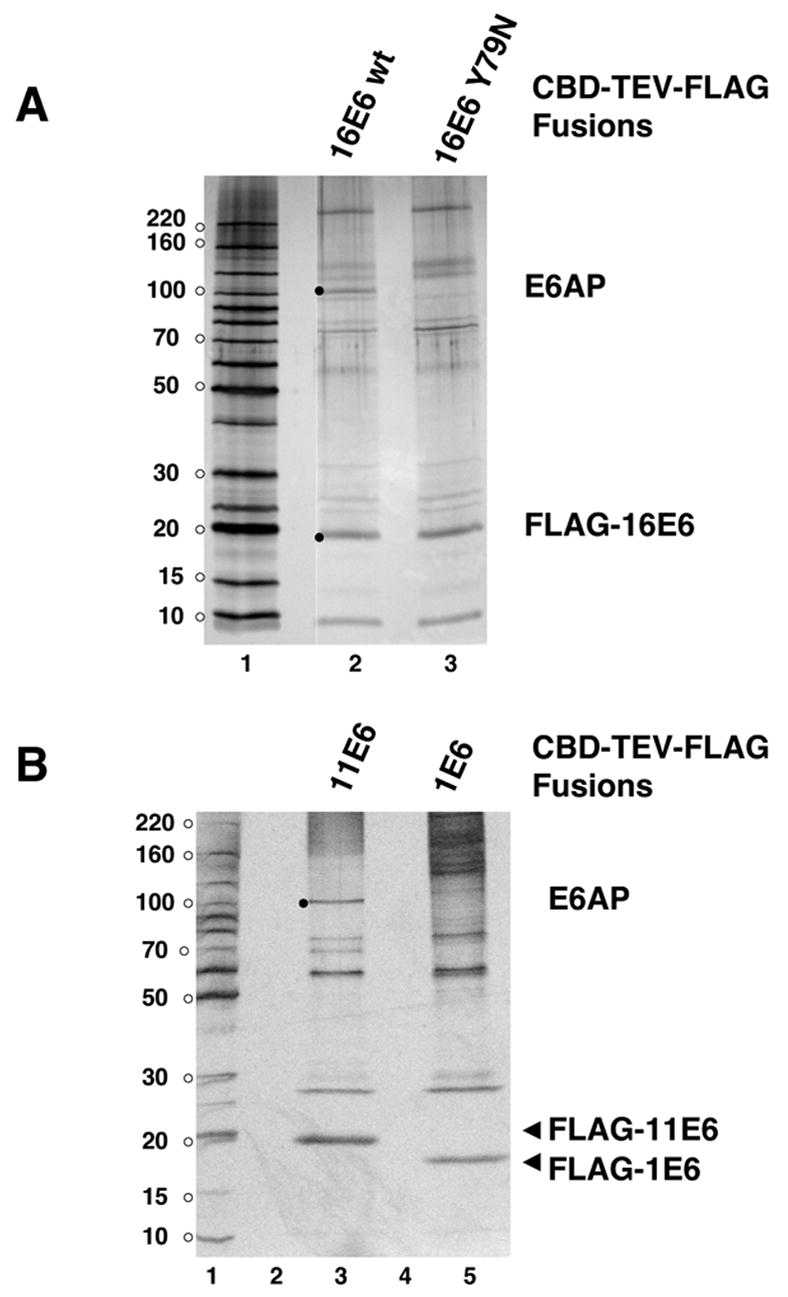
CBD-TEV-FLAG fusions to 16E6, 16E6_Y79N, 11E6, and 1E6 were produced in CV1 cells by vaccinia virus transduction, bound to chitin beads and combined with clarified HaCat cell lysate as described in the methods. FLAG-E6 and associated proteins were released from chitin beads by TEV protease cleavage, and then purified on FLAG antibody beads, washed extensively, eluted by FLAG peptide. A. Association of E6AP with 16E6. Black dots indicate silver-stained bands excised from a 4–20% gradient polyacrylamide gel for protein identification by in-gel trypsinization and LC-MS identification of tryptic peptides. Thirty-one unique peptides in the indicated 100 kDa band in the 16E6 lane were derived from E6AP, while no E6AP peptides were identified in the corresponding gel slice for 16E6_Y79N. Molecular weight markers (lane 1) contain 100 ng protein per band. B. Association of E6AP with 11E6. In vitro binding and in-gel trypsinization performed as in A. The indicated 100 kDa band in lane 3 contained 60 unique peptides derived from E6AP.
Figure 4
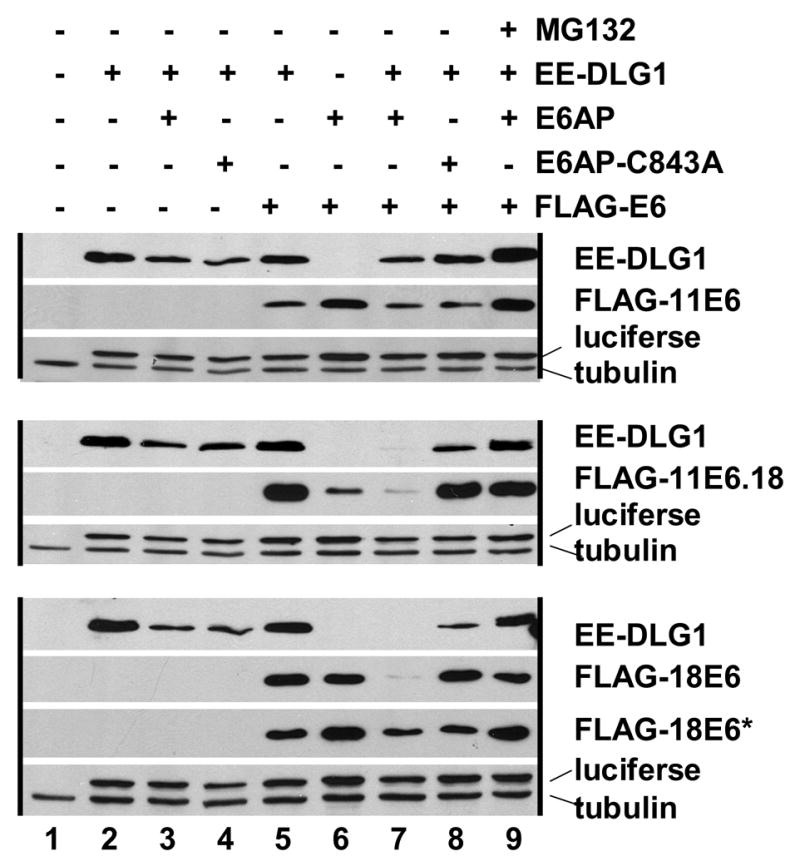
Figure 4. E6AP and proteasome-dependent degradation of a synthetic substrate by 11E6
E6AP null mouse embryo fibroblasts were transfected with the indicated plasmids. SDS lysed cells were analyzed by immunoblot 24 hrs later. Black vertical lines group together samples transfected either with FLAG vector, FLAG-11E6, or FLAG-11.18E6 (11E6 with a c-terminal fusion to the 7 amino acid PDZ ligand of 18E6). FLAG-18E6 transfected cells produced two species corresponding to the expected 20 kDa full-length FLAG-18E6 and a smaller indicated band that is presumed to result from an internally spliced 18E6 product termed 18E6*. A constant amount of luciferase was included in the transfection mixture in lanes 2–9 as a transfection efficiency control.

References

    1. Bohl J, Das K, Dasgupta B, Vande Pol SB. Competitive binding to a charged leucine motif represses transformation by a papillomavirus E6 oncoprotein. Virology. 2000;271(1):163–170. - PubMed
    1. Chen JJ, Hong Y, Rustamzadeh E, Baleja JD, Androphy EJ. Identification of an alpha helical motif sufficient for association with papillomavirus E6. J Biol Chem. 1998;273(22):13537–44. - PubMed
    1. Cooper B, Schneider S, Bohl J, Jiang Y, Beaudet A, Vande Pol S. Requirement of E6AP and the features of human papillomavirus E6 necessary to support degradation of p53. Virology. 2003;306(1):87–99. - PubMed
    1. Elbel M, Carl S, Spaderna S, Iftner T. A comparative analysis of the interactions of the E6 proteins from cutaneous and genital papillomaviruses with p53 and E6AP in correlation to their transforming potential. Virology. 1997;239(1):132–49. - PubMed
    1. Elroy-Stein O, Fuerst TR, Moss B. Cap-independent translation of mRNA conferred by encephalomyocarditis virus 5’ sequence improves the performance of the vaccinia virus/bacteriophage T7 hybrid expression system. Proc Natl Acad Sci U S A. 1989;86(16):6126–6130. - PMC - PubMed

Publication types

MeSH terms

Substances