. 2006 Dec 5;103(49):18816-21.
doi: 10.1073/pnas.0604711103. Epub 2006 Oct 5.

The plasma membrane Na+/H+ antiporter SOS1 interacts with RCD1 and functions in oxidative stress tolerance in Arabidopsis

Affiliations

The plasma membrane Na+/H+ antiporter SOS1 interacts with RCD1 and functions in oxidative stress tolerance in Arabidopsis

Surekha Katiyar-Agarwal et al. Proc Natl Acad Sci U S A. .

Abstract

The adverse effects of high salt on plants include Na(+) toxicity and hyperosmotic and oxidative stresses. The plasma membrane-localized Na(+)/H(+) antiporter SOS1 functions in the extrusion of toxic Na(+) from cells and is essential for plant salt tolerance. We report here that, under salt or oxidative stress, SOS1 interacts through its predicted cytoplasmic tail with RCD1, a regulator of oxidative-stress responses. Without stress treatment, RCD1 is localized in the nucleus. Under high salt or oxidative stress, RCD1 is found not only in the nucleus but also in the cytoplasm. Like rcd1 mutants, sos1 mutant plants show an altered sensitivity to oxidative stresses. The rcd1mutation causes a decrease in salt tolerance and enhances the salt-stress sensitivity of sos1 mutant plants. Several genes related to oxidative-stress tolerance were found to be regulated by both RCD1 and SOS1. These results reveal a previously uncharacterized function of a plasma membrane Na(+)/H(+) antiporter in oxidative-stress tolerance and shed light on the cross-talk between the ion-homeostasis and oxidative-stress detoxification pathways involved in plant salt tolerance.


Conflict of interest statement

Conflict of interest statement: No conflicts declared.

Figures
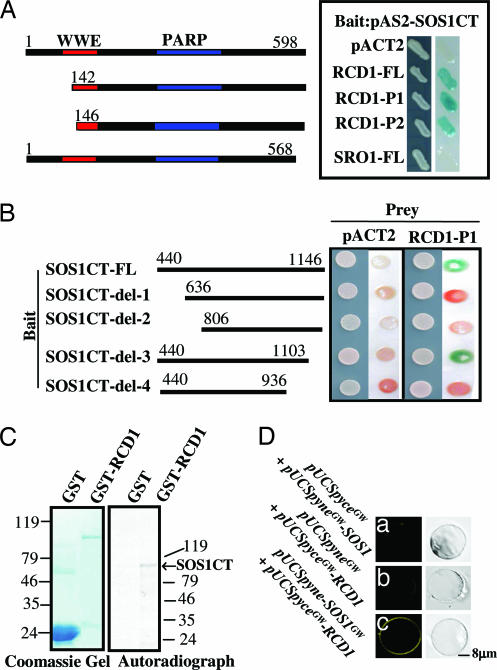
Fig. 1.
Fig. 1.
Interaction between SOS1CT and RCD1 in vitro and in vivo. (A) Interactions between SOS1CT and different fragments of RCD1 in the yeast two-hybrid system. Yeast strains containing the pAS2-SOS1CT bait and pACT2-RCD1 and SRO1 prey were used for β-galactosidase filter assays. RCD1-FL (full-length RCD1), RCD1-P1, and RCD1-P2 are truncated RCD1, and SRO1-FL is full-length SRO1. The pAS2-SOS1CT and pACT2 combination was used as a negative control. The fragments used for interaction studies are shown on the far left, with the amino acid positions at the top. (B) The interaction between different portions of SOS1CT and RCD1. The combination of pACT2 and pAS2 containing different portions of SOS1CT was used as a negative control. The left side of each panel shows the growth of yeast colonies, and the right side shows the β-galactosidase filter assay. (C) In vitro binding assay. [35S]methionine-labeled SOS1CT was pulled down by RCD1-GST but not by GST alone. (D) In vivo interaction between SOS1 and RCD1 by the bimolecular fluorescence complementation assay (C). The protoplasts were treated with 25 mM NaCl for 2 h, followed by the addition of 1.5 mM H2O2 for 2 h. Negative controls are shown (a and b).
Fig. 2.
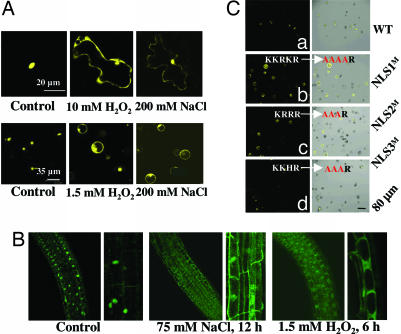
Fig. 2.
Localization of RCD1-GFP or RCD1-YFP fusion protein under control and stress conditions. (A) WT Arabidopsis leaves and mesophyll protoplasts were transfected with RCD1-YFP. Fourteen hours after the transfection, leaves and protoplasts were treated with H2O2 or NaCl and viewed under a confocal microscope. (B) RCD1-GFP transgenic seedlings were exposed to 75 mM NaCl or 1.5 mM H2O2, and the roots were examined for GFP localization. Enlarged pictures are shown on the right side of each panel. (C) Localization of RCD1-YFP containing WT (a) and mutated NLSs (bd). Overlays of fluorescence and bright field are shown on the right side of each panel.
Fig. 3.
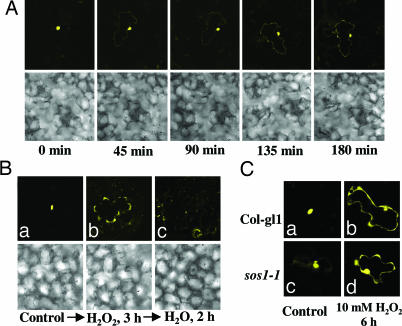
Fig. 3.
Kinetics of subcellular redistribution of RCD1-YFP. (A) Time course of stress-induced RCD1-YFP redistribution. Epidermal cells of mature Arabidopsis leaves were microprojectile-bombarded with RCD1-YFP construct, and, after 14 h of recovery, the leaves were treated with 10 mM H2O2. The epidermal cells were visualized under a confocal microscope every 45 min. (B) RCD1-YFP localization before (a) and after stress removal. After 3 h of H2O2 treatment (b), transiently transformed leaves were washed with water and floated on water for 2 h (c). Bright-field images are shown at the bottom of each panel. (C) Transient expression of RCD1-YFP in WT (a and b) and sos11 mutant (c and d) leaves.
Fig. 4.
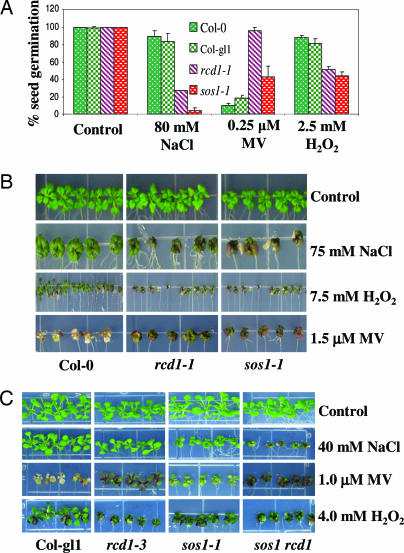
Fig. 4.
Phenotypic evaluation of WT (Col-0 or Col-gl1), rcd11, sos11, rcd13, and sos1 rcd1 double mutant under salt and oxidative stresses. (A) Effects on seed germination in response to salt or oxidative stress. The average of three independent experiments is shown. (B and C) Effects on seedling response to stress. Photographs were taken after 15 days of stress treatments.
Fig. 5.
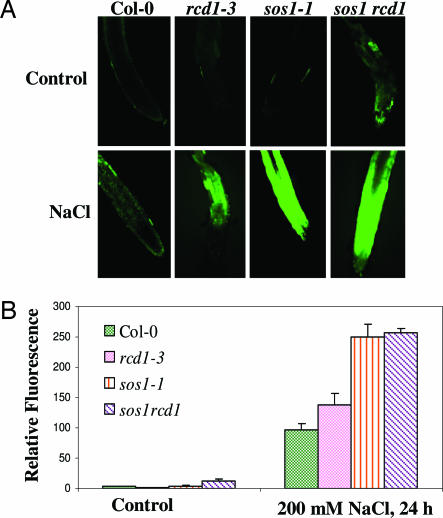
Fig. 5.
ROS accumulation in roots of rcd11 and sos11 mutant seedlings under salt stress. (A and B) Seedlings were exposed to 200 mM NaCl and then stained with 10 μM 2′,7′-dichlorodihydrofluorescein diacetate for 15 min. Fluorescence images (A) and fluorescence intensity (B) are shown. Data plotted are the average of six roots.
Fig. 6.
Fig. 6.
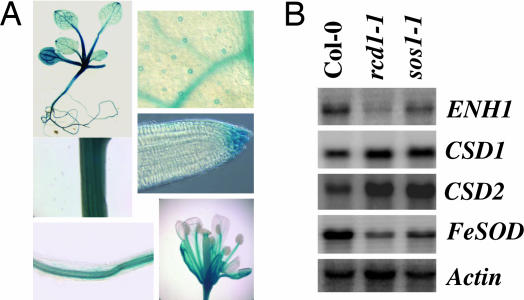
RCD1 expression pattern and effect of sos1 and rcd1 mutations on gene expression. (A) Histochemical localization of GUS activity directed by RCD1 promoter in transgenic Arabidopsis. (B) Gene expression in WT and rcd11 and sos11 mutants. Actin was used as a loading control.

References

    1. Zhu J-K. Annu Rev Plant Biol. 2002;53:247–273. - PMC - PubMed
    1. Qiu Q, Guo Y, Dietrich MA, Schumaker KS, Zhu J-K. Proc Natl Acad Sci USA. 2002;99:8436–8441. - PMC - PubMed
    1. Liu J, Zhu J-K. Science. 1998;280:1943–1945. - PubMed
    1. Ishitani M, Liu J, Halfter U, Kim C-S, Shi W, Zhu J-K. Plant Cell. 2000;12:1667–1677. - PMC - PubMed
    1. Liu J, Ishitani M, Halfter U, Kim C-S, Zhu J-K. Proc Natl Acad Sci USA. 2000;97:3730–3734. - PMC - PubMed

Publication types

MeSH terms

LinkOut - more resources