. 2006 Oct 6;314(5796):140-3.
doi: 10.1126/science.1129663.

Genetic variant BDNF (Val66Met) polymorphism alters anxiety-related behavior

Affiliations

Genetic variant BDNF (Val66Met) polymorphism alters anxiety-related behavior

Zhe-Yu Chen et al. Science. .

Abstract

A common single-nucleotide polymorphism in the brain-derived neurotrophic factor (BDNF) gene, a methionine (Met) substitution for valine (Val) at codon 66 (Val66Met), is associated with alterations in brain anatomy and memory, but its relevance to clinical disorders is unclear. We generated a variant BDNF mouse (BDNF(Met/Met)) that reproduces the phenotypic hallmarks in humans with the variant allele. BDNF(Met) was expressed in brain at normal levels, but its secretion from neurons was defective. When placed in stressful settings, BDNF(Met/Met) mice exhibited increased anxiety-related behaviors that were not normalized by the antidepressant, fluoxetine. A variant BDNF may thus play a key role in genetic predispositions to anxiety and depressive disorders.


Figures
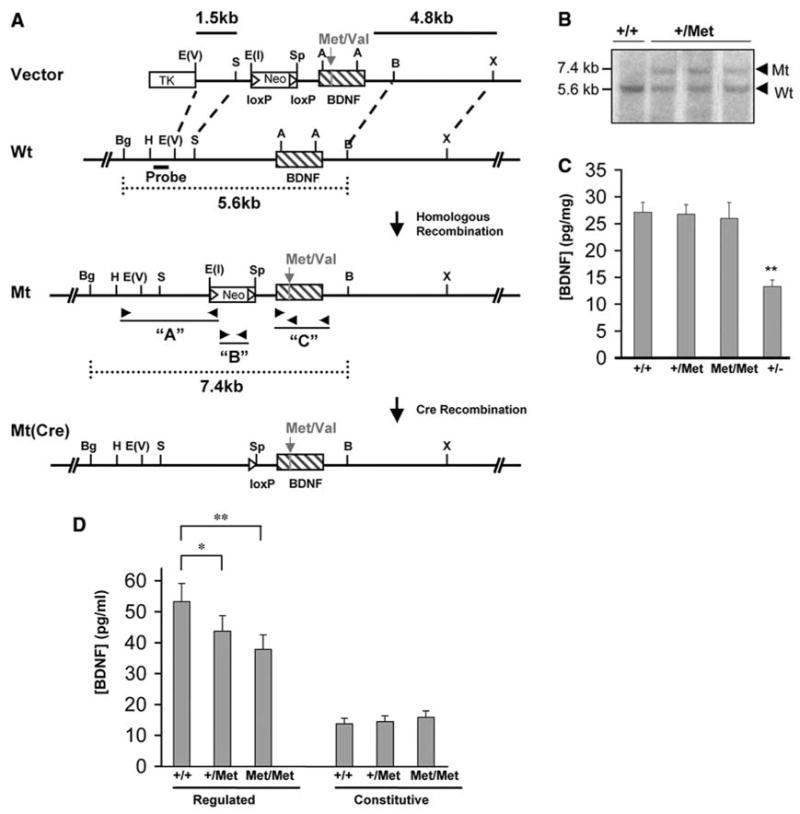
Fig. 1
Fig. 1
Generation and validation of BDNFMet transgenic mice. (A) Schematic diagram of the strategy used to replace the coding region of the BDNF gene with BDNFMet. The entire coding region is in exon V. For the variant BDNF, a point mutation has been made (G196A) to change the valine in position 66 to a methionine. (B) Southern blots of representative embryonic stem cell clones for BDNFMet. Bgl II and Bam HI restriction enzyme digestion and 5′ external probe indicated in (A) were used to detect homologous replacement in the BDNF locus. The 5.6-kilobase (kb) WT and 7.4-kb rearranged variant DNA bands are indicated. (C) BDNF ELISA analyses of total BDNF levels from postnatal day 21 (P21) brain lysates from WT (+/+), heterozygous (+/Met), and homozygous (Met/Met) mice, as well as BDNF heterozygous KO mice (+/−) (**P < 0.01, Student’s t test). (D) Hippocampal-cortical neurons obtained from embryonic day 18 (E18) BDNF+/Met (+/Met), BDNFMet/Met (Met/Met), and WT (+/+) pups were cultured. After 72 hours, media were collected under depolarization (regulated) or basal (constitutive) secretion conditions as described previously (10). Media were then concentrated and analyzed by BDNF ELISA. (*P < 0.05, **P < 0.01, Student’s t test).
Fig. 2
Fig. 2
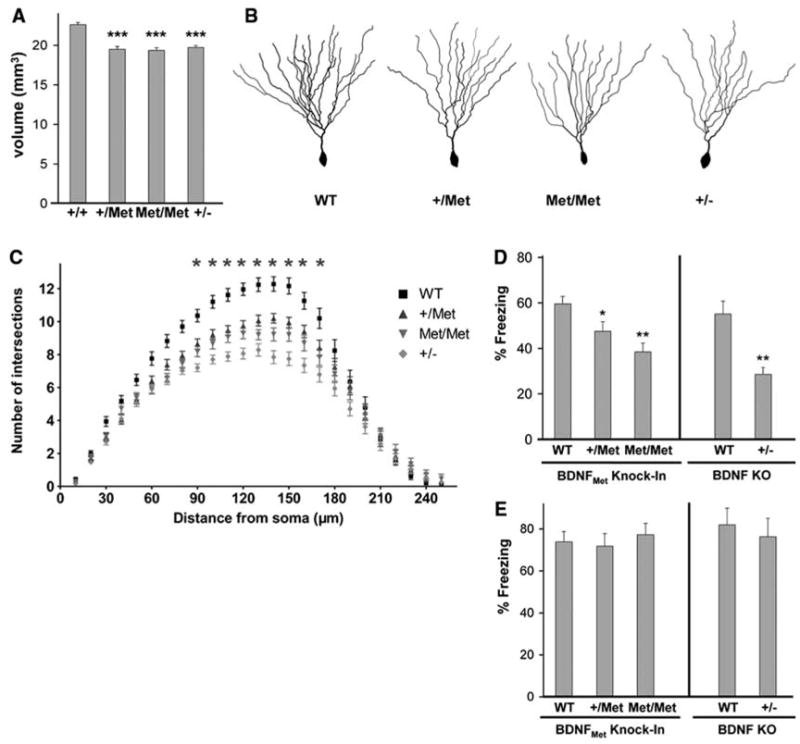
Altered hippocampal anatomy and behavior in transgenic BDNFMet mice. (A) Total hippocampal volume estimations were obtained from Nissl-stained sections of adult (P60) hippocampi from WT (+/+), heterozygous (+/Met), homozygous (Met/Met), and heterozygous BDNF KO (+/−) mice by Cavalieri analyses. All results are presented as means ± SEM determined from analysis of six mice per genotype (***P < 0.001, Student’s t test). (B) Examples of Golgi-stained dentate gyrus neurons from P60 WT (+/+), heterozygous (+/Met), homozygous (Met/Met), and heterozygous BDNF KO (+/−) mice. (C) Sholl analyses of dentate gyrus neurons from P60 mice, five mice per genotype, 10 neurons per mouse. All results are presented as means ± SEM determined from analysis of five mice per genotype and statistics in comparison with WT controls (*P < 0.001). Fear-conditioned learning in adult transgenic BDNFMet mice. WT (+/+), heterozygous (+/Met), homozygous (Met/Met), and heterozygous BDNF (+/−) KO mice were tested in (D) contextual and (E) cue-dependent fear conditioning. The percentage of time spent freezing in each session was quantified. All results are presented as means ± SEM determined from analysis of eight mice per genotype (*P < 0.05, **P < 0.01, Student’s t test).
Fig. 3
Fig. 3
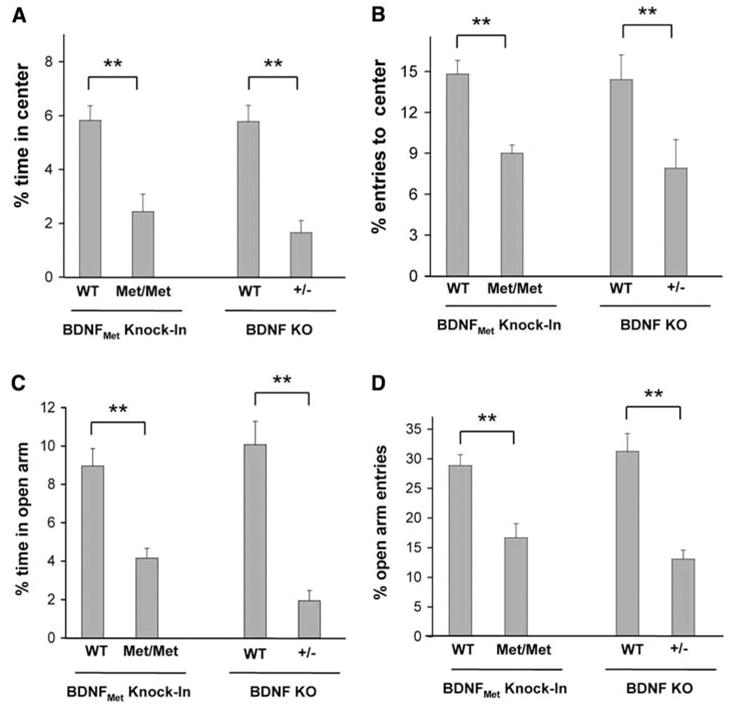
Anxiety-related behavior in BDNFMet/Met mice in the open field (A and B) and elevated plus maze (C and D). Percentage of time spent in the center (A) and entries into the center (B) in the open field are shown, as well as percentage time spent in the open arm (C) and percentage of open arm entries (D) in the plus maze. All results are presented as means ± SEM determined from analysis of eight mice per genotype (**P < 0.01).
Fig. 4
Fig. 4
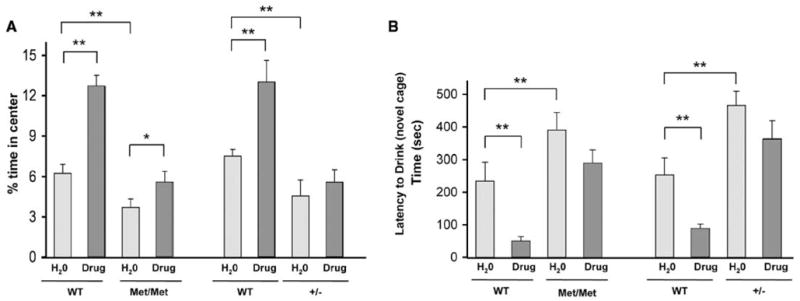
Decreased response to long-term fluoxetine in BDNFMet/Met mice in the (A) open-field and (B) novelty-induced hypophagia tests. In the open-field test, percentage of time spent in the center in the absence (H2O) or presence of fluoxetine (drug) treatment was measured. In the novelty-induced hypophagia test, latency to begin drinking in a novel cage in the absence (H2O) or presence of fluoxetine (drug) treatment is shown in seconds. All results are presented as means ± SEM determined from analysis of eight mice per genotype (*P < 0.05, **P < 0.01).

References

    1. Shimizu E, Hashimoto K, Iyo M. Am J Med Genet B Neuropsychiatr Genet. 2004;126B:122. - PubMed
    1. Bueller JA, et al. Biol Psychiatry. 2006;59:812. - PubMed
    1. Pezawas L, et al. J Neurosci. 2004;24:10099. - PMC - PubMed
    1. Szeszko PR, et al. Mol Psychiatry. 2005;10:631. - PubMed
    1. Hariri AR, et al. J Neurosci. 2003;23:6690. - PMC - PubMed

Publication types

MeSH terms

Substances