


Structural basis of chemokine receptor function--a model for binding affinity and ligand selectivity
- PMID: 17024562
- PMCID: PMC2671010
- DOI: 10.1007/s10540-006-9025-9
Structural basis of chemokine receptor function--a model for binding affinity and ligand selectivity
Abstract
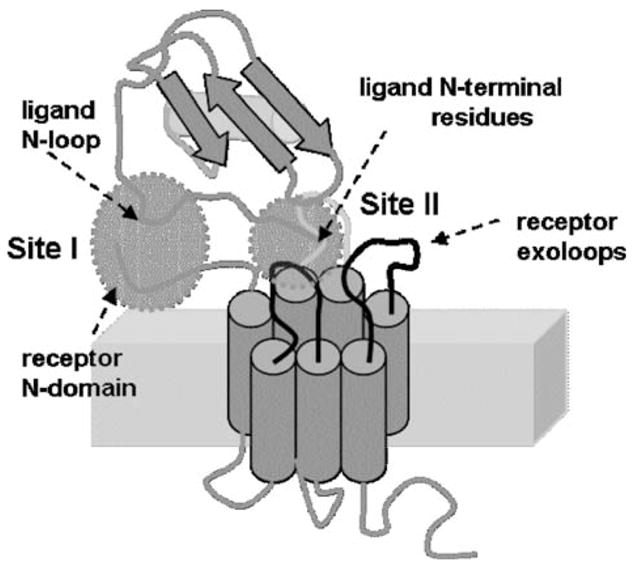
Chemokine receptors play fundamental roles in human physiology from embryogenesis to inflammatory response. The receptors belong to the G-protein coupled receptor class, and are activated by chemokine ligands with a range of specificities and affinities that result in a complicated network of interactions. The molecular basis for function is largely a black box, and can be directly attributed to the lack of structural information on the receptors. Studies to date indicate that function can be best described by a two-site model, that involves interactions between the receptor N-domain and ligand N-terminal loop residues (site-I), and between receptor extracellular loop and the ligand N-terminal residues (site-II). In this review, we describe how the two-site model could modulate binding affinity and ligand selectivity, and also highlight some of the unique chemokine receptor features, and their role in function.
Figures

References
-
- Ahuja SK, Lee JC, Murphy PM. CXC chemokines bind to unique sets of selectivity determinants that can function independently and are broadly distributed on multiple domains of human interleukin-8 receptor B. Determinants of high affinity binding and receptor activation are distinct. J Biol Chem. 1996;271:225–232. - PubMed
-
- Ahuja SK, Murphy PM. The CXC chemokines growth-regulated oncogene (GRO)α, GROβ, GROγ, Neutrophil-activating peptide-2, and epithelial cell-dervived neutrophil-activating peptide-78 are potent agonists for the type B, but not the type A, Human interleukin-8 receptor. J Biol Chem. 1996;271:20545–20550. - PubMed
-
- Alcami A. Viral mimicry of cytokines, chemokines and their receptors. Nat Rev Immunol. 2003;3:36–50. - PubMed
-
- Baldwin JM. Structure and function of receptors coupled to G proteins. Curr Opin Cell Biol. 1994;6:180–190. - PubMed
-
- Baltus T, Weber KS, Johnson Z, Proudfoot AE, Weber C. Oligomerization of RANTES is required for CCR1-mediated arrest but not CCR5-mediated transmigration of leukocytes on inflamed endothelium. Blood. 2003;102:1985–1988. - PubMed
Publication types
MeSH terms
Substances
Grants and funding
LinkOut - more resources
Full Text Sources
Other Literature Sources
