


Types of information physicians provide when prescribing antidepressants
- PMID: 17026727
- PMCID: PMC1831652
- DOI: 10.1111/j.1525-1497.2006.00589.x
Types of information physicians provide when prescribing antidepressants
Abstract
Background: Providing antidepressant information to patients may foster greater adherence to therapy.
Objective: To assess physician information-giving while prescribing antidepressants, and to identify factors that influence the provision of information.
Design: Randomized experiment using standardized patients (SPs). Standardized patients roles were generated by crossing 2 clinical conditions (major depression or adjustment disorder) with 3 medication request types (brand-specific, general, or none).
Participants: One hundred and fifty-two general internists and family physicians recruited from solo and group practices and health maintenance organizations; cooperation rates ranged from 53% to 61%.
Measurements: We assessed physician information-giving by analyzing audio-recordings of interactions between physicians and SPs, and collected physician background information by survey. Generalized estimating equations were used to examine the influence of patient and physician factors on physicians' provision of information.
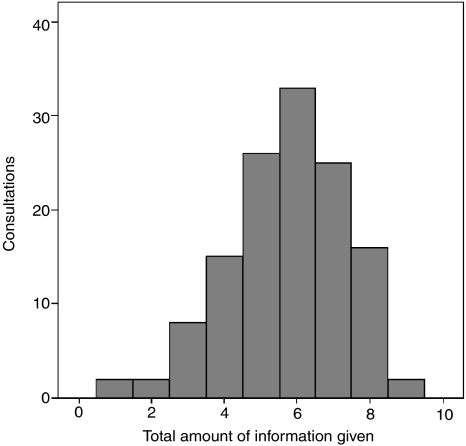
Results: One hundred and one physicians prescribed antidepressants, accounting for 131 interactions. The mean age of physicians was 46.3 years; 69% were males. Physicians mentioned an average of 5.7 specific topics of antidepressant-related information (of a possible maximum of 11). The most frequently mentioned topic was purpose (96.1%). Physicians infrequently provided information about the duration of therapy (34.9%) and costs (21.4%). Standardized patients who presented with major depression received less information than those with adjustment disorder, and older and solo/private practice physicians provided significantly less information to SPs.
Conclusions: Physicians provide limited information to patients while prescribing antidepressants, often omitting critical information that may promote adherence. Mechanisms are needed to ensure that patients receive pertinent antidepressant information.
Figures
References
-
- Kessler RC, Berglund P, Demler O, et al. The epidemiology of major depressive disorder: results from the National Comorbidity Survey Replication (NCS-R) JAMA. 2003;289:3095–105. - PubMed
-
- Rush AJ, Golden WE, Hall GW, et al. Depression in Primary Care: Clinical Practice Guideline. Rockville, MD: US Department of Health and Human Services; 1993.
-
- Stimmel GL. How to counsel patients about depression and its treatment. Pharmacotherapy. 1995;15:100S–4S. - PubMed
-
- Lin EH, Von Korff M, Katon W, et al. The role of the primary care physician in patients' adherence to antidepressant therapy. Med Care. 1995;33:67–74. - PubMed
-
- Nemeroff CB. Improving antidepressant adherence. J Clin Psychiatry. 2003;64:25–30. - PubMed
Publication types
MeSH terms
Substances
Grants and funding
LinkOut - more resources
Full Text Sources
Medical