


Fos responses of dopamine neurons to sociosexual stimuli in male zebra finches
- PMID: 17027163
- PMCID: PMC2570784
- DOI: 10.1016/j.neuroscience.2006.08.046
Fos responses of dopamine neurons to sociosexual stimuli in male zebra finches
Abstract
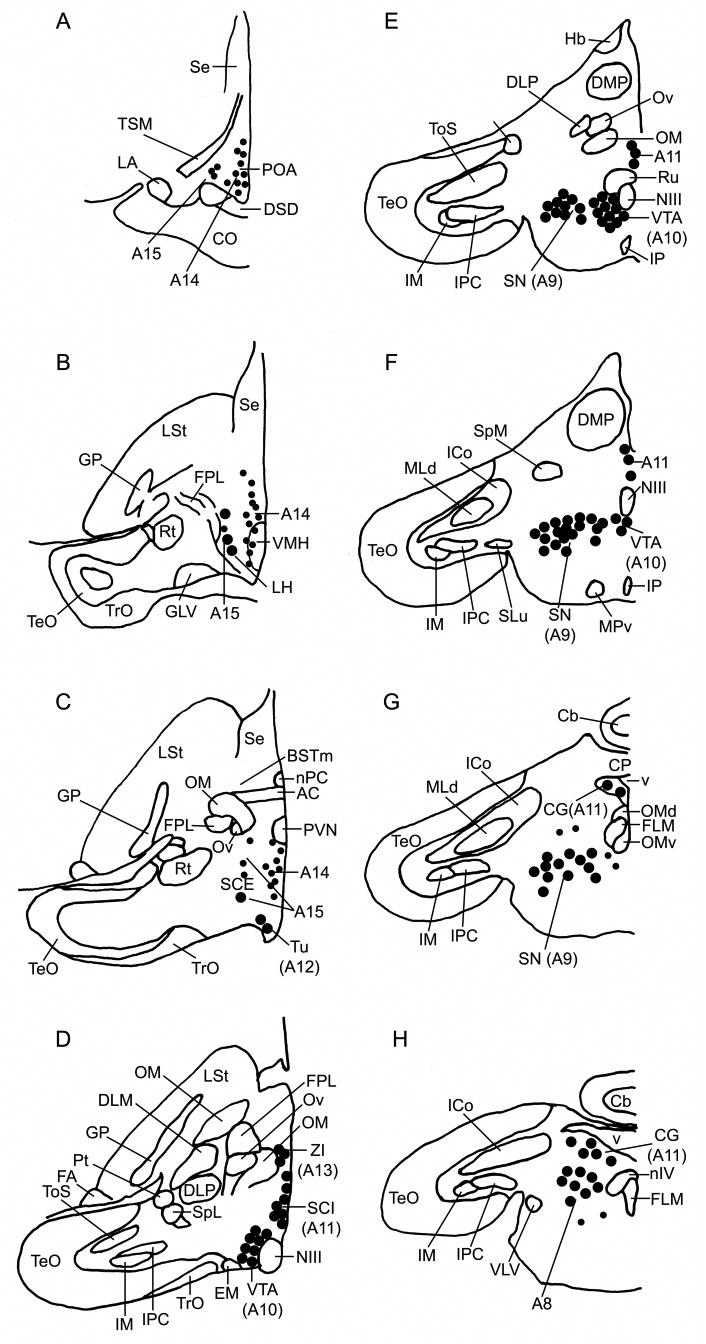
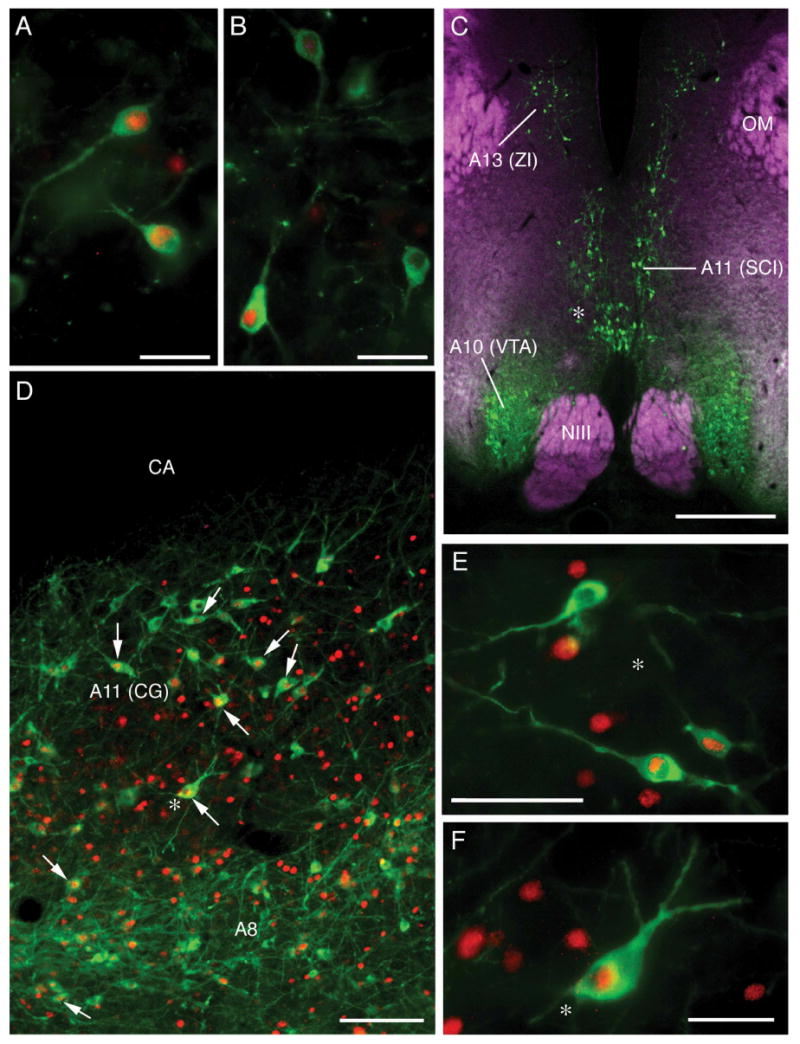
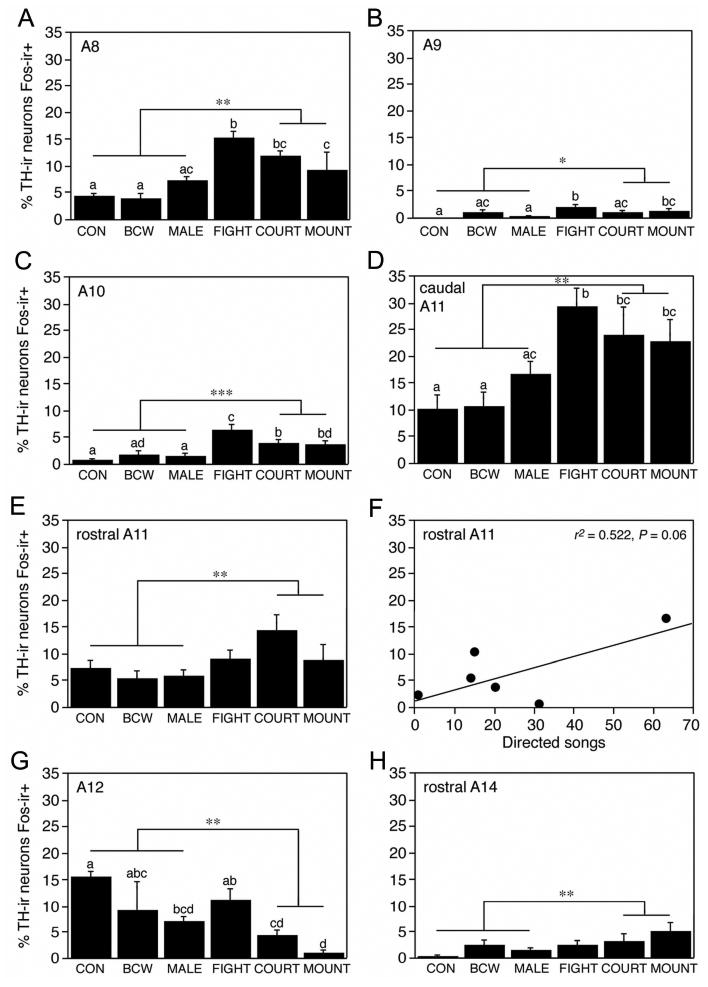
Dopamine (DA) is produced in numerous brain areas and influences a wide variety of social behaviors, but very few data are available to establish the socially-relevant response properties of most DA populations, which comprise eight cell groups numbered A8-A15. Anatomically, these DA populations are evolutionarily conserved, and all have been identified in both birds and mammals. We now report the Fos responses of tyrosine hydroxylase-immunoreactive (TH-ir; putatively dopaminergic) neurons in the A8-A15 cell groups of male zebra finches following exposure to a control condition or one of six different social stimuli: a heterospecific male, conspecific male, fighting in a mate competition paradigm (which includes both male and female stimuli), a courtship interaction without physical contact, a courtship interaction with physical contact but no mounting, and a courtship interaction with mounting. We found that the DA cell groups exhibit distinctive profiles of responsiveness to social stimuli. Fos induction in A8, A9, A10 and midbrain A11 neurons increased significantly in response to a variety of conspecific stimuli, but not heterospecific stimuli. In contrast, Fos induction in the preoptic A14 neurons was observed specifically in response to sexual interactions, and Fos induction in hypothalamic A11 neurons appears to primarily reflect the performance of courtship singing. Infundibular A12 neurons, which may be involved in stress-related processes, showed the highest level of TH+Fos colocalization in control subjects. This colocalization decreased in response to all conspecific stimuli except fighting, and did not decrease following exposure to a heterospecific male.
Figures
References
-
- Absil P, Das S, Balthazart J. Effects of apomorphine on sexual behavior in male quail. Pharmacol Biochem Behav. 1994;47:77–88. - PubMed
-
- Adkins-Regan E, Robinson TM. Sex differences in aggressive behavior in zebra finches (Poephila guttata) J Comp Psychol. 1993;107:223–229.
-
- Adrio F, Anadon R, Rodriguez-Moldes I. Distribution of tyrosine hydroxylase (TH) and dopamine β-hydroxylase (DBH) immunoreactivity in the central nervous system of two chondrostean fishes (Acipenser baeri and Huso huso) J Comp Neurol. 2002;448:280–297. - PubMed
-
- Appeltants D, Absil P, Balthazart J, Ball GF. Identification of the origin of catecholaminergic inputs to HVc in canaries by retrograde tract tracing combined with tyrosine hydroxylase immunocytochemistry. J Chem Neuroanat. 2000;18:117–133. - PubMed
-
- Appeltants D, Ball GF, Balthazart J. The distribution of tyrosine hydroxylase in the canary brain: demonstration of a specific and sexually dimorphic catecholaminergic innervation of the telencephalic song control nuclei. Cell Tissue Res. 2001;304:237–259. - PubMed
Publication types
MeSH terms
Substances
Grants and funding
LinkOut - more resources
Full Text Sources
