. 2006 Dec;142(4):1621-41.
doi: 10.1104/pp.106.088781. Epub 2006 Oct 6.

Molecular interactions between the specialist herbivore Manduca sexta (Lepidoptera, Sphingidae) and its natural host Nicotiana attenuata. VII. Changes in the plant's proteome

Affiliations

Molecular interactions between the specialist herbivore Manduca sexta (Lepidoptera, Sphingidae) and its natural host Nicotiana attenuata. VII. Changes in the plant's proteome

Ashok P Giri et al. Plant Physiol. 2006 Dec.

Abstract

When Manduca sexta attacks Nicotiana attenuata, fatty acid-amino acid conjugates (FACs) in the larvae's oral secretions (OS) are introduced into feeding wounds. These FACs trigger a transcriptional response that is similar to the response induced by insect damage. Using two-dimensional gel electrophoresis, matrix-assisted laser desorption ionization-time of flight, and liquid chromatography-tandem mass spectrometry, we characterized the proteins in phenolic extracts and in a nuclear fraction of leaves elicited by larval attack, and/or in leaves wounded and treated with OS, FAC-free OS, and synthetic FACs. Phenolic extracts yielded approximately 600 protein spots, many of which were altered by elicitation, whereas nuclear protein fractions yielded approximately 100 spots, most of which were unchanged by elicitation. Reproducible elicitor-induced changes in 90 spots were characterized. In general, proteins that increased were involved in primary metabolism, defense, and transcriptional and translational regulation; those that decreased were involved in photosynthesis. Like the transcriptional defense responses, proteomic changes were strongly elicited by the FACs in OS. A semiquantitative reverse transcription-PCR approach based on peptide sequences was used to compare transcript and protein accumulation patterns for 17 candidate proteins. In six cases the patterns of elicited transcript accumulation were consistent with those of elicited protein accumulation. Functional analysis of one of the identified proteins involved in photosynthesis, RuBPCase activase, was accomplished by virus-induced gene silencing. Plants with decreased levels of RuBPCase activase protein had reduced photosynthetic rates and RuBPCase activity, and less biomass, responses consistent with those of herbivore-attacked plants. We conclude that the response of the plant's proteome to herbivore elicitation is complex, and integrated transcriptome-proteome-metabolome analysis is required to fully understand this ubiquitous ecological interaction.


Figures

Figure 1.
Figure 1.
Leaf numbering and elicitation procedures. The left section depicts the numbering system of leaf nodes of 30-d-old rosette-stage plants, and the upper-right section the leaf-wounding procedure with the pattern wheel, according to which three leaves (+1, +2, and +3) were wounded and elicitor solutions applied six times at 30-min intervals. The elicitor solutions were water, 0.005% Triton X-100, M. sexta OS, OS without FACs (OS-FAC-free), and chemically synthesized FACs, and, in the lower-right section, a feeding first-instar M. sexta larva.
Figure 2.
Figure 2.
Proteomic maps of two-dimensionally separated control and elicited leaf proteins. Locally treated leaves were collected 30 h after the first OS elicitation and proteins were extracted using the phenol extraction protocol. Approximately 550 μg of protein was resolved on 24-cm IPG strips of pH range 3 to 10 NL (isoelectric focusing), further separated on 12% acrylamide SDS-PAGE gels, and stained with Bio-Safe Coomassie G-250 stain. Gels were scanned and images analyzed using PDQuest software. Representative protein profiles (from nine gels) of control (A) and W + OS-elicited (B) leaves from different plants were used to compare protein accumulation patterns. Numbers and arrows indicate protein spots experiencing up-regulation (red arrows), down-regulation (black arrows), or no change (green arrows) in response to OS elicitation at this time point. For identities of the protein spots and their accumulation patterns in response to several elicitation treatments from 6 to 72 h time points, see Tables I and II.
Figure 3.
Figure 3.
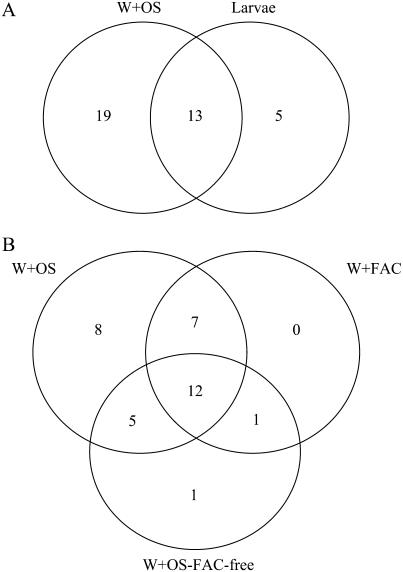
Comparison of protein accumulation patterns in N. attenuata leaves among different inducers. The Venn diagram presents the number of protein spots that exhibit differential accumulation patterns among different elicitor treatments compared to control leaves. Shown are a comparison between larvae- and W + OS-induced leaves (A) and a comparison among the W + OS, W + FACs, and W + OS-FAC-free leaves (B). The numbers in circles indicate the protein spots having differential accumulation and the numbers in the common area represent protein spots with similar patterns of accumulation.
Figure 4.
Figure 4.
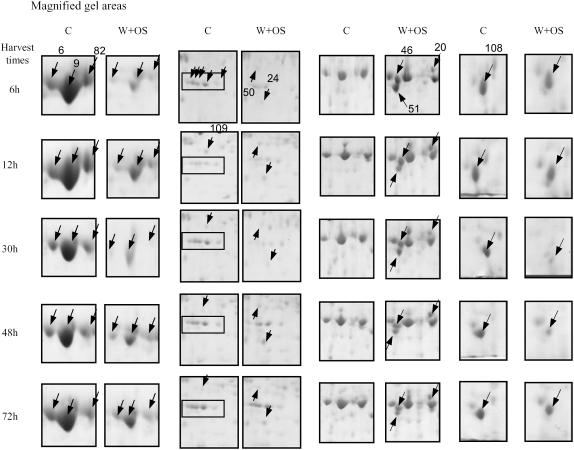
Magnified areas of two-dimensional gels. The four sections show magnified areas of control and W + OS-elicited leaves at different times after elicitation (6–72 h). The boxes in the gel area (column 2) encompass spots 74, 75, 77, 78, and 80 (left to right). Numbers of protein spots with arrows are indicated in the first gel of their appearance, whereas only the positions of protein spots are shown with arrows in subsequent gels. Proteins eluted from these spots were identified by MALDI-TOF and/or LC-MS/MS (see Table I).
Figure 5.
Figure 5.
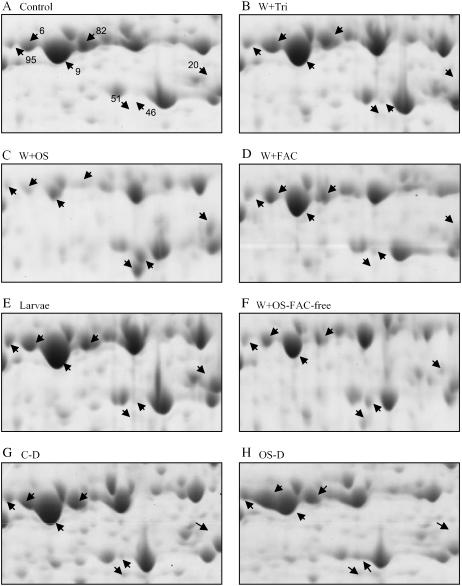
Magnified areas [see areas (a) and (b) in Supplemental Figure S4] of two-dimensional gels of protein extracts from control and elicited plants from treated and distal leaves for RCA spots. Leaf protein profiles of control (A) and punctured leaves treated with 0.0025% Triton X-100 (W + Tri; B), solutions of M. sexta OS (W + OS; C), chemically synthesized FACs (W + FAC; D), feeding M. sexta larva (E), OS without FACs (W+OS-FAC-free; F), a control of distal leaves (C-D; G) and W + OS of distal leaves (OS-D; H) are shown. Leaves were collected 30 h after the application of elicitor solution and 48 h after the release of larvae on local leaves. The accumulation patterns of RCA spots were compared among these treatments.
Figure 6.
Figure 6.
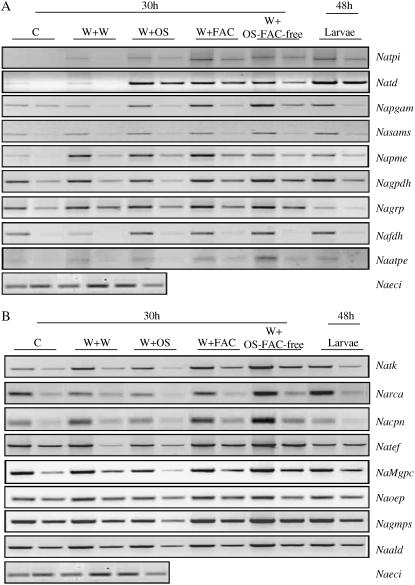
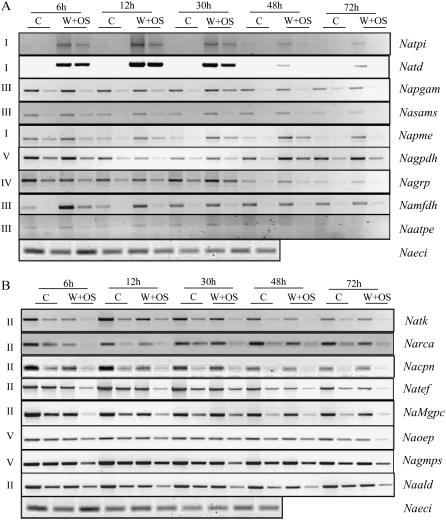
Gene expression analysis using the RT-PCR approach on candidate proteins differentially elicited in N. attenuata leaves after various elicitor treatments. Quantitative RT-PCR analysis of 17 candidate genes in nonwounded and in wounded leaves treated with different elicitors, which show (A) pattern of nine genes: TPI (Natpi), TD (Natd), PGM (Napgam), S-adenosylmethionine synthetase (Nasams), PME (Napme), glyceraldehyde-3-P dehydrogenase (Nagpdh), Gly-rich RNA-binding protein (Nagrp), mitochondrial formate dehydrogenase (Namfd), and ATPase (Naatpe); and (B) pattern of eight genes: TK (Natk), RCA (Narca), chaperonin (Nacpn), translation elongation factor (Natef), Mg-protoporphyrin IX chelatase (NaMgpc), oxygen-evolving protein (Naoep), Gln synthetase (Nagmps), and ALD (Naald). Transcript abundance was checked after 48 h of larval feeding and 30 h for control (C), and the application of wounding with water (W + W), larval OS (W + OS), FACs (W + FAC), and OS devoid of FACs (W + OS-FAC-free). PCR reactions were carried out with two concentrations of cDNA for all primers, in at least three replicates. A single concentration of cDNA was used for ECI (AB010717, sulfite reductase) primers. ECI was used as internal standard to determine the equal amplification of cDNA. The gene names, accession numbers, primer sequences, sizes of amplified cDNA fragments, and respective peptide sequence maps of proteins are provided in Supplemental Table S1 and Supplemental Figure S5.
Figure 7.
Figure 7.
Gene expression analysis of candidate proteins exhibiting differential accumulation in control and OS-induced N. attenuata leaves at different times after elicitation. Quantitative RT-PCR analysis of candidate genes in control leaves (C) and OS-induced leaves (W + OS) that show up-regulation (A; nine genes) and down-regulation (B; eight genes) between 6 and 72 h is shown. PCR reactions were carried out with two concentrations of cDNA for all primers, in at least three replicates. A single concentration of cDNA was used for ECI primers to determine the equal amount of the cDNA. The gene names, accession numbers, primer sequences, sizes of amplified cDNA fragments, and respective peptide sequence maps on proteins are provided in Supplemental Table S1 and Supplemental Figure S5.
Figure 8.
Figure 8.
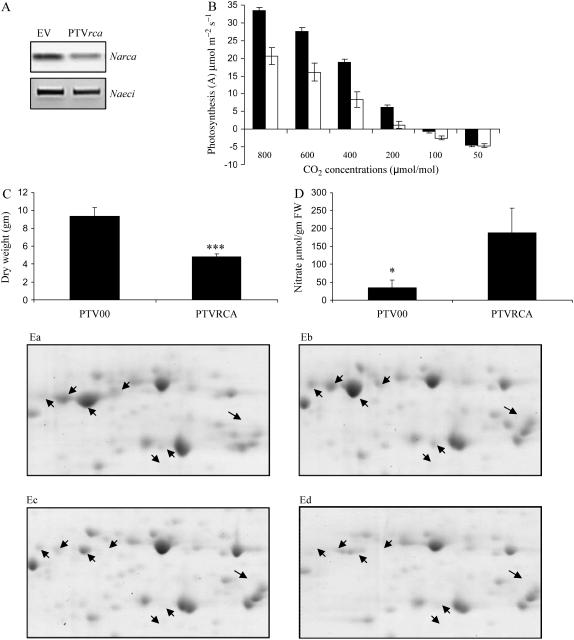
Effect of RCA reduction on photosynthesis, biomass, and nitrate content in N. attenuata. Three-week-old N. attenuata plants were inoculated with Agrobacterium tumefaciens harboring a TRV-based construct containing a 268-bp fragment of Narca or EV constructs for the VIGS experiments. A, Gene silencing was confirmed at transcript and (Ea–Ed) proteomic levels. RCA spots are from rca-silenced plants compared with EV-transformed plants; shown are EV control leaves (Ea), EV leaves treated with OS (Eb), rca-VIGS control leaves (Ec), and rca-VIGS leaves treated with OS (Ed). B, Net photosynthetic rates and intercellular CO2 concentrations of rca-VIGS plants (white bars) were measured and compared to EV control plants (black bars) under saturating light (approximately 1,400 μm m−2 s−1) intensities using a LI-COR 6400 portable photosynthesis system. C, Seven-week-old plants were harvested and dried in the oven at 60oC for 48 h for dry mass measurements. D, The nitrate content of these plants was measured spectrophotometrically.

References

    1. Aebersold R, Mann M (2003) Mass spectrometry-based proteomics. Nature 422: 198–207 - PubMed
    1. Anderson JP, Thatcher LF, Singh KB (2005) Plant defence responses: conservation between models and crops. Funct Plant Biol 32: 21–34 - PubMed
    1. Baldwin IT (2001) An ecologically motivated analysis of plant-herbivore interactions in native tobacco. Plant Physiol 127: 1449–1458 - PMC - PubMed
    1. Bertone P, Snyder M (2005) Prospects and challenges in proteomics. Plant Physiol 138: 560–562 - PMC - PubMed
    1. Bischoff M, Schaller A, Bieri F, Kessler F, Amrhein N, Schmid J (2001) Molecular characterization of tomato 3-dehydroquinate dehydratase-shikimate:NADP oxidoreductase. Plant Physiol 125: 1891–1900 - PMC - PubMed

Publication types

MeSH terms

LinkOut - more resources