


Rapid evolution of diminished transformability in Acinetobacter baylyi
- PMID: 17028281
- PMCID: PMC1698229
- DOI: 10.1128/JB.00846-06
Rapid evolution of diminished transformability in Acinetobacter baylyi
Abstract
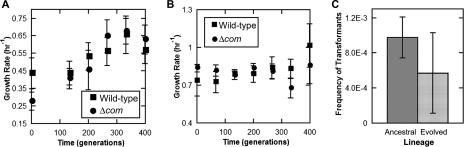
The reason for genetic exchange remains a crucial question in evolutionary biology. Acinetobacter baylyi strain ADP1 is a highly competent and recombinogenic bacterium. We compared the parallel evolution of wild-type and engineered noncompetent lineages of A. baylyi in the laboratory. If transformability were to result in an evolutionary benefit, it was expected that competent lineages would adapt more rapidly than noncompetent lineages. Instead, regardless of competency, lineages adapted to the same extent under several laboratory conditions. Furthermore, competent lineages repeatedly evolved a much lower level of transformability. The loss of competency may be due to a selective advantage or the irreversible transfer of loss-of-function alleles of genes required for transformation within the competent population.
Figures
References
-
- Ausubel, F. M. 1997. Short protocols in molecular biology: a compendium of methods from Current Protocols in Molecular Biology, 3rd ed. Wiley, New York, N.Y.
-
- Barbe, V., D. Vallenet, N. Fonknechten, A. Kreimeyer, S. Oztas, L. Labarre, S. Cruveiller, C. Robert, S. Duprat, P. Wincker, L. N. Ornston, J. Weissenbach, P. Marliere, G. N. Cohen, and C. Medigue. 2004. Unique features revealed by the genome sequence of Acinetobacter sp. ADP1, a versatile and naturally transformation competent bacterium. Nucleic Acids Res. 32:5766-5779. - PMC - PubMed
-
- Bell, G. 1982. The masterpiece of nature: the evolution and genetics of sexuality. University of California Press, Berkeley.
-
- Bell, G. 1997. Selection: the mechanism of evolution. Chapman & Hall, New York, N.Y.
Publication types
MeSH terms
Substances
Grants and funding
LinkOut - more resources
Full Text Sources
