. 2006 Dec;98(6):1301-10.
doi: 10.1093/aob/mcl219. Epub 2006 Oct 7.

Drought, abscisic acid and transpiration rate effects on the regulation of PIP aquaporin gene expression and abundance in Phaseolus vulgaris plants

Affiliations

Drought, abscisic acid and transpiration rate effects on the regulation of PIP aquaporin gene expression and abundance in Phaseolus vulgaris plants

Ricardo Aroca et al. Ann Bot. 2006 Dec.

Abstract

Background and aims: Drought causes a decline of root hydraulic conductance, which aside from embolisms, is governed ultimately by aquaporins. Multiple factors probably regulate aquaporin expression, abundance and activity in leaf and root tissues during drought; among these are the leaf transpiration rate, leaf water status, abscisic acid (ABA) and soil water content. Here a study is made of how these factors could influence the response of aquaporin to drought.

Methods: Three plasma membrane intrinsic proteins (PIPs) or aquaporins were cloned from Phaseolus vulgaris plants and their expression was analysed after 4 d of water deprivation and also 1 d after re-watering. The effects of ABA and of methotrexate (MTX), an inhibitor of stomatal opening, on gene expression and protein abundance were also analysed. Protein abundance was examined using antibodies against PIP1 and PIP2 aquaporins. At the same time, root hydraulic conductance (L), transpiration rate, leaf water status and ABA tissue concentration were measured.

Key results: None of the treatments (drought, ABA or MTX) changed the leaf water status or tissue ABA concentration. The three treatments caused a decline in the transpiration rate and raised PVPIP2;1 gene expression and PIP1 protein abundance in the leaves. In the roots, only the drought treatment raised the expression of the three PIP genes examined, while at the same time diminishing PIP2 protein abundance and L. On the other hand, ABA raised both root PIP1 protein abundance and L.

Conclusions: The rise of PvPIP2;1 gene expression and PIP1 protein abundance in the leaves of P. vulgaris plants subjected to drought was correlated with a decline in the transpiration rate. At the same time, the increase in the expression of the three PIP genes examined caused by drought and the decline of PIP2 protein abundance in the root tissues were not correlated with any of the parameters measured.


Figures
F<sc>ig</sc>. 1
Fig. 1
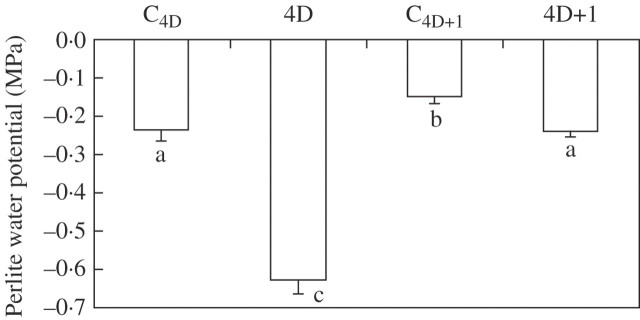
Perlite water potential of common bean plants subjected to drought for 4 d (4D) and 1 d after re-watering (4D + 1), and the corresponding control plants (C4D and C4D+1). Bars represent the mean ± s.e. (n = 10). Bars with the same letter indicate that there are no significant differences (P > 0.05) among them after ANOVA and Fisher l.s.d. tests.
F<sc>ig</sc>. 2
Fig. 2
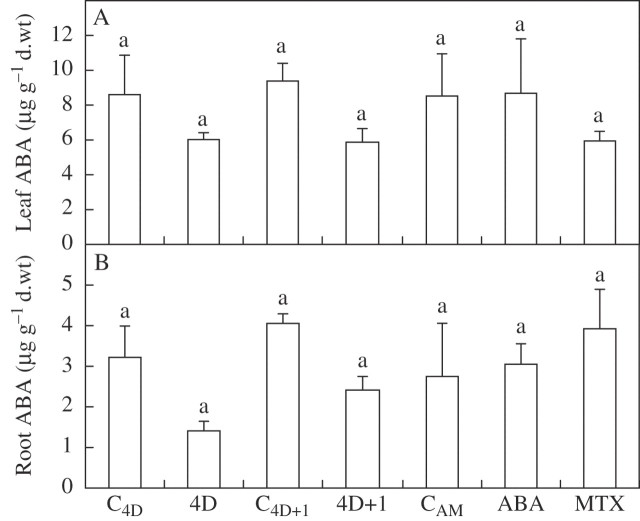
Leaf (A) and root (B) endogenous ABA content of common bean plants subjected to drought for 4 d (4D) and 1 d after re-watering (4D + 1), and the corresponding control plants (C4D and C4D+1), or of plants leaf sprayed 24 h earlier with 100 μm ABA or 200 μm MTX, and unsprayed control plants (CAM). Bars represent the mean ± s.e. (n = 4). Bars with the same letter indicate that there are no significant differences (P > 0.05) among them after ANOVA and Fisher l.s.d. tests.
F<sc>ig</sc>. 3
Fig. 3
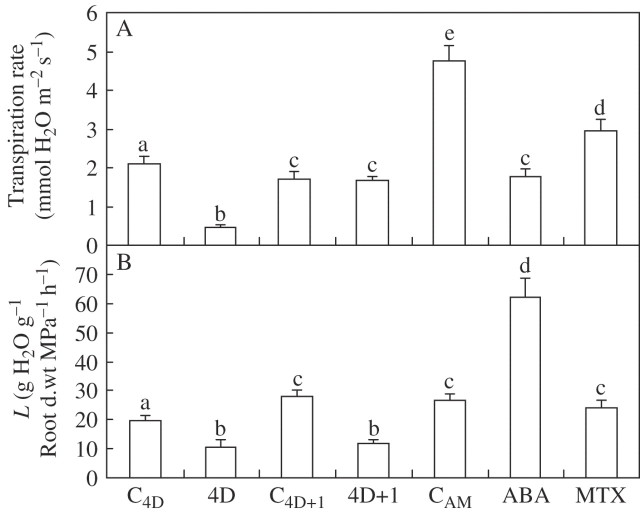
Leaf transpiration rate (A) and osmotic root hydraulic conductance (L; B) of common bean plants subjected to drought for 4 d (4D) and 1 d after re-watering (4D + 1), and the corresponding control plants (C4D and C4D+1), or of plants leaf sprayed 24 h earlier with 100 μm ABA or 200 μm MTX, and unsprayed control plants (CAM). Bars represent the mean ± s.e. (n = 20). Bars with the same letter indicate that there are no significant differences (P > 0.05) among them after ANOVA and Fisher l.s.d. tests.
F<sc>ig</sc>. 4
Fig. 4
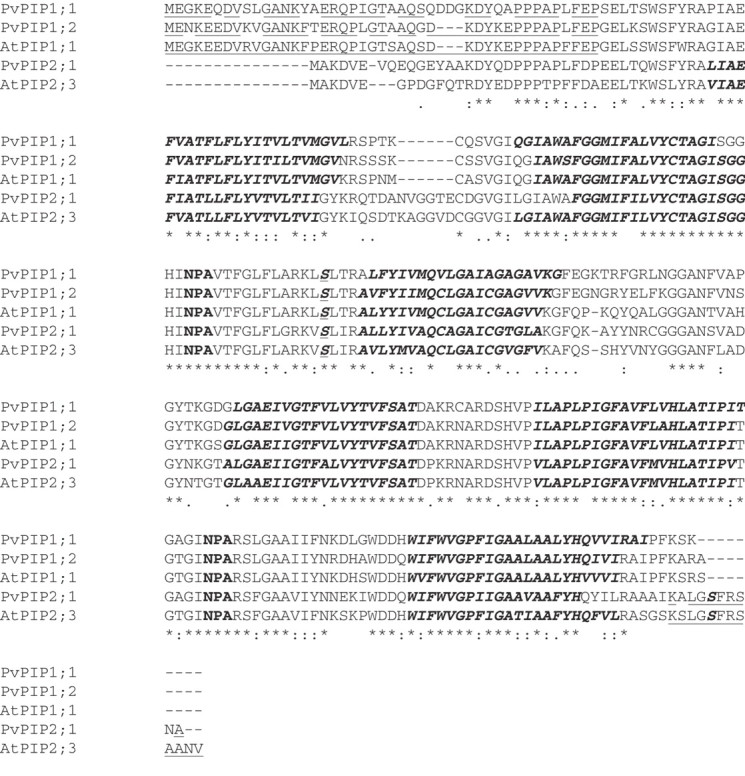
Alignment of the deduced amino acid sequence of P. vulgaris cDNAs PvPIP1;1 (accession no. U97023), PvPIP1;2 (accession no. AY995196) and PvPIP2;1 (accession no. AY995195), and comparison with AtPIP1;1 (accession no. X75881) and AtPIP2;3 (accession no. D13254). Two conserved NPA motifs are in bold. Putative membrane-spanning regions are in bold and italics. Putative phosphorylation sites at Ser117 and Ser280 are in italics, underlined and in bold. Regions recognized by antibodies are underlined. Asterisks indicate conserved sites in all the genes aligned. : and . indicate degree of amino acid similarity among protein sequences.
F<sc>ig</sc>. 5
Fig. 5
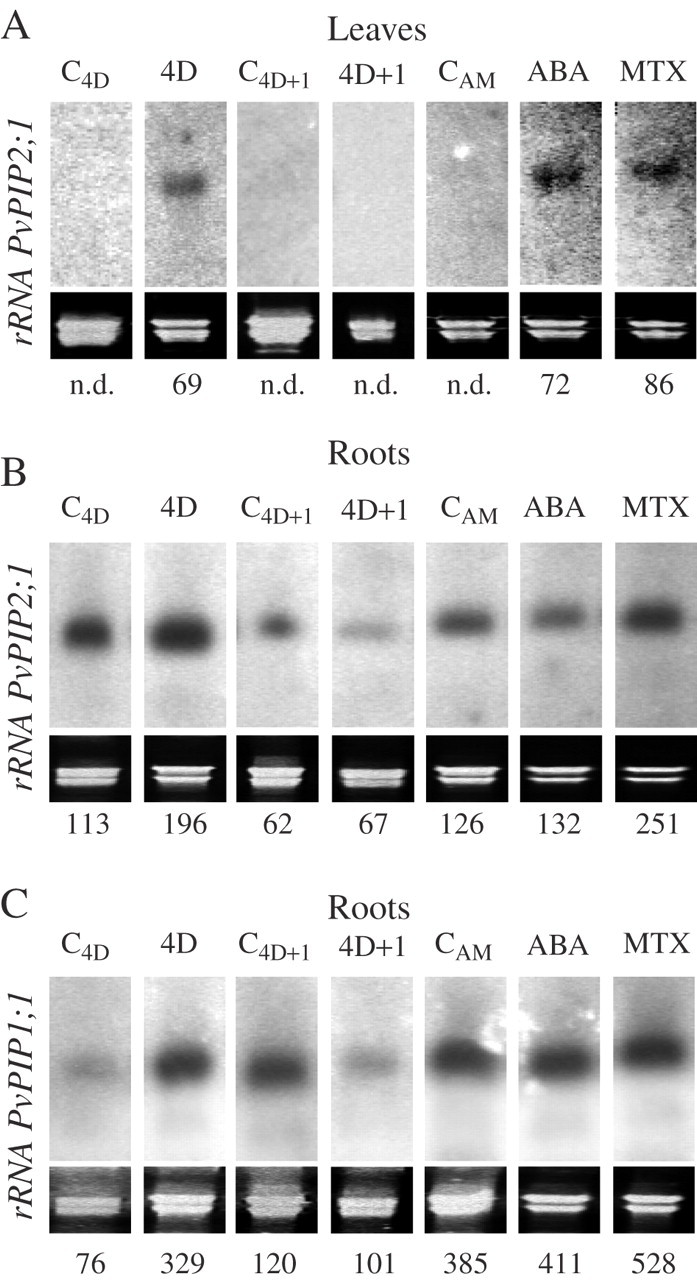
Northern blots of the PvPIP2;1 gene in leaves (A) and roots (B) and the PvPIP1;1 gene in roots (C) of common bean plants subjected to drought for 4 d (4D) and 1 d after re-watering (4D + 1), and the corresponding control plants (C4D and C4D+1), or of plant leaves sprayed 24 h earlier with 100 μm ABA or 200 μm MTX, and unsprayed control plants (CAM). The signal from the PvPIP1;2 gene was the same as that for PvPIP1;1 (data not shown). Blots were repeated three times with different sets of plants; representative blots are shown. Quantification of the gene expression was performed by dividing the intensity value of each band by the intensity of the corresponding rRNA stained with ethidium bromide. n.d., not detected.
F<sc>ig</sc>. 6
Fig. 6
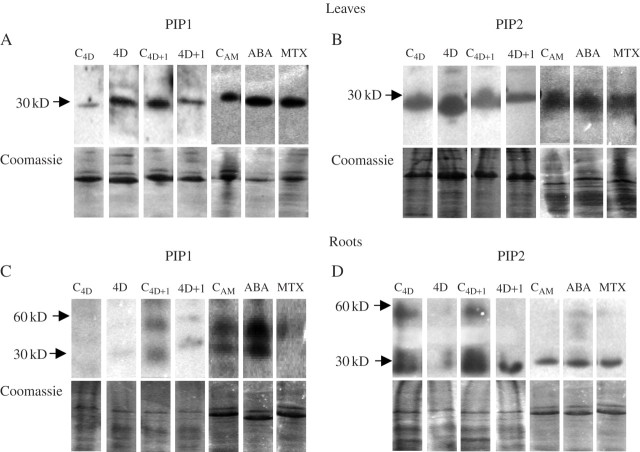
Western blots using antibodies against PIP1 (A and C) and PIP2 (B and D) proteins in leaves (A and B) and in roots (C and D) of common bean plants subjected to drought for 4 d (4D) and 1 d after re-watering (4D + 1), and the corresponding control plants (C4D and C4D+1), leaves sprayed 24 h earlier with 100 μm ABA or 200 μm MTX, and unsprayed control plants (CAM). Blots were repeated three times with different sets of plants; representative blots are shown. The corresponding Coomassie-stained gel shows the protein loaded in each lane.

References

    1. Aharon R, Shahak Y, Wininger S, Bendov R, Kapulnik Y, Galili G. (2003) Overexpression of a plasma membrane aquaporin in transgenic tobacco improves plant vigor under favorable growth conditions but not under drought or salt stress. Plant Cell 15439–447. - PMC - PubMed
    1. Alexandersson E, Fraysse L, Sjövall-Larsen S, Gustavsson S, Fellert M, Karlsson M, et al. (2005) Whole gene family expression and drought stress regulation of aquaporins. Plant Molecular Biology 59469–484. - PubMed
    1. Aroca R. (2006) Exogenous catalase and ascorbate modify the effects of abscisic acid (ABA) on root hydraulic properties in Phaseolus vulgaris L. plants. Journal of Plant Growth Regulation 2510–17.
    1. Aroca R, Vernieri P, Irigoyen JJ, Sánchez-Díaz M, Tognoni F, Pardossi A. (2003) Involvement of abscisic acid in leaf and root of maize (Zea mays L.) in avoiding chilling-induced water stress. Plant Science 165671–679.
    1. Aroca R, Amodeo G, Fernádez-Illescas S, Herman EH, Chaumont F, Chrispeels MJ. (2005) The role of aquaporins and membrane damage in chilling and hydrogen peroxide induced changes in the hydraulic conductance of maize roots. Plant Physiology 137341–353. - PMC - PubMed

Publication types