. 2006 Dec;174(4):1745-54.
doi: 10.1534/genetics.106.058933. Epub 2006 Oct 8.

Centromere-proximal crossovers are associated with precocious separation of sister chromatids during meiosis in Saccharomyces cerevisiae

Affiliations

Centromere-proximal crossovers are associated with precocious separation of sister chromatids during meiosis in Saccharomyces cerevisiae

Beth Rockmill et al. Genetics. 2006 Dec.

Abstract

In most organisms, meiotic chromosome segregation is dependent on crossovers (COs), which enable pairs of homologous chromosomes to segregate to opposite poles at meiosis I. In mammals, the majority of meiotic chromosome segregation errors result from a lack of COs between homologs. Observations in Homo sapiens and Drosophila melanogaster have revealed a second class of exceptional events in which a CO occurred near the centromere of the missegregated chromosome. We show that in wild-type strains of Saccharomyces cerevisiae, most spore inviability is due to precocious separation of sister chromatids (PSSC) and that PSSC is often associated with centromere-proximal crossing over. COs, as opposed to nonreciprocal recombination events (NCOs), are preferentially associated with missegregation. Strains mutant for the RecQ homolog, SGS1, display reduced spore viability and increased crossing over. Much of the spore inviability in sgs1 results from PSSC, and these events are often associated with centromere-proximal COs, just as in wild type. When crossing over in sgs1 is reduced by the introduction of a nonnull allele of SPO11, spore viability is improved, suggesting that the increased PSSC is due to increased crossing over. We present a model for PSSC in which a centromere-proximal CO promotes local loss of sister-chromatid cohesion.


Figures
F<sc>igure</sc> 1.—
Figure 1.—
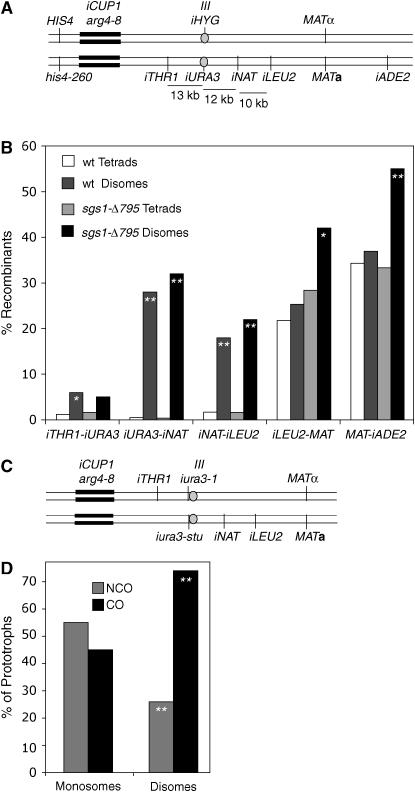
Centromere-proximal crossovers are associated with disomy. (A) Configuration of markers in strains used for the detection and analysis of chromosome III disomy and associated recombination events. (B) Map distances in five intervals from four-spore viable tetrads (converted to random spore data) are compared to map distances found in disomic spores derived from wild type and sgs1795 (materials and methods). Intervals where map distances in disomic spores are significantly different from map distances in tetrads are indicated by asterisks (*, P < 0.05; **, P ≪ 0.001). (C) Configuration of markers in the strain used to measure COs associated with gene conversion. (D) The frequency of crossing over associated with gene conversion is shown for monosomic Ura+ recombinants and for mating-competent Ura+ disomes. The results from monosomes and disomes are significantly different (P < 0.0001 using chi-square analysis).
F<sc>igure</sc> 2.—
Figure 2.—
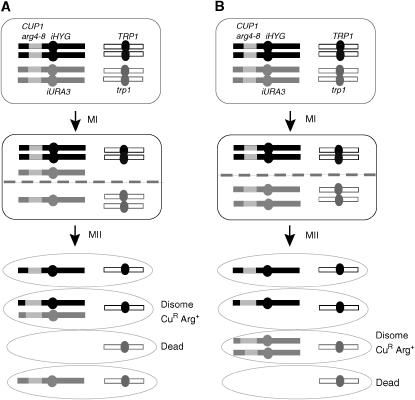
Precocious separation of sister chromatids. (A) PSSC at meiosis I. Shown are two pairs of homologous chromosomes, with each chromosome consisting of two sister chromatids. The larger chromosomes carry the markers used to detect disomes (arg4-8, CUP1, bars with light shading). Circles represent centromeres. At meiosis I, the pair of small chromosomes segregates properly, while one of the large chromosomes undergoes PSSC. At meiosis II, intact pairs of sister chromatids undergo proper sister segregation, but single chromatids segregate randomly. This results in a tetrad in which one spore is disomic, containing nonsister chromatids, and this spore has a viable sister spore. Two spores are euploid, and one is inviable due to aneuploidy. (B) PSSC at meiosis II. Chromosomes segregate properly at meiosis I. At meiosis II, both sister chromatids segregate to the same pole, forming a disomic spore carrying sister chromatids and an inviable sister spore.
F<sc>igure</sc> 3.—
Figure 3.—
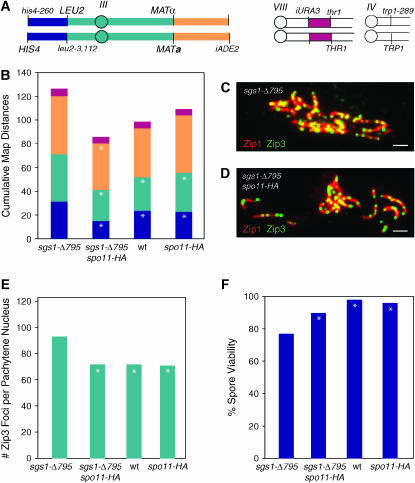
SPO11-HA suppresses sgs1795. (A) Configuration of markers in strains used for analysis of crossing over in various mutant backgrounds. (B) COs were measured in four intervals in wild type (BR4316), sgs1795 (BR4474), spo11-HA (BR4357), and sgs1795 spo11-HA (BR4475). Intervals are designated by the color utilized in A. Asterisks denote intervals in which map distances are significantly different from those in sgs1 (P < 0.05). (C) Spread nucleus from sgs1795 cell at pachytene stained for Zip3-GFP (green) and Zip1 (red) in pachytene. Yellow indicates regions of overlap. Bar, 1 μm. (D) Spread nucleus from sgs1795 spo11-HA stained as in C. Bar, 1 μm. (E) Zip3-GFP foci were quantified in pachytene-staged chromosome spreads. Asterisks denote strains in which the number of Zip3 foci is significantly different from that of sgs1795 (P < 0.05 using the t-test). (F) Spore viability. Differences between strains were assessed using the big G-test with spore viability patterns (i.e., four-, three-, two-, one-, and zero-spore viable, not shown). Asterisks denote strains in which spore viability is significantly different from that of sgs1795.

References

    1. Agarwal, S., and G. S. Roeder, 2000. Zip3 provides a link between recombination enzymes and synaptonemal complex proteins. Cell 102: 245–255. - PubMed
    1. Baudat, F., and A. Nicolas, 1997. Clustering of meiotic double-strand breaks on yeast chromosome III. Proc. Natl. Acad. Sci. USA 94: 5213–5218. - PMC - PubMed
    1. Blat, Y., and N. Kleckner, 1999. Cohesins bind to preferential sites along yeast chromosome III, with differential regulation along arms versus the centric region. Cell 98: 249–259. - PubMed
    1. Bloom, K., S. Sharma and N. V. Dokholyan, 2006. The path of DNA in the kinetochore. Curr. Biol. 16: R276–R278. - PMC - PubMed
    1. Boeke, J. D., F. Lacroute and G. R. Fink, 1984. A positive selection for mutants lacking orotidine-5′-phosphate decarboxylase activity in yeast: 5-fluoro-orotic acid resistance. Mol. Gen. Genet. 197: 345–346. - PubMed

Publication types

Substances