


Molecular characterization of deletion breakpoints in adults with 22q11 deletion syndrome
- PMID: 17028864
- PMCID: PMC3139629
- DOI: 10.1007/s00439-006-0242-x
Molecular characterization of deletion breakpoints in adults with 22q11 deletion syndrome
Abstract
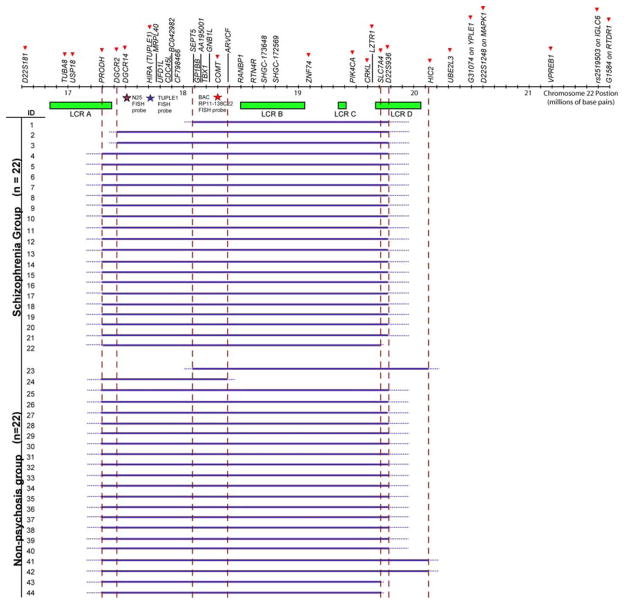
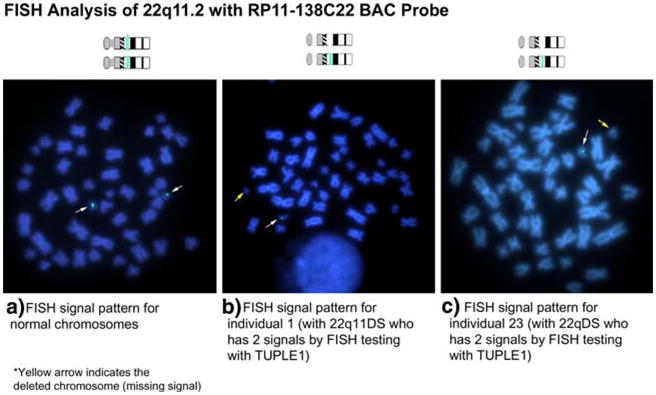
22q11 Deletion syndrome (22q11DS) is a common microdeletion syndrome with variable expression, including congenital and later onset conditions such as schizophrenia. Most studies indicate that expression does not appear to be related to length of the deletion but there is limited information on the endpoints of even the common deletion breakpoint regions in adults. We used a real-time quantitative PCR (qPCR) approach to fine map 22q11.2 deletions in 44 adults with 22q11DS, 22 with schizophrenia (SZ; 12 M, 10 F; mean age 35.7 SD 8.0 years) and 22 with no history of psychosis (NP; 8 M, 14 F; mean age 27.1 SD 8.6 years). QPCR data were consistent with clinical FISH results using the TUPLE1 or N25 probes. Two subjects (one SZ, one NP) negative for clinical FISH had atypical 22q11.2 deletions confirmed by FISH using the RP11-138C22 probe. Most (n = 34; 18 SZ, 16 NP) subjects shared a common 3 Mb hemizygous 22q11.2 deletion. However, eight subjects showed breakpoint variability: a more telomeric proximal breakpoint (n = 2), or more centromeric (n = 3) or more telomeric distal breakpoint (n = 3). One NP subject had a proximal nested 1.4 Mb deletion. COMT and TBX1 were deleted in all 44 subjects, and PRODH in 40 subjects (19 SZ, 21 NP). The results delineate proximal and distal breakpoint variants in 22q11DS. Neither deletion extent nor PRODH haploinsufficiency appeared to explain the clinical expression of schizophrenia in the present study. Further studies are needed to elucidate the molecular basis of schizophrenia and clinical heterogeneity in 22q11DS.
Conflict of interest statement
None of the authors have financial interests that might present a conflict of interest.
Figures
References
-
- Amati F, Conti E, Novelli A, Bengala M, Diglio MC, Marino B, Giannotti A, Gabrielli O, Novelli G, Dallapiccola B. Atypical deletions suggest five 22q11.2 critical regions related to the DiGeorge/velo-cardio-facial syndrome. Eur J Hum Genet. 1999;7:903–909. - PubMed
-
- Bartsch O, Nemeckova M, Kocarek E, Wagner A, Puchmajerova A, Poppe M, Ounap K, Goetz P. DiGeorge/velocardiofacial syndrome: FISH studies of chromosomes 22q11 and 10p14, and clinical reports on the proximal 22q11 deletion. Am J Med Genet A. 2003;117:1–5. - PubMed
-
- Beatty B, Mai S, Squire J. FISH: a practical approach. Oxford University Press; Oxford, New York: 2002.
Publication types
MeSH terms
Associated data
- Actions
- Actions
Grants and funding
LinkOut - more resources
Full Text Sources
Medical
Miscellaneous
