


Fine motor skills in South African children with symptoms of ADHD: influence of subtype, gender, age, and hand dominance
- PMID: 17029638
- PMCID: PMC1626473
- DOI: 10.1186/1744-9081-2-33
Fine motor skills in South African children with symptoms of ADHD: influence of subtype, gender, age, and hand dominance
Abstract
Background: Motor problems, often characterised as clumsiness or poor motor coordination, have been associated with ADHD in addition to the main symptom groups of inattention, impulsiveness, and overactivity. The problems addressed in this study were: (1) Are motor problems associated with ADHD symptoms, also in African cultures? (2) Are there differences in motor skills among the subtypes with ADHD symptoms? (3) Are there gender differences? (4) Is there an effect of age? (5) Are there differences in performance between the dominant and non-dominant hand?
Method: A total of 528 children (264 classified as having symptoms of ADHD and 264 matched comparisons) of both genders and from seven different South African ethnic groups participated in the study. They were assessed with three simple, easy to administer instruments which measure various functions of motor speed and eye-hand coordination: The Grooved Pegboard, the Maze Coordination Task, and the Finger Tapping Test. The results were analysed as a function of subtype, gender, age, and hand dominance.
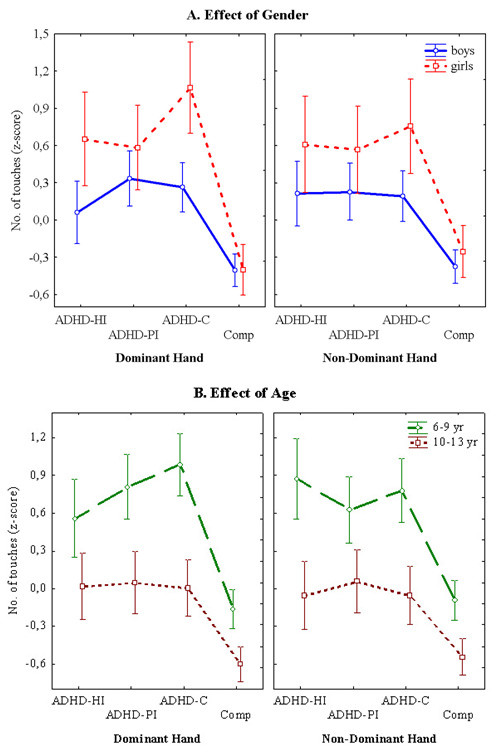
Results: The findings indicate that children with symptoms of ADHD performed significantly poorer on the Grooved Pegboard and Motor Coordination Task, but not on the Finger Tapping Test than their comparisons without ADHD symptoms. The impairment was most severe for the subtype with symptoms of ADHD-C (combined) and less severe for the subtypes with symptoms of ADHD-PI (predominantly inattentive) and ADHD-HI (predominantly hyperactive/impulsive). With few exceptions, both genders were equally affected while there were only slight differences in performance between the dominant and non-dominant hand. The deficiencies in motor control were mainly confined to the younger age group (6-9 yr).
Conclusion: An association between the symptoms of ADHD and motor problems was demonstrated in terms of accuracy and speed in fairly complex tasks, but not in simple motor tests of speed. This deficiency is found mainly in the children with ADHD-C symptoms, but also to a lesser degree in the children with symptoms of ADHD-PI and ADHD-HI.
Figures


References
-
- American Psychiatric Association . Diagnostic and statistical manual of mental disorders: DSM-IV-TR. Washington DC, Author; 2000.
-
- Barkley RA. Attention-deficit hyperactivity disorder: A handbook for diagnosis and treatment. 2. New York, The Guilford Press; 1998.
LinkOut - more resources
Full Text Sources
Research Materials
Miscellaneous
