


Value of recruitment strategies used in a primary care practice-based trial
- PMID: 17030154
- PMCID: PMC3760001
- DOI: 10.1016/j.cct.2006.08.009
Value of recruitment strategies used in a primary care practice-based trial
Abstract
Purpose: "Physicians-recruiting-physicians" is the preferred recruitment approach for practice-based research. However, yields are variable; and the approach can be costly and lead to biased, unrepresentative samples. We sought to explore the potential efficiency of alternative methods.
Methods: We conducted a retrospective analysis of the yield and cost of 10 recruitment strategies used to recruit primary care practices to a randomized trial to improve cardiovascular disease risk factor management. We measured response and recruitment yields and the resources used to estimate the value of each strategy. Providers at recruited practices were surveyed about motivation for participation.
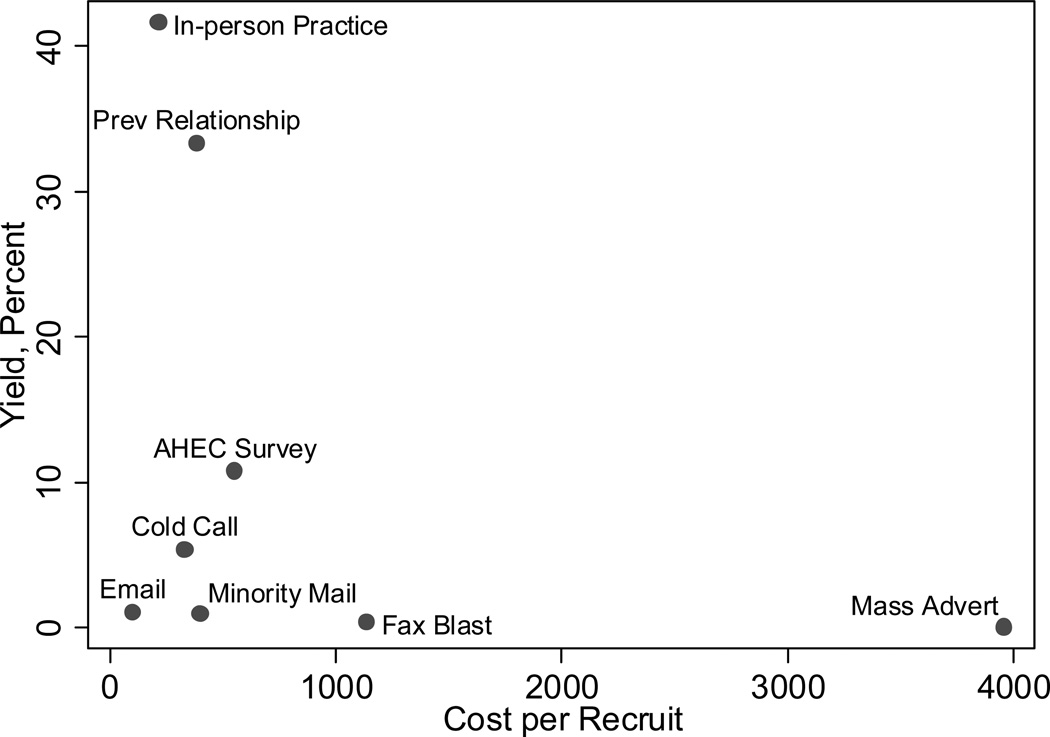
Results: Response to 6 opt-in marketing strategies was 0.40% (53/13290), ranging from 0% to 2.86% by strategy; 33.96% (18/53) of responders were recruited to the study. Of those recruited from opt-out strategies, 8.68% joined the study, ranging from 5.35% to 41.67% per strategy. A strategy that combined both opt-in and opt-out approaches resulted in a 51.14% (90/176) response and a 10.80% (19/90) recruitment rate. Cost of recruitment was $613 per recruited practice. Recruitment approaches based on in-person meetings (41.67%), previous relationships (33.33%), and borrowing an Area Health Education Center's established networks (10.80%), yielded the most recruited practices per effort and were most cost efficient. Individual providers who chose to participate were motivated by interest in improving their clinical practice (80.5%); contributing to CVD primary prevention (54.4%); and invigorating their practice with new ideas (42.1%).
Conclusions: This analysis provides suggestions for future recruitment efforts and research. Translational studies with limited funds could consider multi-modal recruitment approaches including in-person presentations to practice groups and exploitation of previous relationships, which require the providers to opt-out, and interactive opt-in approaches which rely on borrowed networks. These approaches can be supplemented with non-relationship-based opt-out strategies such as cold calls strategically targeted to underrepresented provider groups.
Conflict of interest statement
The authors Shellie Ellis, Alain Bertoni, Denise Bonds, Aarthi Balasubramanyam, Caroline Blackwell, Haiying Chen, C. Randall Clinch, and David Goff, Jr. have no conflicts of interest. Michael Lischke oversees the Northwest Area Health Education Center of Wake Forest University School of Medicine.
Figures
References
-
- Nutting PA, Beasley JW, Werner JJ. Practice-based research networks answer primary care questions. JAMA. 1999:686–688. - PubMed
-
- Park ER, MacDonald Gross NA, Goldstein MG, DePue JD, Hecht JP, Eaton CA, Niaura R, Dube CE. Physician recruitment for a community-based smoking cessation intervention. J Fam. Pract. 2002:70. - PubMed
-
- Reid CM, Ryan P, Nelson M, Beckinsale P, McMurchie M, Gleave D, DeLoozef F, Wing LM. General practitioner participation in the second Australian National Blood Pressure Study (ANBP2) Clin. Exp. Pharmacol. Physiol. 2001:663–667. - PubMed
-
- Shelton BJ, Wofford JL, Gosselink CA, McClatchey MW, Brekke K, Conry C, Wolfe P, Cohen SJ. Recruitment and retention of physicians for primary care research. J Community Health. 2002:79–89. - PubMed
Publication types
MeSH terms
Grants and funding
LinkOut - more resources
Full Text Sources
Medical
