


Utility of a new model to diagnose an alcohol basis for steatohepatitis
- PMID: 17030176
- PMCID: PMC2483536
- DOI: 10.1053/j.gastro.2006.08.020
Utility of a new model to diagnose an alcohol basis for steatohepatitis
Abstract
Background & aims: Distinguishing an alcohol basis from a nonalcoholic basis for the clinical and histologic spectrum of steatohepatitic liver disease is difficult because of unreliability of alcohol consumption history. Unfortunately, various biomarkers have had limited utility in distinguishing alcoholic liver disease (ALD) from nonalcoholic fatty liver disease (NAFLD). Thus, the aim of our study was to create and validate a model to diagnose ALD in patients with steatohepatitis.
Methods: A cross-sectional cohort study was performed at the Mayo Clinic, Rochester, Minnesota, to create a model using multivariable logistic regression analysis. This model was validated in 3 independent data sets comprising patients of varying severity of steatohepatitis spanning over 10 years.
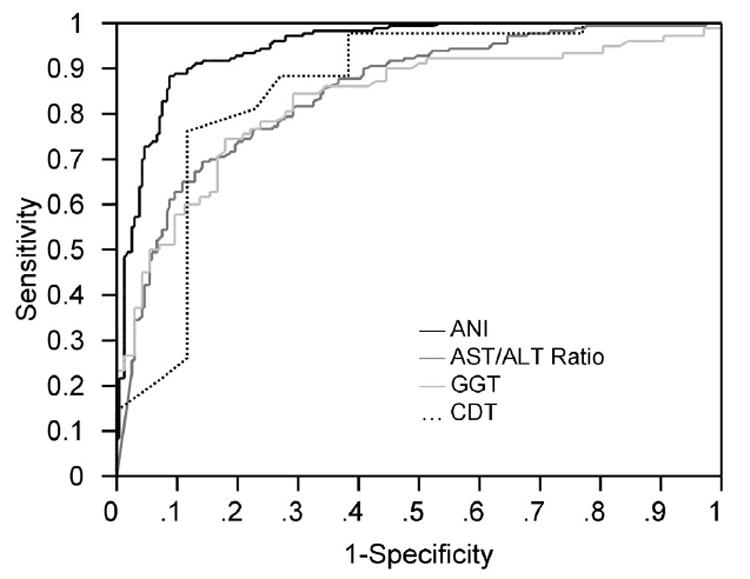
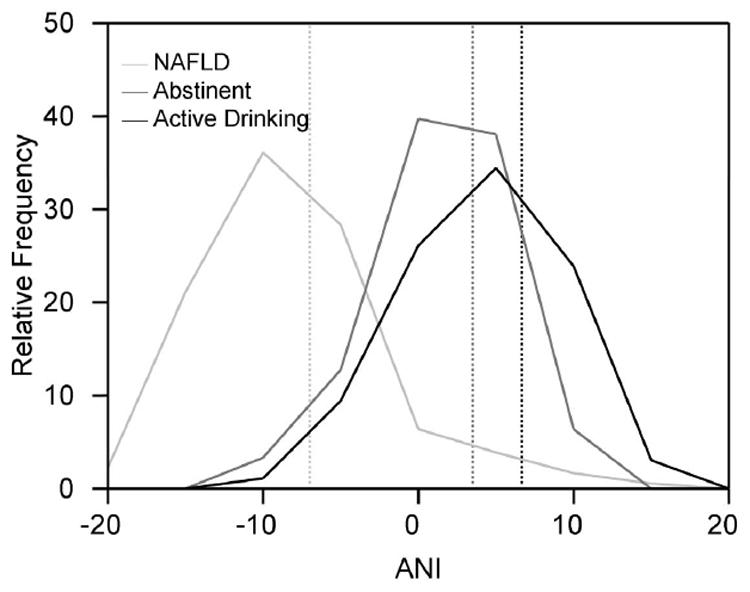
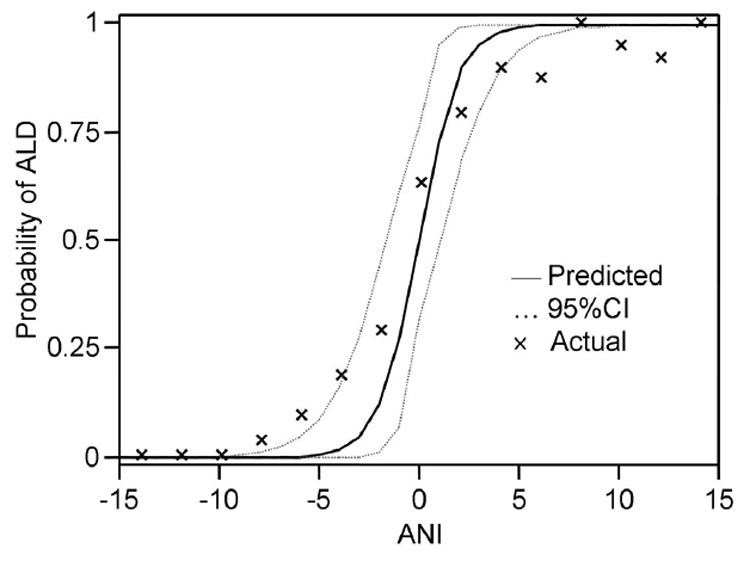
Results: Logistic regression identified mean corpuscular volume, aspartate aminotransferase (AST)/alanine aminotransferase (ALT) ratio, body mass index, and gender as the most important variables that separated patients with ALD from NAFLD. These variables were used to generate the ALD/NAFLD Index (ANI), with ANI of greater than zero incrementally favoring ALD and ANI of less than zero incrementally favoring a diagnosis of NAFLD, thus making ALD unlikely. ANI had a c-statistic of 0.989 in the derivation sample, and 0.974, 0.989, 0.767 in the 3 validation samples. ANI performance characteristics were significantly better than several conventional and recently proposed biomarkers used to differentiate ALD from NAFLD, including the histopathologic marker protein tyrosine phosphatase 1b, AST/ALT ratio, gamma-glutamyl transferase, and carbohydrate-deficient transferrin.
Conclusions: ANI, derived from easily available objective variables, accurately differentiates ALD from NAFLD in hospitalized, ambulatory, and pretransplantation patients and compares favorably with other traditional and proposed biomarkers.
Figures
Comment in
-
Usefulness of a new model to diagnose alcoholic liver disease in patients with steatohepatitis.Nat Clin Pract Gastroenterol Hepatol. 2007 May;4(5):258-9. doi: 10.1038/ncpgasthep0789. Nat Clin Pract Gastroenterol Hepatol. 2007. PMID: 17389873 No abstract available.
-
Distinguishing nonalcoholic fatty liver disease from alcoholic liver disease: is ANI enough?Gastroenterology. 2007 May;132(5):2076-7; author reply 2077-8. doi: 10.1053/j.gastro.2007.03.083. Gastroenterology. 2007. PMID: 17484908 No abstract available.
References
-
- Said A, Williams J, Holden J, Remington P, Musat A, Lucey MR. The prevalence of alcohol-induced liver disease and hepatitis C and their interaction in a tertiary care setting. Clin Gastroenterol Hepatol. 2004;2:928–34. - PubMed
-
- Mofrad P, Contos MJ, Haque M, Sargeant C, Fisher RA, Luketic VA, Sterling RK, Shiffman ML, Stravitz RT, Sanyal AJ. Clinical and histologic spectrum of nonalcoholic fatty liver disease associated with normal ALT values. Hepatology. 2003;37:1286–92. - PubMed
-
- Kunde SS, Lazenby AJ, Clements RH, Abrams GA. Spectrum of NAFLD and diagnostic implications of the proposed new normal range for serum ALT in obese women. Hepatology. 2005;42:650–6. - PubMed
-
- Akriviadis E, Botla R, Briggs W, Han S, Reynolds T, Shakil O. Pentoxifylline improves short-term survival in severe acute alcoholic hepatitis: a double-blind, placebo-controlled trial. Gastroenterology. 2000;119:1637–48. - PubMed
-
- Carithers RJ, Herlong H, Diehl A, Shaw E, Combes B, Fallon H, Maddrey W. Methylprednisolone therapy in patients with severe alcoholic hepatitis. A randomized multicenter trial [see comments] Annals of Internal Medicine. 1989;110:685–90. - PubMed
Publication types
MeSH terms
Substances
Grants and funding
LinkOut - more resources
Full Text Sources
Other Literature Sources
Medical
