. 2006 Oct 17;103(42):15588-93.
doi: 10.1073/pnas.0604524103. Epub 2006 Oct 9.

High-molecular-mass APOBEC3G complexes restrict Alu retrotransposition

Affiliations

High-molecular-mass APOBEC3G complexes restrict Alu retrotransposition

Ya-Lin Chiu et al. Proc Natl Acad Sci U S A. .

Abstract

APOBEC3G (A3G) and related deoxycytidine deaminases are potent intrinsic antiretroviral factors. A3G is expressed either as an enzymatically active low-molecular-mass (LMM) form or as an enzymatically inactive high-molecular-mass (HMM) ribonucleoprotein complex. Resting CD4 T cells exclusively express LMM A3G, where it functions as a powerful postentry restriction factor for HIV-1. Activation of CD4 T cells promotes the recruitment of LMM A3G into 5- to 15-MDa HMM complexes whose function is unknown. Using tandem affinity purification techniques coupled with MS, we identified Staufen-containing RNA-transporting granules and Ro ribonucleoprotein complexes as specific components of HMM A3G complexes. Analysis of RNAs in these complexes revealed Alu and small Y RNAs, two of the most prominent nonautonomous mobile genetic elements in human cells. These retroelement RNAs are recruited into Staufen-containing RNA-transporting granules in the presence of A3G. Retrotransposition of Alu and hY RNAs depends on the reverse transcriptase machinery provided by long interspersed nucleotide elements 1 (L1). We now show that A3G greatly inhibits L1-dependent retrotransposition of marked Alu retroelements not by inhibiting L1 function but by sequestering Alu RNAs in cytoplasmic HMM A3G complexes away from the nuclear L1 enzymatic machinery. These findings identify nonautonomous Alu and hY retroelements as natural cellular targets of A3G and highlight how different forms of A3G uniquely protect cells from the threats posed by exogenous retroviruses (LMM A3G) and endogenous retroelements (HMM A3G).


Conflict of interest statement

The authors declare no conflict of interest.

Figures

Fig. 1.
Fig. 1.
Characterization of HMM A3G complexes. (A) NTAP–A3G expressed in 293T cells principally resides in HMM complexes that are converted to LMM forms after RNase A treatment. FPLC analysis was performed as described (13). The upper band of the doublet recognized by anti-A3G corresponds to the tagged A3G, and the bottom band corresponds to nontagged A3G derived from a cleavage reaction occurring between the tags and A3G. (B) TAP of HMM NTAP–A3G complexes. Purified proteins were visualized by Coomassie staining (Left) and anti-A3G blotting (Right). Control cell lysates containing unlinked NTAP and HA–A3G were identically processed (lane 1). (C) NTAP–APO1 (lane 1) and NTAP–A3G (lane 3) bind different sets of proteins based on silver staining. ◇, NTAP-tagged proteins.
Fig. 2.
Fig. 2.
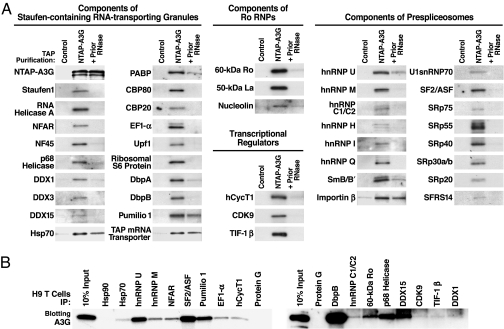
Verifying the tandem MS-identified protein cofactors. (A) Purified complexes (NTAP–A3G) or control purifications (unlinked NTAP plus HA–A3G) were immunoblotted with antibodies specific for the indicated proteins. To test RNase A sensitivity of cofactor binding, lysates were pretreated with 50 μg/ml RNase A (+Prior RNase) for 2 h at 4°C before purification. Shown are 42 representative components of Staufen-containing RNA-transporting granules, Ro RNPs, transcriptional regulators, and prespliceosomes. Some cofactors (e.g., Hsp70, Pumilio 1, TAP mRNA transporter, and importin-β) were detected after RNase treatment, suggesting RNA-independent interactions with A3G. Several multifunctional proteins, including nucleolin, DbpB, RNA helicase A, NFAR, and E1B–Ap5, participate in more than one RNP. (B) Endogenous A3G in H9 T cells assembles into the same RNPs. IP analyses were performed with antibodies reacting with select components of the various RNPs identified in HMM A3G complexes followed by rabbit (Left) or mouse (Right) anti-A3G blotting. IP with protein G-agarose or antibodies reacting with Hsp90, an abundant protein not copurifying with NTAP–A3G, were included as negative controls. Fig. 8 provides data on the IP efficiency of each antibody.
Fig. 3.
Fig. 3.
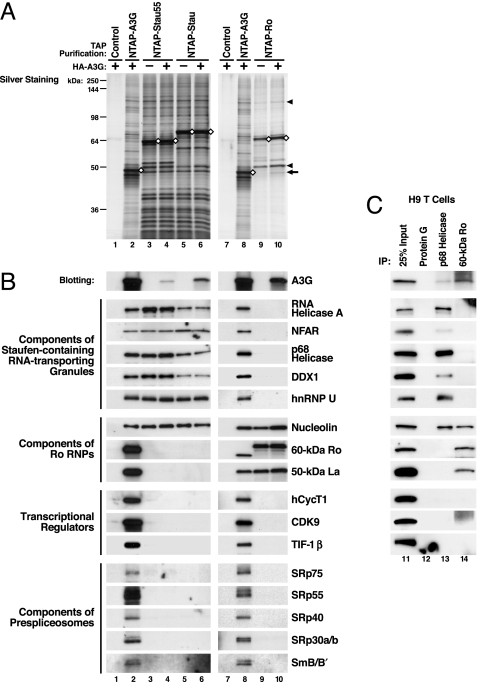
HMM A3G complexes correspond to at least three RNP complexes. (A) NTAP-tagged Staufen1 (Stau), a 55-kDa splicing variant of Staufen1 (Stau55), and 60-kDa Ro were subjected to TAP after expression in the absence or presence of HA–A3G coexpression. As controls, cell lysates containing unlinked NTAP and HA–A3G were identically processed (lanes 1 and 7). Arrow, HA–A3G copurified with NTAP–Ro; arrowheads, nucleolin and 50-kDa La. (B) Purified proteins were immunoblotted with antibodies reacting with the indicated proteins. Association of HA–A3G with NTAP–Stau (Stau55) and NTAP–Ro RNPs was detected by anti-HA (top sets of panels). (C) Endogenous A3G associates with the same RNP complexes. Lysates from A3G-expressing H9 T cells were subjected to IP with antibodies reacting with p68 helicase, a major component of RNA-transporting granules, and 60-kDa Ro, a major component of Ro RNPs, followed by immunoblotting. IP with protein G-agarose was included as a negative control.
Fig. 4.
Fig. 4.
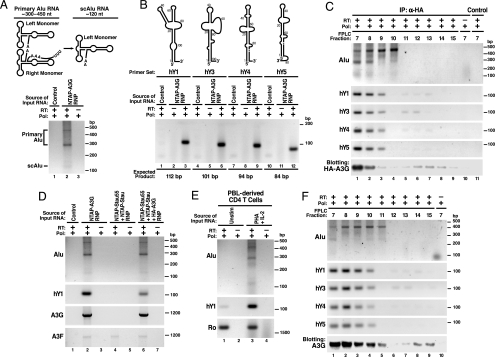
Detection of nonautonomous mobile genetic elements in the HMM A3G complexes. (A Upper) Schematic of primary Alu and processed scAlu RNAs. (A Lower) RT-PCR detection of primary Alu and scAlu RNAs in HMM A3G complexes. Control purifications: unlinked NTAP+HA–A3G. (B Upper) Schematic of hY RNAs. (B Lower) RT-PCR detection of hY RNAs in HMM A3G complexes. (C) Co-IP of Alu and hY RNAs with HA–A3G from HMM fractions of 293T lysates resolved by FPLC. Protein G-agarose in the absence of anti-HA served as a control. (D) A3G-dependent recruitment of Alu and hY RNAs into the Staufen-containing RNA granules. A3G and endogenous A3F mRNAs are also present in purified NTAP–A3G and NTAP–Stau (Stau55) complexes. Of note, 293T cells expressed extremely low levels of A3F. Alu RNA was not present in the RNA granules unless A3G was coexpressed. (E) PHA–IL-2-induced expression of Alu and hY RNAs in primary CD4 T cells. Cells were either untreated or treated with PHA (5 μg/ml) for 36 h followed by IL-2 (20 units/ml; Roche) for 36 h before analysis. (F) Alu and hY RNAs cofractionate with HMM A3G complexes in PHA–IL-2 activated primary CD4 T cells. Reactions performed with Pfx polymerase (Pol) but not reverse transcriptase (−RT) served as negative controls in each panel. RNA structures in A and B were adapted in part from refs. and .
Fig. 5.
Fig. 5.
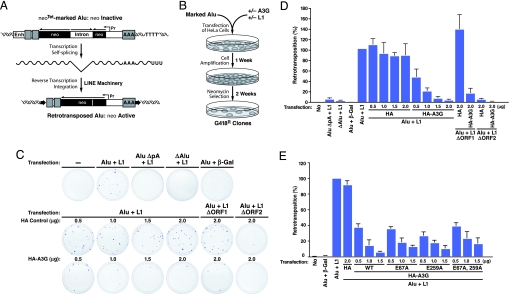
A3G restricts L1-dependent Alu retrotransposition. (A) Summary of marked Alu retrotransposition assay. An Alu element (gray boxes) was marked with the neoTet gene (dark box) driven by SV40 promoter (Pr) and placed in reverse orientation (Top). The neoTet gene is rendered inactive by an autocatalytic tetrahymena (Tet) intron inserted in the forward direction. This intron is removed by autosplicing when RNA is produced (Middle), allowing detection of retrotransposition after L1-dependent reverse transcription and integration. The expected structure of the resulting de novo Alu insertion is shown (Bottom). (B) Experimental procedure for detecting the effects of A3G on L1-dependent Alu retrotransposition. A and B were adapted from ref. . (C) A3G inhibits Alu retrotransposition. HeLa cells were transfected with Alu neoTet, L1 expression plasmids, and graded amounts of HA–A3G or HA vector DNA. Retrotransposition events were detected by staining G418-resistant (G418R) foci. Additional negative controls included an Alu element deficient in polyA tail (AluΔpA neoTet) or in right monomer sequences (ΔAlu neoTet), vectors encoding truncated, nonfunctional L1 mutants (ΔORF2), and the irrelevant β-gal gene. (D) Number of G418R clones. Data were normalized to the positive control (Alu neoTet + L1). Values represent the means ± SD from three independent experiments. (E) Inhibition of Alu retrotransposition by mutants of A3G (E259A and E67A/E259A) lacking deoxycytidine deaminase activity. Wild-type and E67A A3G retaining enzymatic activity were included for comparison. Values represent the means ± SD from three independent experiments.

References

    1. Sheehy AM, Gaddis NC, Choi JD, Malim MH. Nature. 2002;418:646–650. - PubMed
    1. Mangeat B, Turelli P, Caron G, Friedli M, Perrin L, Trono D. Nature. 2003;424:99–103. - PubMed
    1. Lecossier D, Bouchonnet F, Clavel F, Hance AJ. Science. 2003;300:1112. - PubMed
    1. Harris RS, Bishop KN, Sheehy AM, Craig HM, Petersen-Mahrt SK, Watt IN, Neuberger MS, Malim MH. Cell. 2003;113:803–809. - PubMed
    1. Zhang H, Yang B, Pomerantz RJ, Zhang C, Arunachalam SC, Gao L. Nature. 2003;424:94–98. - PMC - PubMed

Publication types