


Divergent mtDNA lineages of goats in an Early Neolithic site, far from the initial domestication areas
- PMID: 17030824
- PMCID: PMC1622831
- DOI: 10.1073/pnas.0602753103
Divergent mtDNA lineages of goats in an Early Neolithic site, far from the initial domestication areas
Abstract
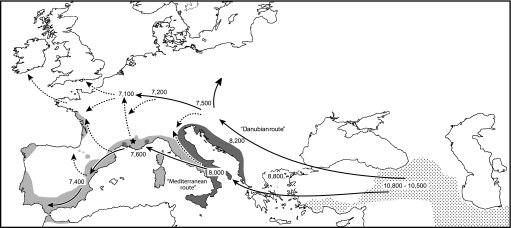
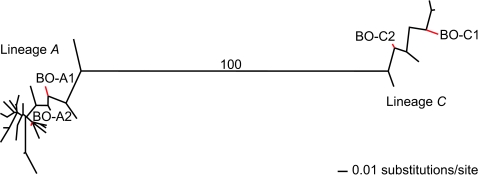
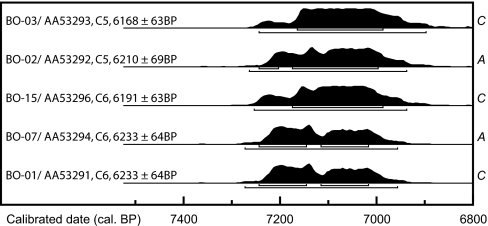
Goats were among the first farm animals domesticated, approximately 10,500 years ago, contributing to the rise of the "Neolithic revolution." Previous genetic studies have revealed that contemporary domestic goats (Capra hircus) show far weaker intercontinental population structuring than other livestock species, suggesting that goats have been transported more extensively. However, the timing of these extensive movements in goats remains unknown. To address this question, we analyzed mtDNA sequences from 19 ancient goat bones (7,300-6,900 years old) from one of the earliest Neolithic sites in southwestern Europe. Phylogenetic analysis revealed that two highly divergent goat lineages coexisted in each of the two Early Neolithic layers of this site. This finding indicates that high mtDNA diversity was already present >7,000 years ago in European goats, far from their areas of initial domestication in the Near East. These results argue for substantial gene flow among goat populations dating back to the early neolithisation of Europe and for a dual domestication scenario in the Near East, with two independent but essentially contemporary origins (of both A and C domestic lineages) and several more remote and/or later origins.
Conflict of interest statement
The authors declare no conflict of interest.
Figures
References
-
- Harris DR. The Origins and Spread of Agriculture and Pastoralism in Eurasia. London: UCL; 1996.
-
- Cauvin J. The Birth of the Gods and the Origins of Agriculture. Cambridge, UK: Cambridge Univ Press; 2000.
-
- Diamond J, Bellwood P. Science. 2003;300:597–603. - PubMed
-
- Guilaine J. De la Vague à la Tombe. La Conquête Néolithique de la Méditerranée. Paris: Le Seuil; 2003.
-
- Zeder MA, Hesse B. Science. 2000;287:2254–2257. - PubMed
Publication types
MeSH terms
Substances
Associated data
- Actions
- Actions
- Actions
- Actions
- Actions
- Actions
LinkOut - more resources
Full Text Sources
Medical
