


Pedicle growth asymmetry as a cause of adolescent idiopathic scoliosis: a biomechanical study
- PMID: 17031702
- PMCID: PMC2229811
- DOI: 10.1007/s00586-006-0235-4
Pedicle growth asymmetry as a cause of adolescent idiopathic scoliosis: a biomechanical study
Abstract
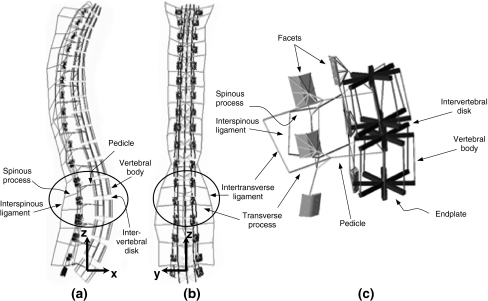
Over the last century the neurocentral junction (NCJ) has been identified as a potential cause of adolescent idiopathic scoliosis (AIS). Disparate growth at this site has been thought to lead to pedicle asymmetry, which then causes vertebral rotation and ultimately, the development of scoliotic curves. The objectives of this study are (1) to incorporate pedicle growth and growth modulation into an existing finite element model of the thoracic and lumbar spine already integrating vertebral body growth and growth modulation; (2) to use the model to investigate whether pedicle asymmetry, either alone or combined with other deformations, could be involved in scoliosis pathomechanisms. The model was personalized to the geometry of a nonpathological subject and used as the reference spinal configuration. Asymmetry of pedicle geometry (i.e. initial length) and asymmetry of the pedicle growth rate alone or in combination with other AIS potential pathogenesis (anterior, lateral, or rotational displacement of apical vertebra) were simulated over a period of 24 months. The Cobb angle and local scoliotic descriptors (wedging angle, axial rotation) were assessed at each monthly growth cycle. Simulations with asymmetrical pedicle geometry did not produce significant scoliosis, vertebral rotation, or wedging. Simulations with asymmetry of pedicle growth rate did not cause scoliosis independently and did not amplify the scoliotic deformity caused by other deformations tested in the previous model. The results of this model do not support the hypothesis that asymmetrical NCJ growth is a cause of AIS. This concurs with recent animal experiments in which NCJ growth was unilaterally restricted and no scoliosis, vertebral wedging, or rotation was noted.
Figures
References
-
- Aubin CE, Descrimes JL, Dansereau J, Skalli W, Lavaste F, Labelle H. Geometrical modeling of the spine and the thorax for the biomechanical analysis of scoliotic deformities using the finite element method. Ann Chir. 1995;49:749–761. - PubMed
-
- Coillard C, Rhalmi S, Rivard CH. Experimental scoliosis in the minipig: study of vertebral deformations. Ann Chir. 1999;53:773–780. - PubMed
Publication types
MeSH terms
LinkOut - more resources
Full Text Sources
Medical
