


Phenotypic features of circulating leucocytes as immunological markers for clinical status and bone marrow parasite density in dogs naturally infected by Leishmania chagasi
- PMID: 17034583
- PMCID: PMC1942052
- DOI: 10.1111/j.1365-2249.2006.03206.x
Phenotypic features of circulating leucocytes as immunological markers for clinical status and bone marrow parasite density in dogs naturally infected by Leishmania chagasi
Abstract
Canine visceral leishmaniasis (CVL) manifests itself as a broad clinical spectrum ranging from asymptomatic infection to patent severe disease. Despite relevant findings suggesting changes on lymphocytes subsets regarding the CVL clinical forms, it still remains to be elucidated whether a distinct phenotypic profile would be correlated with degree of tissue parasite density. Herein, we have assessed the correlation between the clinical status as well as the impact of bone marrow parasite density on the phenotypic profile of peripheral blood leucocytes in 40 Brazilian dogs naturally infected by Leishmania chagasi. Our major findings describe the lower frequency of B cells and monocytes as the most important markers of severe CVL. Our main statistically significant findings reveal that the CD8(+) T cell subset reflects most accurately both the clinical status and the overall bone marrow parasite density, as increased levels of CD8(+) lymphocytes appeared as the major phenotypic feature of asymptomatic disease and dogs bearing a low parasite load. Moreover, enhanced major histocompatibility complex (MHC)-II density as well as a higher CD45RB/CD45RA expression index seems to represent a key element to control disease morbidity. The association between clinical status, bone marrow parasitism and CD8(+) T cells re-emphasizes the role of the T cell-mediated immune response in the resistance mechanisms during ongoing CVL. Higher levels of circulating T lymphocytes (both CD4(+) and CD8(+) T cells) and lower MHC-II expression by peripheral blood lymphocytes seem to be the key for the effective immunological response, a hallmark of asymptomatic CVL.
Figures
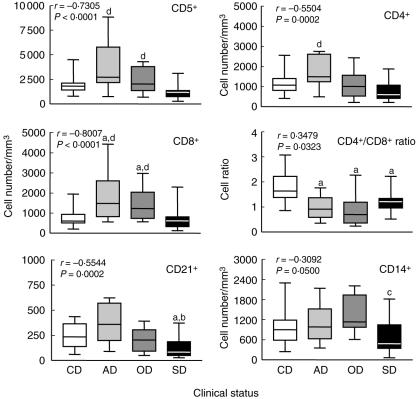
 ), oligosymptomatic (OD =
  ) and symptomatic (SD = ▪) dogs. Uninfected dogs were used as a control group (CD = □). The results are expressed as absolute cell counts and cell ratio in box-plot format highlighting the gap of 50% of data set measurement, the median as well as the maximum and minimum values. Significant differences at P < 0·05 are indicated by the letters ‘a’, ‘b’, ‘c’ and ‘d’ in comparison to CD, AD, OD and SD, respectively. Spearma's correlation indexes (r and P-values) are shown on the graphs.
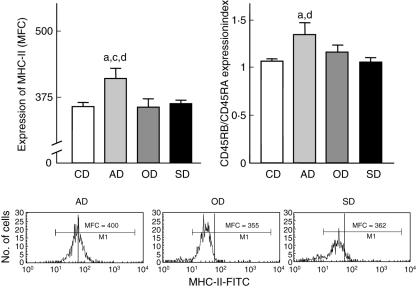 ), oligosymptomatic (OD = ) and symptomatic (SD = ▪) dogs. Uninfected dogs were used as a control group (CD = □). The results are expressed as average of major histocompatibility complex (MHC)-II expression reported as mean fluorescence channel (MFC) and CD45RB/CD45RA expression index plus standard deviation. Significant differences at P < 0·05 are indicated by the letters ‘a’, ‘b’, ‘c’ and ‘d’ in comparison to CD, AD, OD and SD, respectively. Representative histograms illustrating the higher MHC-II expression on circulating lymphocytes from AD are also presented.
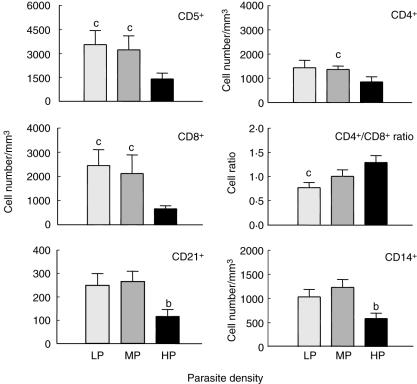 ), medium parasitism (MP = and high parasitism (HP = ▪) dogs. The results are expressed as mean absolute cell counts and cell ratio plus standard deviation. Significant differences at P < 0·05 are indicated by the letters ‘a’, ‘b’ and ‘c’ in comparison to LP, MP and HP, respectively.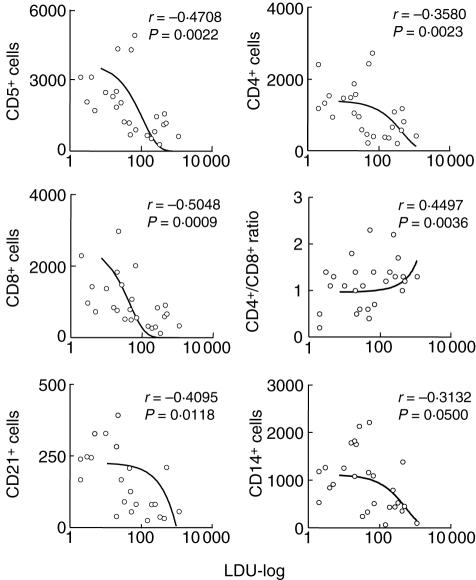
References
-
- Laison R, Shaw JJ. Evolution, classification and geographical distribution. In: Peters W, Killick-Kendrick R, editors. The leishmaniasis in biology and medicine. London: Academic Press; 1987. pp. 1–20.
-
- Tesh RB. Control of zoonotic visceral leishmaniasis: is it time to changes strategies? Am J Trop Med Hyg. 1995;52:287–92. - PubMed
-
- Molina R, Amela C, Nieto J, et al. Infectivity of dogs naturally infected with Leishmania infantum to colonized Phlebotomus perniciosus. Trans R Soc Trop Med Hyg. 1994;88:491–3. - PubMed
-
- Molina R, Lohse JM, Pulido F, et al. Infection of sand flies by humans coinfected with Leishmania infantum and human immunodeficiency virus. Am J Trop Med Hyg. 1999;60:51–3. - PubMed
-
- Guarga JL, Moreno J, Lucientes J, et al. Canine leishmaniasis transmission: higher infectivity amongst naturally infected dogs to sand flies is associated with lower proportions of T helper cells. Res Vet Sci. 2000;69:249–53. - PubMed
Publication types
MeSH terms
Substances
LinkOut - more resources
Full Text Sources
Research Materials
