. 2006 Oct 11:7:256.
doi: 10.1186/1471-2164-7-256.

An overabundance of phase 0 introns immediately after the start codon in eukaryotic genes

Affiliations

An overabundance of phase 0 introns immediately after the start codon in eukaryotic genes

Henrik Nielsen et al. BMC Genomics. .

Abstract

Background: A knowledge of the positions of introns in eukaryotic genes is important for understanding the evolution of introns. Despite this, there has been relatively little focus on the distribution of intron positions in genes.

Results: In proteins with signal peptides, there is an overabundance of phase 1 introns around the region of the signal peptide cleavage site. This has been described before. But in proteins without signal peptides, a novel phenomenon is observed: There is a sharp peak of phase 0 intron positions immediately following the start codon, i.e. between codons 1 and 2. This effect is seen in a wide range of eukaryotes: Vertebrates, arthropods, fungi, and flowering plants. Proteins carrying this start codon intron are found to comprise a special class of relatively short, lysine-rich and conserved proteins with an overrepresentation of ribosomal proteins. In addition, there is a peak of phase 0 introns at position 5 in Drosophila genes with signal peptides, predominantly representing cuticle proteins.

Conclusion: There is an overabundance of phase 0 introns immediately after the start codon in eukaryotic genes, which has been described before only for human ribosomal proteins. We give a detailed description of these start codon introns and the proteins that contain them.


Figures
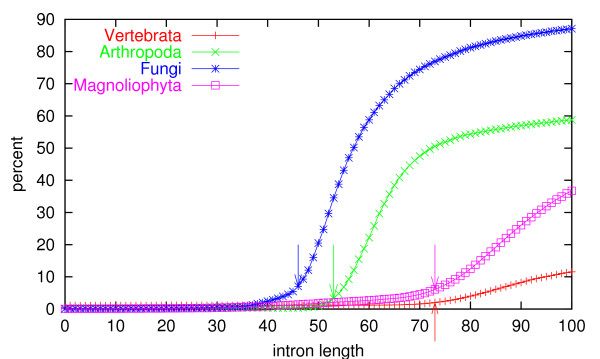
Figure 1
Figure 1
Cumulated length distribution of introns from the four organism groups. The arrows show the chosen values for minimum length cutoff.
Figure 2
Figure 2
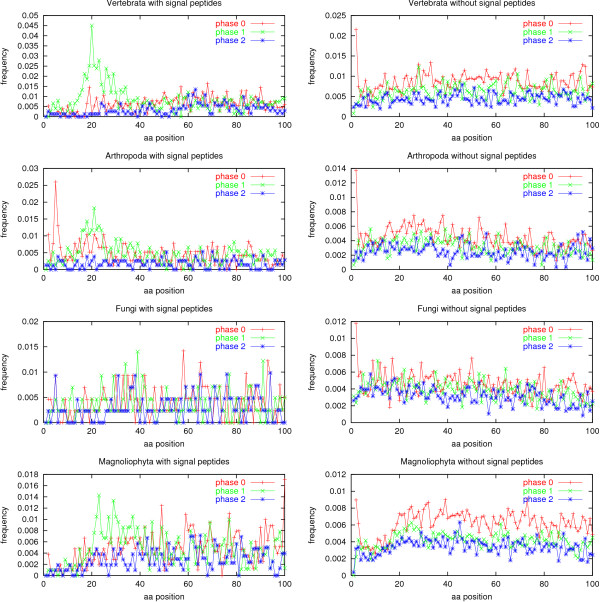
Intron positions in the 100 most N-terminal amino acids of the coding sequence of eukaryotic genes. Genes are divided into the systematic groups vertebrates, arthropods, fungi, and flowering plants (Magnoliophyta). The data sets are homology reduced. Left: genes predicted to code for a protein with a signal peptide; right: genes predicted not to carry a signal peptide. For phase 0 introns the position refers to the amino acid after the intron.
Figure 3
Figure 3
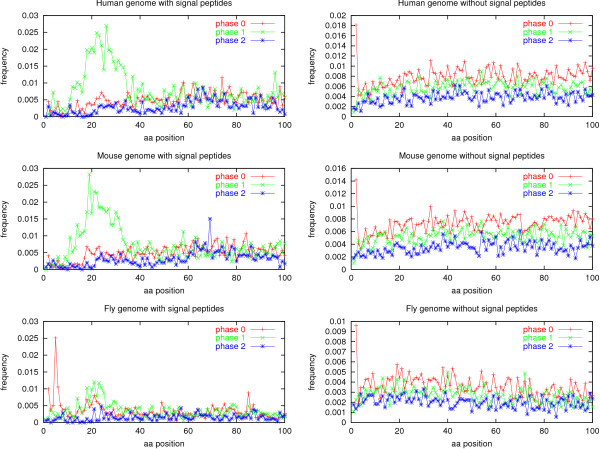
Intron positions in the 100 most N-terminal amino acids of the coding sequence of genes in the Homo sapiens, Mus musculus, and Drosophila melanogaster genomes. The data sets are not homology reduced.
Figure 4
Figure 4
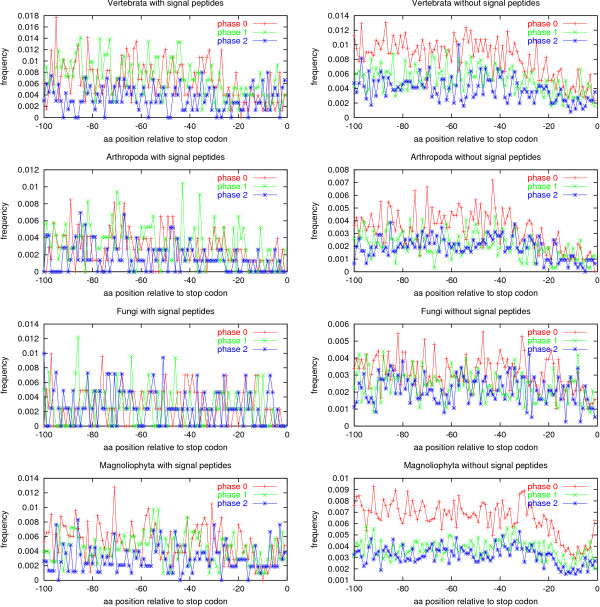
Intron positions in the 100 most C-terminal amino acids of the coding sequence of eukaryotic genes. The data sets are the same as in Figure 2.
Figure 5
Figure 5
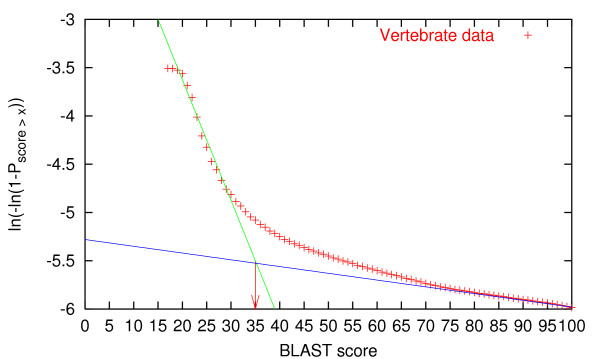
Finding the threshold for homology reduction: the cumulated score distribution is plotted in an extreme value plot, and the threshold is set to the score value where the two lines intersect. Here shown for the vertebrate data set.

References

    1. Rogozin IB, Sverdlov AV, Babenko VN, Koonin EV. Analysis of evolution of exon-intron structure of eukaryotic genes. Briefings in bioinformatics. 2005;6:118–134. doi: 10.1093/bib/6.2.118. - DOI - PubMed
    1. Sakurai A, Fujimori S, Kochiwa H, Kitamura-Abe S, Washio T, Saito R, The RIKEN Genome Exploration Research Group Phase II Team. Carninci P, Hayashizaki Y, Tomita M. On biased distribution of introns in various eukaryotes. Gene. 2002;300:89–95. doi: 10.1016/S0378-1119(02)01035-1. - DOI - PubMed
    1. Mourier T, Jeffares DC. Eukaryotic Intron Loss. Science. 2003;300:1393. doi: 10.1126/science.1080559. - DOI - PubMed
    1. Lin K, Zhang DY. The excess of 5' introns in eukaryotic genomes. Nucleic Acids Res. 2005;33:6522–6527. doi: 10.1093/nar/gki970. - DOI - PMC - PubMed
    1. Sverdlov AV, Babenko VN, Rogozin IB, Koonin EV. Preferential loss and gain of introns in 3' portions of genes suggests a reverse-transcription mechanism of intron insertion. Gene. 2004;338:85–91. doi: 10.1016/j.gene.2004.05.027. - DOI - PubMed

Publication types

LinkOut - more resources