Review
. 2006 Oct 11;7(1):125.
doi: 10.1186/1465-9921-7-125.

Role of TNFalpha in pulmonary pathophysiology

Affiliations
Review

Role of TNFalpha in pulmonary pathophysiology

Srirupa Mukhopadhyay et al. Respir Res. .

Abstract

Tumor necrosis factor alpha (TNFalpha) is the most widely studied pleiotropic cytokine of the TNF superfamily. In pathophysiological conditions, generation of TNFalpha at high levels leads to the development of inflammatory responses that are hallmarks of many diseases. Of the various pulmonary diseases, TNFalpha is implicated in asthma, chronic bronchitis (CB), chronic obstructive pulmonary disease (COPD), acute lung injury (ALI) and acute respiratory distress syndrome (ARDS). In addition to its underlying role in the inflammatory events, there is increasing evidence for involvement of TNFalpha in the cytotoxicity. Thus, pharmacological agents that can either suppress the production of TNFalpha or block its biological actions may have potential therapeutic value against a wide variety of diseases. Despite some immunological side effects, anti-TNFalpha therapeutic strategies represent an important breakthrough in the treatment of inflammatory diseases and may have a role in pulmonary diseases characterized by inflammation and cell death.


Figures
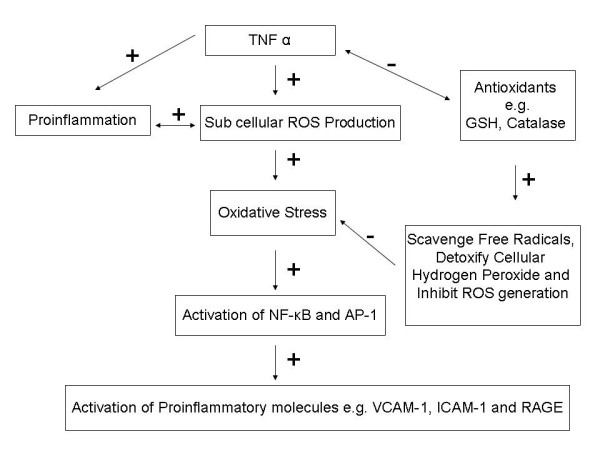
Figure 1
Figure 1
Schematic diagram of the mechanism of action of TNFα. While TNFα-dependent activation of reactive oxygen species (ROS) generation enhances oxidative stress of cells and subsequent activation of pro-inflammatory and pro-oxidative transcription factors nuclear factor kappa-B (NF-κB) and the activator protein one (AP-1), antioxidants namely GSH attenuates oxidative stress and subsequent activation of NF-κB and AP-1. NF-κB and AP-1 are involved in the activation of pro-inflammatory molecules like, vascular cell adhesion molecule one (VCAM-1), intercellular adhesion molecule one (ICAM-1) and receptor for advanced glycation end products (RAGE). + Indicates activation, - indicates inhibition → and ↔ indicate one way and two way flow of signals respectively.
Figure 2
Figure 2
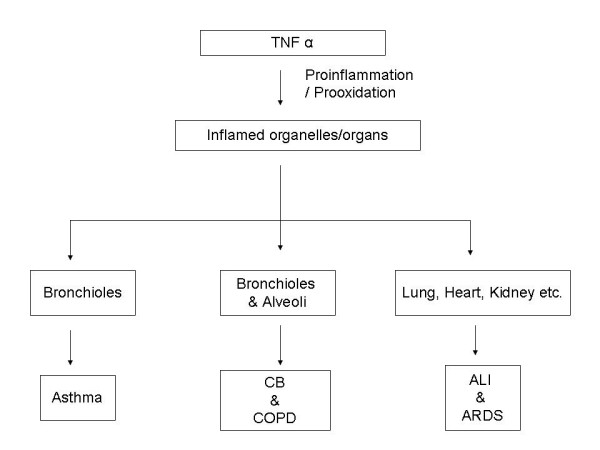
Schematic diagram of the effects of TNFα on various pulmonary tissues. Asthma is mainly a disease of bronchioles; Chronic Bronchitis (CB) and chronic obstructive pulmonary disease (COPD) are the disease of bronchioles and alveoli. In acute lung injury (ALI) and acute respiratory distress syndrome all the vital organs of the body namely lung, heart, kidney, liver etc are affected.

References

    1. Carswell EA, Old LJ, Kassel RL, Green S, Fiore N, Williamson B. An endotoxin-induced serum factor that causes necrosis of tumors. PNAS (USA) 1975;72:3666–3670. doi: 10.1073/pnas.72.9.3666. - DOI - PMC - PubMed
    1. Helson L, Green S, Carswell E, Old LJ. Effect of tumour necrosis factor on cultured human melanoma cells. Nature. 1975;258:731–732. doi: 10.1038/258731a0. - DOI - PubMed
    1. Williamson BD, Carswell EA, Rubin BY, Prendergast JS, Old LJ. Human tumor necrosis factor produced by human B-cell lines: synergistic cytotoxic interaction with human interferon. PNAS (USA) 1983;80:5397–5401. doi: 10.1073/pnas.80.17.5397. - DOI - PMC - PubMed
    1. Goto T, Ishizaka A, Kobayashi F, Kohno M, Sawafuji M, Tasaka S, Ikeda E, Okada Y, Maruyama I, Kobayashi K. Importance of tumor necrosis factor-alpha cleavage process in post-transplantation lung injury in rats. Am J Respir Crit Care Med. 2004;170:1239–1246. doi: 10.1164/rccm.200402-146OC. - DOI - PubMed
    1. Beutler B, Cerami A. Cachectin and tumour necrosis factor as two sides of the same biological coin. Nature. 1986;320:584–588. doi: 10.1038/320584a0. - DOI - PubMed

Publication types

MeSH terms

LinkOut - more resources