


Chlorinated pool attendance, atopy, and the risk of asthma during childhood
- PMID: 17035144
- PMCID: PMC1626429
- DOI: 10.1289/ehp.8461
Chlorinated pool attendance, atopy, and the risk of asthma during childhood
Abstract
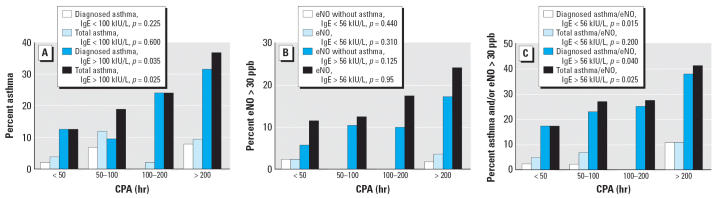
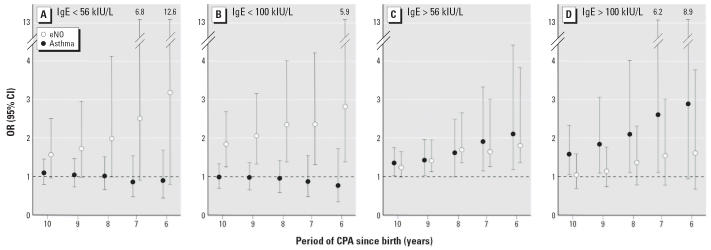
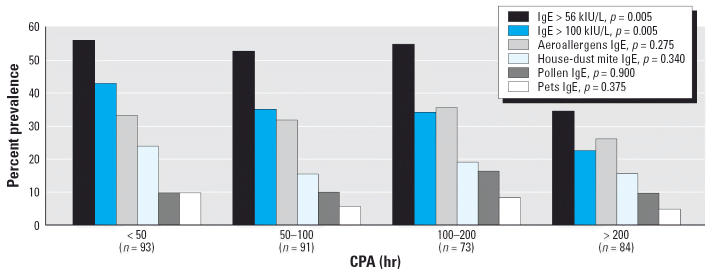
The pool chlorine hypothesis postulates that the rise in childhood asthma in the developed world could result at least partly from the increasing exposure of children to toxic gases and aerosols contaminating the air of indoor chlorinated pools. To further assess this hypothesis, we explored the relationships between childhood asthma, atopy, and cumulated pool attendance (CPA). We studied 341 schoolchildren 10-13 years of age who attended at a variable rate the same public pool in Brussels (trichloramine in air, 0.3-0.5 mg/m3). Examination of the children included a questionnaire, an exercise-induced bronchoconstriction (EIB) test, and the measurement of exhaled nitric oxide (eNO) and total and aeroallergen-specific serum IgE. CPA by children (range, 0-1,818 hr) emerged among the most consistent predictors of asthma (doctor diagnosed or screened with the EIB test) and of elevated eNO, ranking immediately after atopy and family history of asthma or hay fever. Although the risk of elevated eNO increased with CPA [odds ratio (OR) = 1.30; 95% confidence interval (CI), 1.10-1.43] independently of total or specific serum IgE, the probability of developing asthma increased with CPA only in children with serum IgE > 100 kIU/L (OR for each 100-hr increase in CPA = 1.79; 95% CI, 1.07-2.72). All these effects were dose related and most strongly linked to pool attendance before 6-7 years of age. Use of indoor chlorinated pools especially by young children interacts with atopic status to promote the development of childhood asthma. These findings further support the hypothesis implicating pool chlorine in the rise of childhood asthma in industrialized countries.
Figures
Comment in
-
Chlorinated pools and the risk of asthma.Environ Health Perspect. 2007 May;115(5):A240; author reply A240-1. doi: 10.1289/ehp.115-a240a. Environ Health Perspect. 2007. PMID: 17520032 Free PMC article. No abstract available.
References
-
- Allison P. 1999. Logistic Regression using SAS: Theory and Applications. Cary, NC:SAS Institute Inc.
-
- American Lung Association 2004. Trends in Asthma Morbidity and Mortality. New York:American Lung Association.
-
- American Thoracic Society. Standardization of spirometry. Am J Respir Crit Care Med. 1995;152:1107–1138. - PubMed
-
- American Thoracic Society. Recommendations for standardized procedures for the online and offline measurement of exhaled lower respiratory nitric oxide and nasal nitric oxide in adults and children. Am J Respir Crit Care Med. 1999;160:2104–2117. - PubMed
-
- Beeh KM, Ksoll M, Buhl R. Elevation of total serum immunoglobulin E is associated with asthma in nonallergic individuals. Eur Respir J. 2000;16:609–614. - PubMed
Publication types
MeSH terms
Substances
LinkOut - more resources
Full Text Sources
Medical