. 2007 Jan;24(1):203-16.
doi: 10.1093/molbev/msl145. Epub 2006 Oct 11.

Evolution of the Rho family of ras-like GTPases in eukaryotes

Affiliations

Evolution of the Rho family of ras-like GTPases in eukaryotes

Anthony Boureux et al. Mol Biol Evol. 2007 Jan.

Abstract

GTPases of the Rho family are molecular switches that play important roles in converting and amplifying external signals into cellular effects. Originally demonstrated to control the dynamics of the F-actin cytoskeleton, Rho GTPases have been implicated in many basic cellular processes that influence cell proliferation, differentiation, motility, adhesion, survival, or secretion. To elucidate the evolutionary history of the Rho family, we have analyzed over 20 species covering major eukaryotic clades from unicellular organisms to mammals, including platypus and opossum, and have reconstructed the ontogeny and the chronology of emergence of the different subfamilies. Our data establish that the 20 mammalian Rho members are structured into 8 subfamilies, among which Rac is the founder of the whole family. Rho, Cdc42, RhoUV, and RhoBTB subfamilies appeared before Coelomates and RhoJQ, Cdc42 isoforms, RhoDF, and Rnd emerged in chordates. In vertebrates, gene duplications and retrotranspositions increased the size of each chordate Rho subfamily, whereas RhoH, the last subfamily, arose probably by horizontal gene transfer. Rac1b, a Rac1 isoform generated by alternative splicing, emerged in amniotes, and RhoD, only in therians. Analysis of Rho mRNA expression patterns in mouse tissues shows that recent subfamilies have tissue-specific and low-level expression that supports their implication only in narrow time windows or in differentiated metabolic functions. These findings give a comprehensive view of the evolutionary canvas of the Rho family and provide guides for future structure and evolution studies of other components of Rho signaling pathways, in particular regulators of the RhoGEF family.


Figures
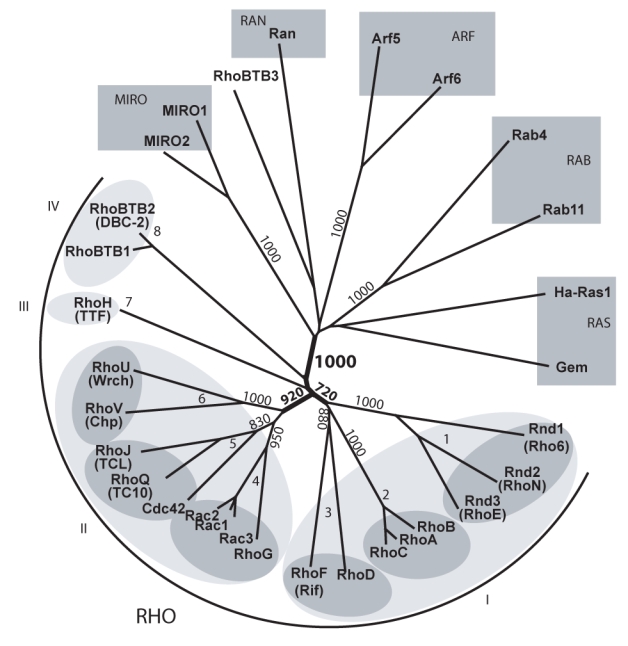
Figure 1
Figure 1. Delineation and structure of the human Rho family
Proteins considered so far as Rho members were aligned with GTPases of other Ras-like families and the unrooted tree was obtained by NJ (ClustalX). Bootstrap values at critical nodes show that MIRO proteins constitute a distinct Ras-like family and RhoBTB3 is branched outside the Rho family. Identical topology was obtained using maximum likelihood (ProML3.6.3). Only the Rho domains, corresponding to aminoacids 5-173 of Rac1, were used for the alignment. Structuration into 4 clusters and 8 sub-families is figured by light and dark grey ellipses respectively. When different, common names are figured into brackets under the HUGO nomenclature.
Figure 2
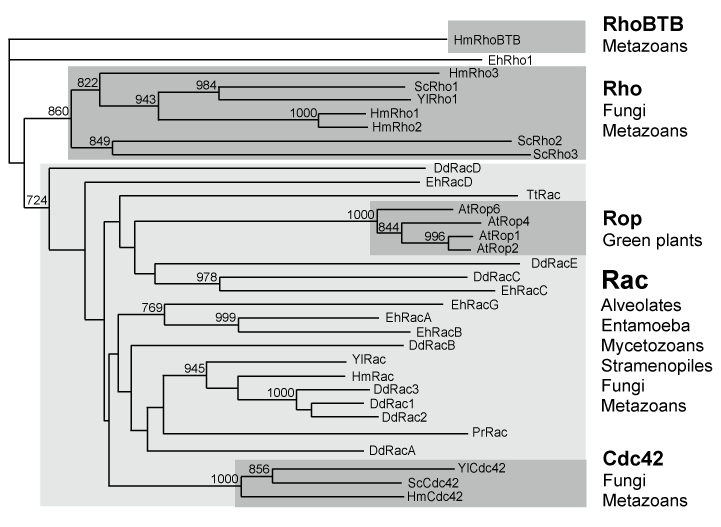
Figure 2. Rac as the founder of the Rho family
Rho sequences from fungi (Saccharomyces cerevisiae - Sc, Yarrowia lipolytica - Yl), entamoeba (Entamoeba histolytica - Eh), mycetozoans (Dictyostelium discoideum - Dd), alveolates (Tetrahymena thermophila - Tt), stramenopiles (Phytophthora ramorum - Pr) and plants (Arabidopsis thaliana - At) were aligned using ClustalX. Hydra magnipapillata (Hm) sequences were included as metazoan Rho sequences and Rab sequences as an external group. Only bootstrap values >700 are indicated on the NJ tree.
Figure 3
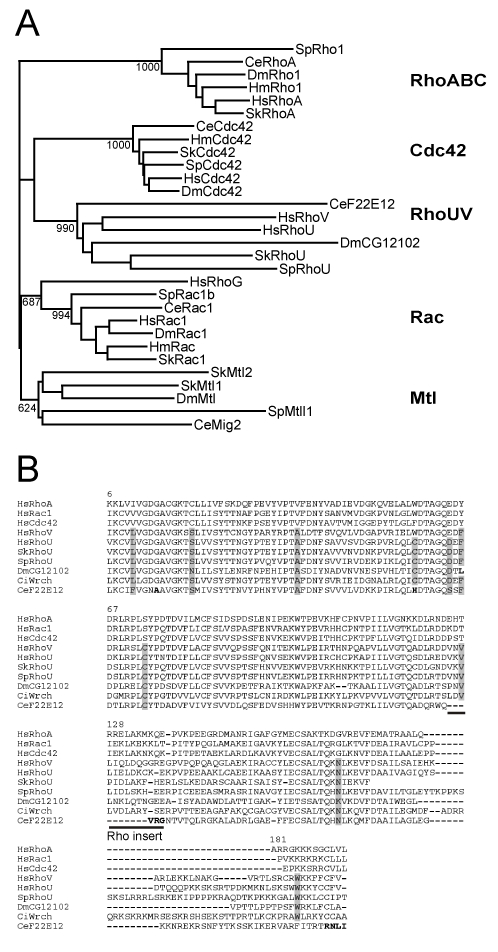
Figure 3. Five Rho subfamilies in Coelomates
A: Rho sequences from Drosophila melanogaster (Dm), Caenorhabditis elegans (Ce), Sacchoglossus kowalevskii (Sk), Strongylocentrotus purpuratus (Sp) were aligned with ClustalX. Hydra magnipapillata (Hm) and human (Hs) sequences were included as acoelomate and chordate groups. Only bootstrap values >600 are indicated on the NJ tree. B: The amino acid sequences of RhoUV members were aligned with ClustalX. Human RhoA, Rac1 and Cdc42 were included as outgoups to delineate residues specific of the RhoUV subfamily (grey shaded). CeF22E12 (CeRhoU) apomorphic positions are in bold.
Figure 4
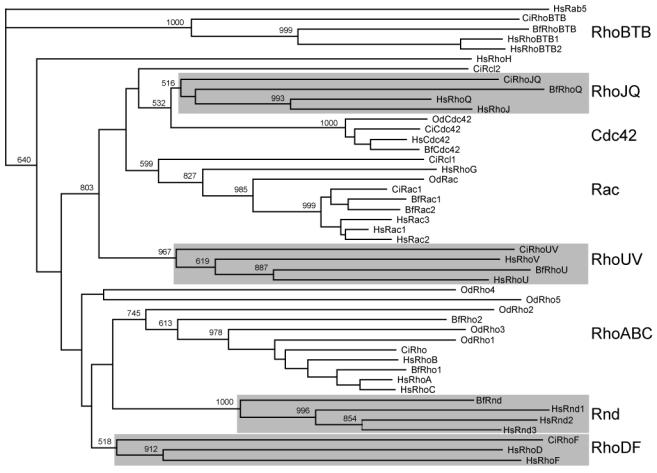
Figure 4. Seven Rho subfamilies in Chordates
Rho sequences from the cephalochordate Branchiostoma floridae (Bf) and from the urochordates Ciona intestinalis (Ci, ascidian) and Oikopleura dioica (Od, larvacean) were aligned with ClustalX. Human Rho sequences were included as vertebrate outgroups. Only bootstrap values >500 are indicated on the NJ tree.
Figure 5
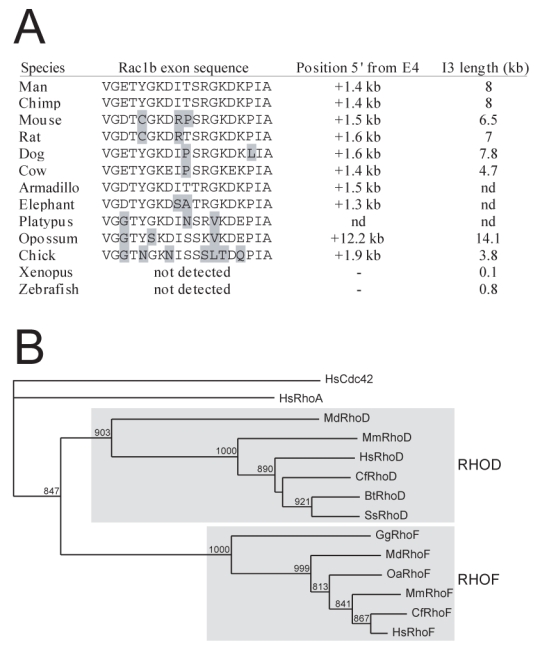
Figure 5. Evolution of Rac1b and RhoD in Vertebrates
A: Vertebrate genomes were searched for the presence of the 57 bp Rac1b-specific exon. For each considered species is shown the predicted peptide, the position of the additional exon upstream of the normal 4th Rac1 exon, and the size of the third exon. B: RhoD and RhoF homologues were searched in mouse (Mm), dog (Cf), pig (Ss), opossum (Md), platypus (Oa) and chicken (Gg) and aligned with human sequences using ClustalX. Human Cdc42 and RhoA were included as external outgroups.
Figure 6
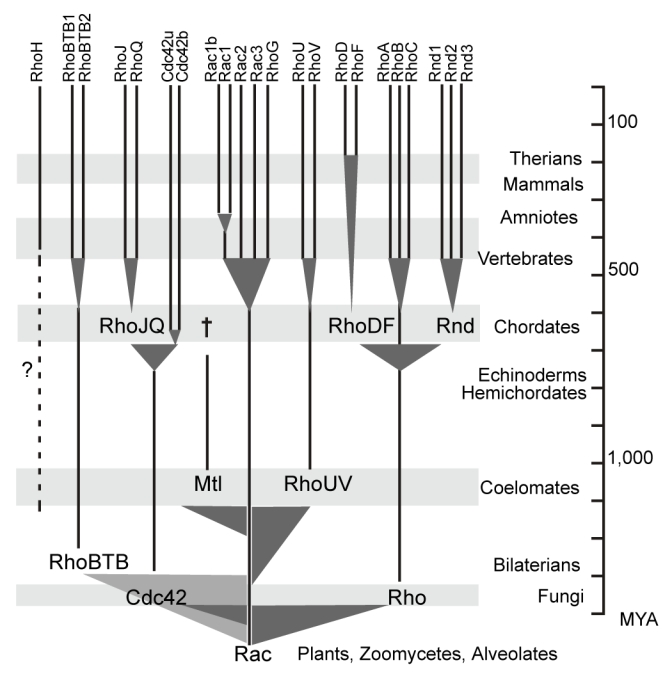
Figure 6. Evolutionary synopsis of the Rho family
The phylogenetic tree of Figure 1 was redrawn taking into accounts the distribution of Rho subfamilies in the examined taxa. Shaded triangles indicate roots and intervals of emergence of the subfamilies. Scale time is in million years (MYA). Broken lines represent discrepancies between inferred phylogeny and observed emergence. indicates subfamily extinction.

References

    1. Abe T, Kato M, Miki H, Takenawa T, Endo T. Small GTPase Tc10 and its homologue RhoT induce N-WASP-mediated long process formation and neurite outgrowth. Journal of Cell Science. 2003;116:155–168. - PubMed
    1. Aktories K, Barbieri JT. Bacterial cytotoxins: targeting eukaryotic switches. Nat Rev Microbiol. 2005;3:397–410. - PubMed
    1. Altschul SF, Madden TL, Schaffer AA, Zhang J, Zhang Z, Miller W, Lipman DJ. Gapped BLAST and PSI-BLAST: a new generation of protein database search programs. Nucleic Acids Res. 1997;25:3389–3402. - PMC - PubMed
    1. Andersen PR, Devare SG, Tronick SR, Ellis RW, Aaronson SA, Scolnick EM. Generation of BALB-MuSV and Ha-MuSC by type C virus transduction of homologous transforming genes from different species. Cell. 1981;26:129–134. - PubMed
    1. Aronheim A, Broder YC, Cohen A, Fritsch A, Belisle B, Abo A. Chp, a homologue of the GTPase Cdc42Hs, activates the JNK pathway and is implicated in reorganizing the actin cytoskeleton. Current Biology. 1998;8:1125–1128. - PubMed

Publication types

Substances