


The Consortium on the Genetics of Endophenotypes in Schizophrenia: model recruitment, assessment, and endophenotyping methods for a multisite collaboration
- PMID: 17035358
- PMCID: PMC2632302
- DOI: 10.1093/schbul/sbl044
The Consortium on the Genetics of Endophenotypes in Schizophrenia: model recruitment, assessment, and endophenotyping methods for a multisite collaboration
Abstract
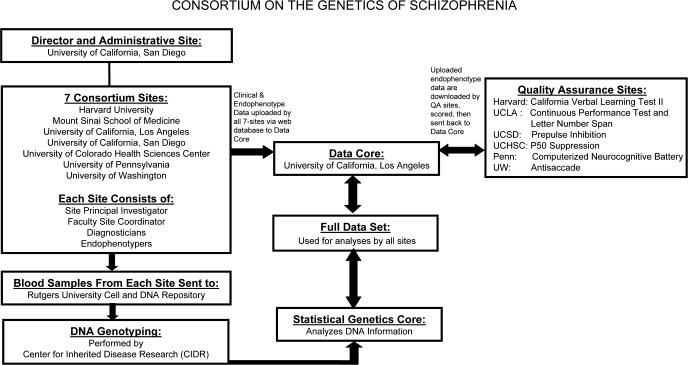
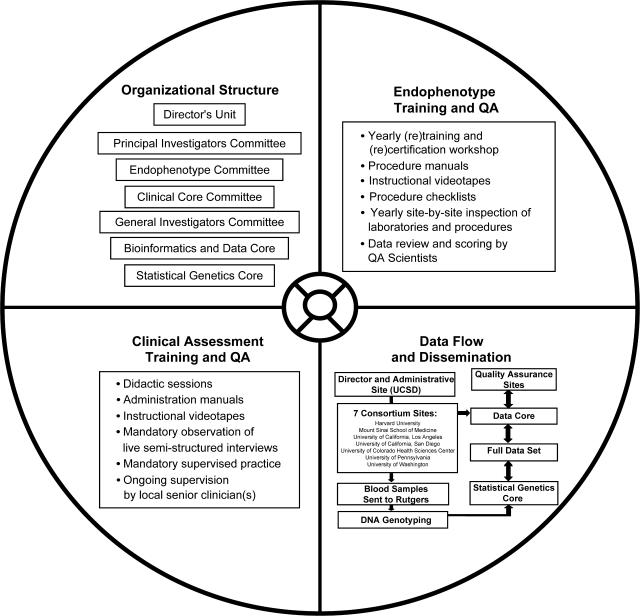
Background: The Consortium on the Genetics of Schizophrenia (COGS) is an ongoing, National Institute of Mental Health-funded, 7-site collaboration investigating the occurrence and genetic architecture of quantitative endophenotypes related to schizophrenia. The purpose of this article is to provide a description of the COGS structure and methods, including participant recruitment and assessment.
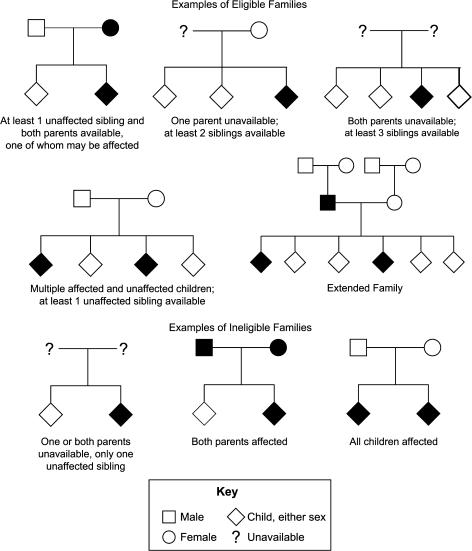
Methods: The hypothesis-driven recruitment strategy ascertains families that include a proband with a Diagnostic and Statistical Manual of Mental Disorders, Fourth Edition diagnosis of schizophrenia, and at least one unaffected full sibling available for genotyping and endophenotyping, along with parents available for genotyping and (optional depending on age) endophenotyping. The family structure is selected to provide contrast in quantitative endophenotypic traits and thus to maximize the power of the planned genetic analyses. Probands are recruited from many sources including clinician referrals, local National Alliance for the Mentally Ill chapters, and advertising via the media. All participants undergo a standardized protocol that includes clinical characterization, a blood draw for genotyping, and endophenotype assessments (P50 suppression, prepulse inhibition, antisaccade performance, continuous performance tasks, letter-number span, verbal memory, and a computerized neurocognitive battery). Investigators participate in weekly teleconferences to coordinate and evaluate recruitment, clinical assessment, endophenotyping, and continuous quality control of data gathering and analyses. Data integrity is maintained through use of a highly quality-assured, centralized web-based database.
Results: As of February 2006, 355 families have been enrolled and 688 participants have been endophenotyped, including schizophrenia probands (n = 154, M:F = 110:44), first-degree biological relatives (n = 343, M:F = 151:192), and community comparison subjects (n = 191, M:F = 81:110).
Discussion: Successful multisite genetics collaborations must institute standardized methodological criteria for assessment and recruitment that are clearly defined, well communicated, and uniformly applied. In parallel, studies utilizing endophenotypes require strict adherence to criteria for cross-site data acquisition, equipment calibration and testing and software equivalence, and continuous quality assurance for many measures obtained across sites. This report describes methods and presents the structure of the COGS as a model of multisite endophenotype genetic studies. It also provides demographic information after the first 2 years of data collection on a sample for whom the behavioral data and genetics of endophenotype performance will be fully characterized in future articles. Some issues discussed in the reviews that follow reflect the challenges of evaluating endophenotypes in studies of the genetic architecture of endophenotypes in schizophrenia.
Figures
References
-
- Faraone SV, Tsuang D, Tsuang MT. Genetics of Mental Disorders: A Guide for Students, Clinicians, and Researchers. New York, NY: Guildford; 1999.
-
- Gottesman, Shields J. Schizophrenia and Genetics; a Twin Study Vantage Point. New York, NY: Academic Press Inc.; 1972.
-
- Braff DL, Freedman R. Endophenotypes in studies of the genetics of schizophrenia. In: Davis KL, Charney DS, Coyle JT, Nemeroff C, editors. Neuropsychopharmacology: The fifth generation of progress. Philadelphia, PA: Lippincott Williams and Wilkens; 2002. pp. 703–716.
-
- Badner JA, Gershon ES. Meta-analysis of whole-genome linkage scans of bipolar disorder and schizophrenia. Mol Psychiatry. 2002;7:405–411. - PubMed
Publication types
MeSH terms
Grants and funding
- R01 MH043518/MH/NIMH NIH HHS/United States
- R01 MH065571/MH/NIMH NIH HHS/United States
- R01-MH65707/MH/NIMH NIH HHS/United States
- R01-MH065571/MH/NIMH NIH HHS/United States
- R01-MH65578/MH/NIMH NIH HHS/United States
- R01 MH065558/MH/NIMH NIH HHS/United States
- R01 MH065554/MH/NIMH NIH HHS/United States
- R01 MH065578/MH/NIMH NIH HHS/United States
- R01 MH065562/MH/NIMH NIH HHS/United States
- R01-MH65558/MH/NIMH NIH HHS/United States
- R01-MH65588/MH/NIMH NIH HHS/United States
- MH43518/MH/NIMH NIH HHS/United States
- R01 MH065588/MH/NIMH NIH HHS/United States
- R01-MH065554/MH/NIMH NIH HHS/United States
- R01-MH065562/MH/NIMH NIH HHS/United States
- R01 MH065707/MH/NIMH NIH HHS/United States
- R37 MH043518/MH/NIMH NIH HHS/United States
LinkOut - more resources
Full Text Sources
Medical
Research Materials
