


Biocompatibility of septal defect closure devices
- PMID: 17035510
- PMCID: PMC1861502
- DOI: 10.1136/hrt.2006.098103
Biocompatibility of septal defect closure devices
Abstract
Objective: Despite their clinical introduction 10 years ago, no human series on the healing response to Amplatzer and Starflex devices in humans have been reported yet. We sought to investigate the biocompatibility of Amplatzer and Cardioseal/Starflex septal occluder devices in humans and compare the findings to results in experimental animals.
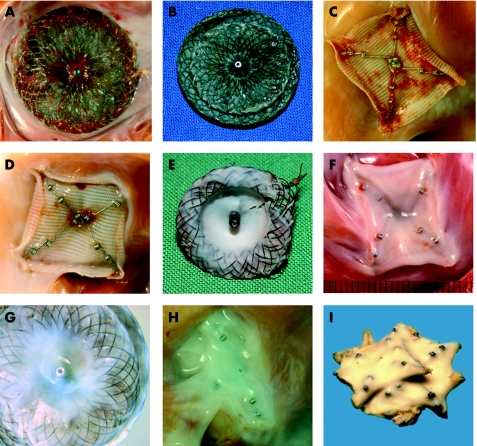
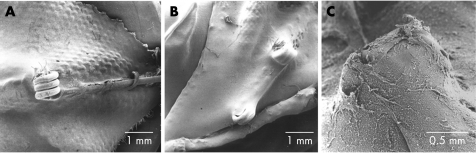
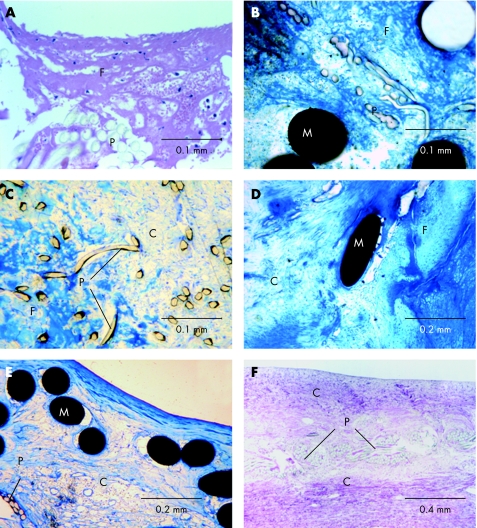
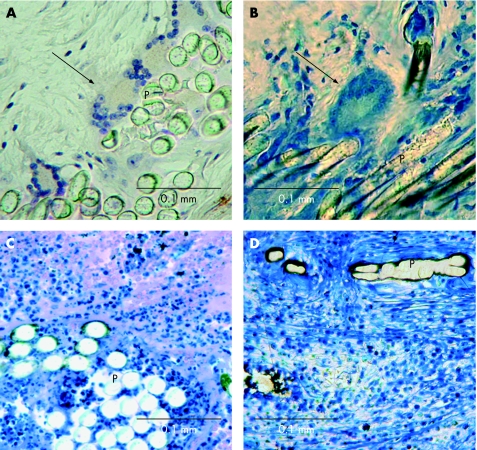
Methods: The healing response of Amplatzer and Cardioseal/Starflex septal occluder devices in humans (n = 12, follow-up periods from 5 days to 4 years) and in experimental animals (n = 32, follow-up periods from 4 days to 1 year) was studied using a uniform work up protocol. Histological sections of paraffin-wax-embedded or methacrylate-embedded specimen and scanning electron microscopy were used for biocompatibility screening.
Results: Neoendothelialisation of all examined devices was complete after 3 months in vivo. Protruding metal frame parts, like screw threads and spring arms, were covered last. The initial deposition of fibrin and blood cells on the polyester fabric was subsequently organised by ingrown fibroblastic cells. Loosely arranged and poorly vascularised young granulation tissue was transformed time-dependently into quiescent fibre-rich connective repair tissue poor of cellular and capillary vessel components. Consistently, a mild chronic inflammatory response directed against textile fibres of both types of implants characterised by lymphocytic infiltration and multinucleated foreign body giant cells was observed equally in human and animal explants.
Conclusions: Systematic biocompatibility screening in a series of explanted human septal occluder devices showed results corresponding to findings in animal studies with regard to neoendothelialisation, cellular organisation of initial thrombus and persisting immune response.
Conflict of interest statement
Competing interests: None declared.
References
-
- Kreutzer J, Ryan C A, Gauvreau K.et al Healing response to the clamshell device for closure of intracardiac defects in humans. Catheter Cardiovasc Interv 200154101–111. - PubMed
-
- Lock J E, Rome J J, Davis R.et al Transcatheter closure of atrial septal defects. Experimental studies. Circulation 1989791091–1099. - PubMed
-
- Kuhn M A, Latson L A, Cheatham J P.et al Biological response to Bard clamshell septal occluders in the canine heart. Circulation 1996931459–1463. - PubMed
-
- Sharafuddin M J, Gu X, Titus J L.et al Transvenous closure of secundum atrial septal defects: preliminary results with a new self‐expanding nitinol prosthesis in a swine model. Circulation 1997952162–2168. - PubMed
-
- Das G S, Voss G, Jarvis G.et al Experimental atrial septal defect closure with a new, transcatheter, self‐centering device. Circulation 1993881754–1764. - PubMed
MeSH terms
Substances
LinkOut - more resources
Full Text Sources
