


doi: 10.1038/sj.emboj.7601378.
Epub 2006 Oct 12.
Pannexin-1 mediates large pore formation and interleukin-1beta release by the ATP-gated P2X7 receptor
Affiliations
- PMID: 17036048
- PMCID: PMC1630421
- DOI: 10.1038/sj.emboj.7601378
Item in Clipboard
Pannexin-1 mediates large pore formation and interleukin-1beta release by the ATP-gated P2X7 receptor
EMBO J.
.
Abstract
P2X(7) receptors are ATP-gated cation channels; their activation in macrophage also leads to rapid opening of a membrane pore permeable to dyes such as ethidium, and to release of the pro-inflammatory cytokine, interleukin-1beta (IL-1beta). It has not been known what this dye-uptake path is, or whether it is involved in downstream signalling to IL-1beta release. Here, we identify pannexin-1, a recently described mammalian protein that functions as a hemichannel when ectopically expressed, as this dye-uptake pathway and show that signalling through pannexin-1 is required for processing of caspase-1 and release of mature IL-1beta induced by P2X(7) receptor activation.
Figures
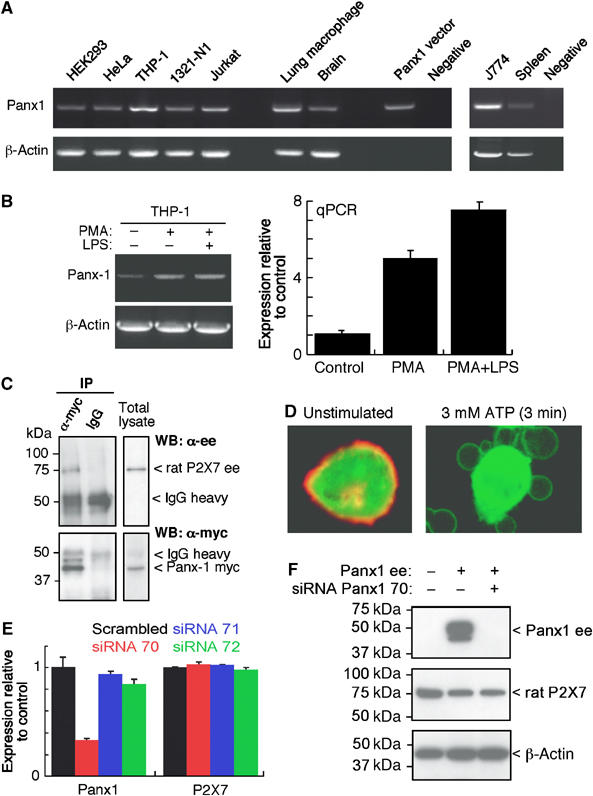
Panx1 is associated with P2X7R protein and its signalling. (A) Panx1 mRNA detected by RT–PCR from human and mouse cells as indicated; THP-1 macrophages, lung alveolar macrophage, Jurkat lymphocytes and mouse J774 macrophage show highest expression. (B) RT–PCR example and qPCR summary showing panx1 mRNA upregulation by PMA (0.5 μM for 30 min) and further increased by PMA plus LPS (100 ng/ml for 4 h). (C) HEK cells stably expressing P2X7-ee receptor were transfected with Panx1-myc and immunoprecipitation (IP) of cell lysates with anti-myc Ab carried out followed by Western blotting (WB) with anti-ee Ab. (D) Immunohistochemical localization of panx1 (red) to plasma membrane in HEK cell co-transfected with panx1-ee and eGFP (green, cytoplasmic localization, left-hand panel); photo on right is HEK P2X7-expressing cell transfected with panx1-eGFP construct showing panx1 protein in blebs induced by ATP stimulation. (E, F) siRNA knockdown of endogenous levels of panx1 mRNA in HEK cells (E) and exogenously expressed panx1 protein (F). mRNA levels show mean±s.e.m. from qPCR assays for four separate experiments, P<0.001 for panx1 mRNA levels of cells transfected with siRNA70 versus scrambled siRNA. For WB, lysates were immunoblotted with anti-ee (panx1), anti-P2X7R and anti-β-actin as loading control; note panx1 siRNA did not alter levels of P2X7R.
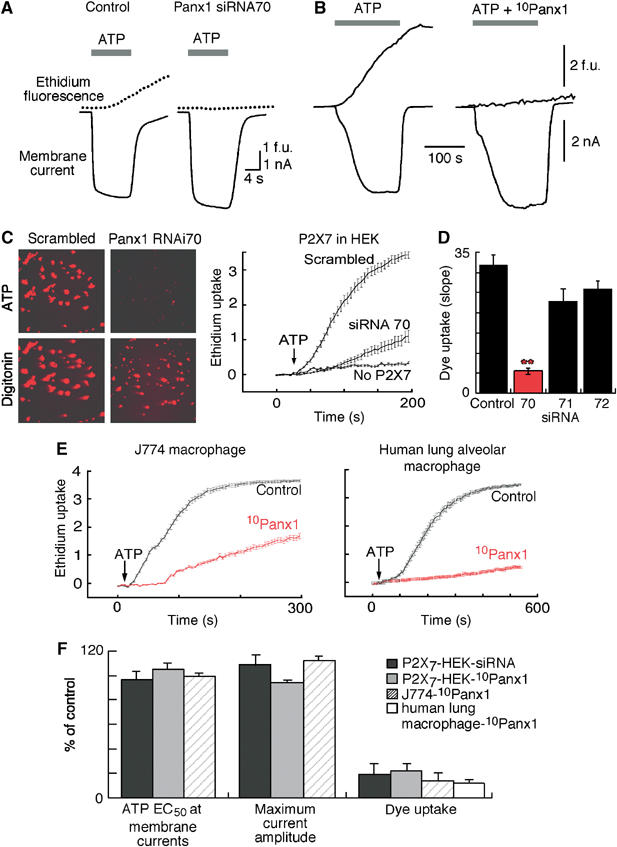
Selective inhibition of Panx1 blocks P2X7R-induced dye uptake but not ionic currents. (A) Representative traces of simultaneous recording of membrane current and ethidium uptake from control or panx1 siRNA70 transfected HEK cell expressing P2X7R in response to 3 mM ATP stimulation. (B) Similar recordings obtained from control cell and cell exposed to 10panx1 peptide (200 μM for 10 min). (C) Representative photos (5 min in ATP) and kinetic traces of ethidium uptake recorded from populations of P2X7R expressing or nonexpressing HEK cells as indicated after transfection with scrambled or panx1 siRNA70. Digitonin (100 μM) applied at end of experiment to induce maximum dye uptake; siRNA did not alter ethidium fluorescence after digitonin treatment (n=20 cells for each treatment and representative of 7 independent experiments). (D) Summary of all dye uptake obtained from siRNA experiments illustrated in A and C. Histograms show slope of dye uptake in response to maximum concentration of ATP (5 mM) from cells transfected with scrambled (control) or panx1-targettted siRNA; siRNA70 reduced ATP-evoked dye uptake by >80%. **P<0.001. (E) Kinetic traces of ethidium uptake from mouse J774 or human alveolar macrophage in the absence or presence of 10panx1-mimetic peptide (100 μM for 20 min); each trace is mean±s.e.m. of 50 cells in field of view and representative of 2–6 independent experiments. (F) Plots EC50 concentration of ATP, maximum current amplitude and dye uptake induced by maximum ATP concentration (expressed as % control response) from P2X7R-expressing HEK cells transfected with panx1 siRNA70, and from HEK, J774 and human alveolar macrophage incubated for 10–30 min with 10panx1 peptide as indicated. In all cases dye-uptake was reduced by >80% without alteration of membrane currents.
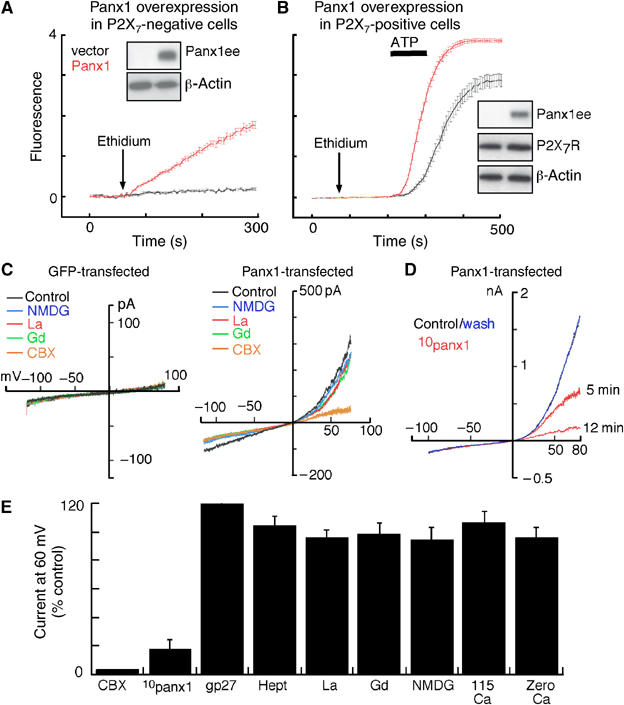
Overexpression of panx1 induces constitutive dye-uptake and hemichannel-like currents selectively blocked by 10panx1 and CBX. (A) Ethidium uptake in P2X7R-negative HEK cells transfected with empty or panx1 expression vector; superfusion of cells with ethidium resulted in immediate uptake in panx1 transfected cells; each trace is mean±s.e.m. of 50 cells in field of view. (B) Similar experiment in P2X7R-positive HEK cells; ethidium application did not result in constitutive dye uptake but the ATP-evoked response showed faster kinetics and maximum fluorescence; traces are mean±s.e.m. of 50 cells. Western blots obtained from cells used in these experiments are shown; panx1 overexpression did not change P2X7R protein expression. (C) Currents in response to ramp voltages (−120 to 80 mV) from control (GFP-transfected) or panx1 transfected HEK cell in normal extracellular solution, in solution containing the larger cation NMDG in place of sodium, in the presence of lanthanum (100 μM), gadolinium (100 μM) or CBX (5 μM) as indicated. (D) Currents from panx1 transfected HEK cell in 0 (control), 5 and 12 min in presence of 100 μM 10panx1 peptide and 15 min after washout; complete inhibition was observed within 10–15 min. (E) Summary of all similar experiments where current at 60 mV is shown as % of control response; only 10panx1 peptide and CBX (20 μM) inhibited the current while other connexin hemichannel inhibitors (heptanol, gp27 peptide and replacing sodium with calcium) or Trp channel inhibitors (NMDG, lanthanum, gadolinium) were without effect. Removal of extracellular calcium, which activates connexin hemichannel currents, also was without effect on panx1 currents (n=24 for CBX and lanthanum, nine for 10panx1 peptide and six for others).
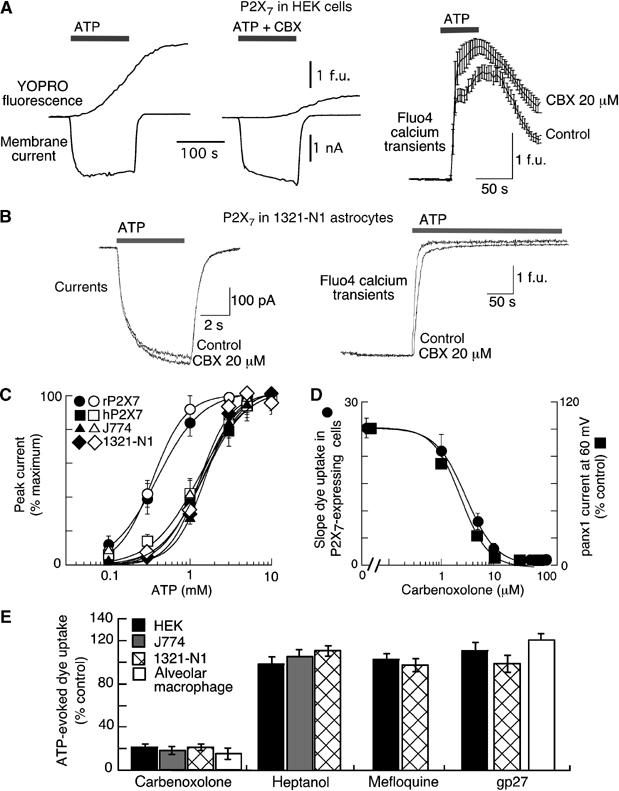
CBX but not other connexin channel blockers blocks ATP-mediated dye-uptake without inhibiting P2X7R activation. (A, B) Membrane currents, YOPRO-1 uptake and Fluo4 calcium transients (as indicated) recorded from HEK (A) or 1321-N1 (B) cells expressing P2X7Rs. CBX (20 μM) effectively blocked YOPRO-1 uptake without altering currents or calcium transients. All recordings obtained from physically isolated, single cells. (C) ATP concentration–response curves for membrane current (recorded at −60 mV holding potential) from all experiments as illustrated in (A) and (B), in control (closed symbols) and in 20 μM CBX (open symbols) for HEK cells expressing rat or human P2X7R, for 1321-N1 cells expressing human P2X7R and for mouse J774 macrophage, as indicated. CBX had no effect. (D) Concentration–response curve for CBX inhibition of dye uptake (circles) in P2X7R-expressing cells and for inhibition of panx1 currents recorded from HEK cells (squares) transfected with panx1 expression vector. (E) Summary of actions of several nonspecific connexin channel blockers to inhibit P2X7R-induced dye uptake from cells ectopically (HEK and 1321-N1) or endogenously (mouse J774 and human alveolar macrophage) expressing P2X7R. Concentrations used were CBX (20 μM), heptanol (200 μM), mefloquine (100 μM) and gp27 (1 mM); each value is mean±s.e.m. from 4 to 12 experiments.
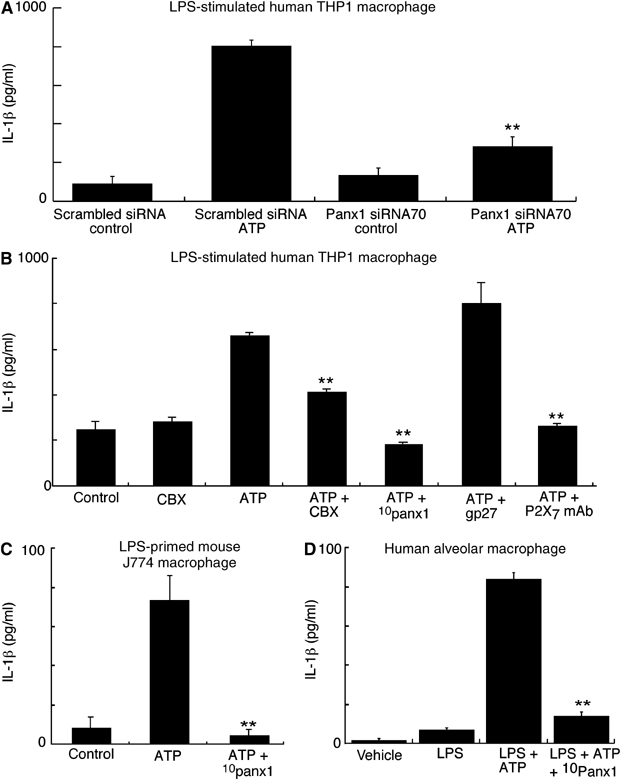
Panx1 blockade inhibits ATP-mediated IL-1β release from activated macrophage. (A) IL-1β release from LPS-primed THP-1 macrophages after transfection with scrambled or panx1 siRNA70. Neither siRNA alone induced IL-1β release nor did the scrambled siRNA alter ATP-induced release relative to untransfected cells, but panx1 siRNA70 significantly inhibited ATP-induced release; results are representative of three similar experiments. **P<0.005. (B) IL-1β release from LPS-primed THP-1 macrophages under conditions indicated. CBX (20 μM), 10pan1 peptide (200 μM) and the monoclonal anti-P2X7R Ab, but not the connexin blocking peptide gp27 (1 mM), significantly inhibited ATP-evoked IL-1β release. (C, D) Similar experiments performed on mouse J774 macrophage and human alveolar macrophage; 10panx1 inhibitory peptide completely blocked ATP-mediated IL-1β release from these cells. Results are representative of 3–6 similar experiments in each case; error bars are standard deviation of triplicate samples. **P<0.005.
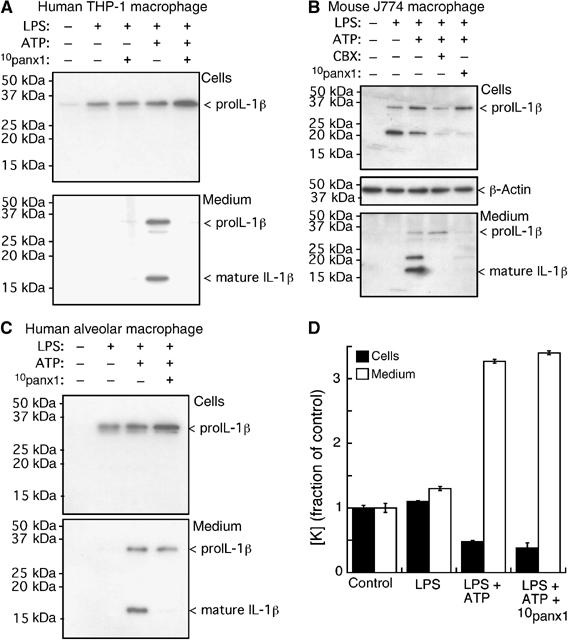
Panx1 blockade inhibits IL-1β processing but not intracellular K+ depletion from LPS-primed macrophage. Western blot analysis of cell lysate and medium from human THP-1 macrophages (A), mouse J774 macrophage (B) and human alveolar macrophage (C). No 17 kDa form was present intracellularly under any condition, while medium contained both pro-IL-1β and fully processed, 17 kDa, IL-1β only after LPS priming and ATP treatment. No processed 17 kDa IL-1β was observed in the medium after treatment with 10panx1 inhibitory peptide. (D) Intracellular and released K+ (plotted as fraction of control) from parallel wells of J774 cells treated as in (B), n=4.
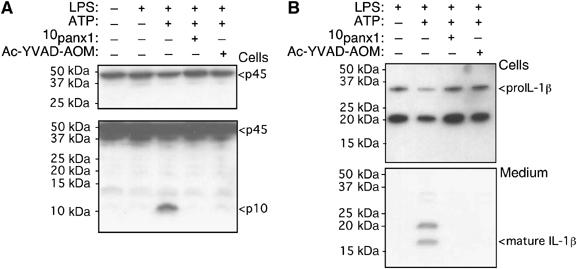
Panx1 inhibition blocks intracellular caspase 1 processing. Western blot analysis of mouse J774 macrophage for caspase-1 (A) and IL-1β (B). (A) Same gel is shown, upper lanes with short exposure and lower lanes with longer exposure; we used short exposure to assess p45 pro-caspase-1 protein levels in each lane and longer exposure to reveal processing and active caspase-1 p10 fragment. After LPS priming, ATP induced strong caspase-1 processing, which was prevented by either 10panx1 inhibitory peptide or the caspase-1 inhibitor, Ac-YVAD-AOM. (B) Western blot for IL-1β from same set of experiments confirms ATP-mediated IL-1β processing and release are also prevented by 10panx1 inhibitory peptide or caspase-1 inhibitor.
References
-
- Bao L, Locovei S, Dahl G (2004) Pannexin membrane channels are mechanosensitive conduits for ATP. FEBS Lett 572: 65–68 - PubMed
-
- Barbe MT, Monyer H, Bruzzone R (2006) Cell–cell communication beyond connexins: the pannexin channels. Physiology 21: 103–114 - PubMed
-
- Beyer EC, Steinberg TH (1991) Evidence that the gap junction protein connexin-43 is the ATP-induced pore of mouse macrophages. J Biol Chem 266: 7971–7974 - PubMed
-
- Bruzzone R, Barbe MT, Jakob NJ, Monyer H (2005) Pharmacological properties of homomeric and heteromeric pannexin hemichannels expressed in Xenopus oocytes. J Neurochem 92: 1033–1043 - PubMed
-
- Buell G, Chessell IP, Michel AD, Collo G, Salazzo M, Herren S, Gretener D, Grahames C, Kaur R, Kosco-Vilbois MH, Humphrey PP (1998) Blockade of human P2X7 receptor function with a monoclonal antibody. Blood 92: 3521–3528 - PubMed
Publication types
MeSH terms
Substances
Grants and funding
LinkOut - more resources
Full Text Sources
Other Literature Sources
Molecular Biology Databases
Research Materials
Miscellaneous
